
The short version
- Crypto is digital money that runs on a shared record book (a blockchain) instead of a bank’s database.
- Bitcoin was the first, in 2009. Only 21 million will ever exist, and no company or government controls it.
- You don’t own an account. You own a key, and whoever holds the key controls the coins.
- Prices swing hard. Learn how it works before you put money in, and never more than you can afford to lose.
Most people meet crypto through a price chart or a friend who won’t stop talking about it. Neither tells you what it actually is. So here is the short answer: crypto is money that lives on the internet and moves without a bank in the middle.
That sounds simple, and in a way it is. The clever part is how thousands of strangers who don’t trust each other still agree on who owns what. This guide walks you through it in plain English, so the rest of the Trail Guides make sense.
The problem crypto solves
When you pay with a card, your bank updates its own private database. Your balance goes down, the shop’s goes up. You trust the bank to keep that list honest, to stay open, and to let you use your money when you want.
Usually that works. Sometimes it doesn’t. Banks freeze accounts, payments across borders take days and cost a fortune, and in some countries the local money loses a big chunk of its value every year.
The hard part of building money for the internet was always copying. A photo or a song can be copied endlessly. If money could be copied, you could spend the same coin twice. That’s called the double-spend problem, and before 2009 the only fix was a trusted middleman keeping the books.
So what is crypto?
Crypto (short for cryptocurrency) is digital money that keeps its own books in public. Instead of one bank holding the list of balances, thousands of computers around the world each hold a full copy. They follow the same rules and check each other’s work.
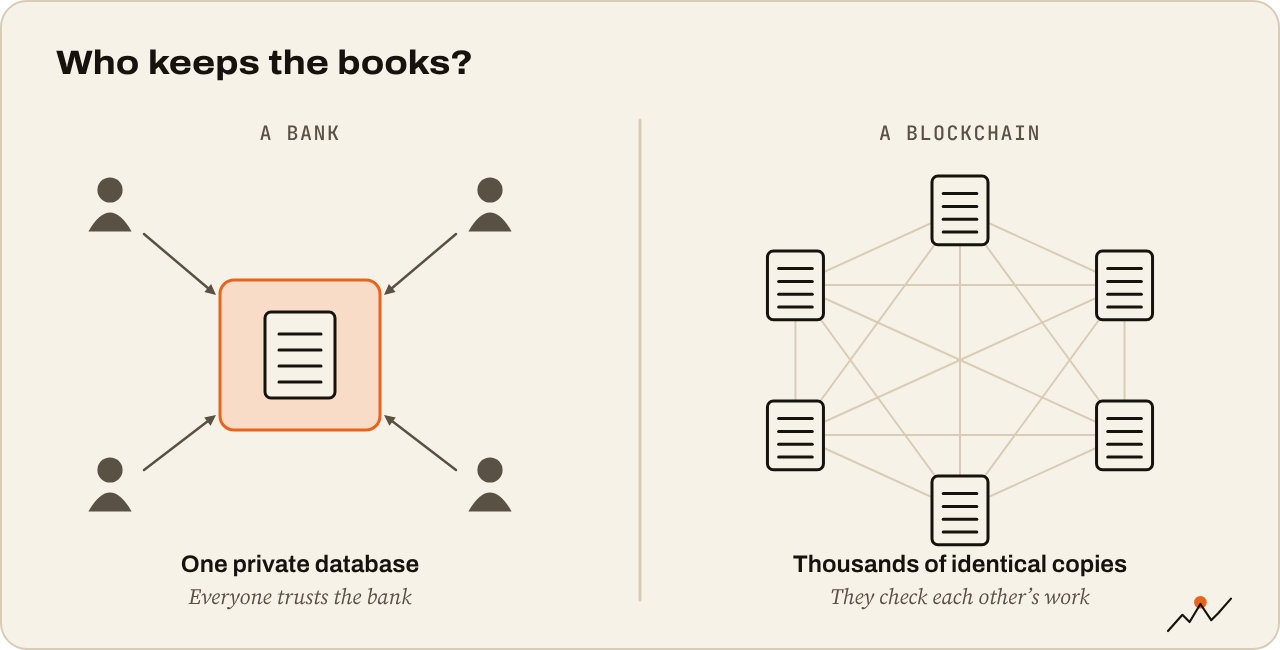
That shared record book is called a blockchain. Every few minutes a new page (a block) is added with the latest payments. Each page is locked to the one before it with math, so changing an old page would mean redoing every page after it, faster than the whole network. In practice, that’s impossible.
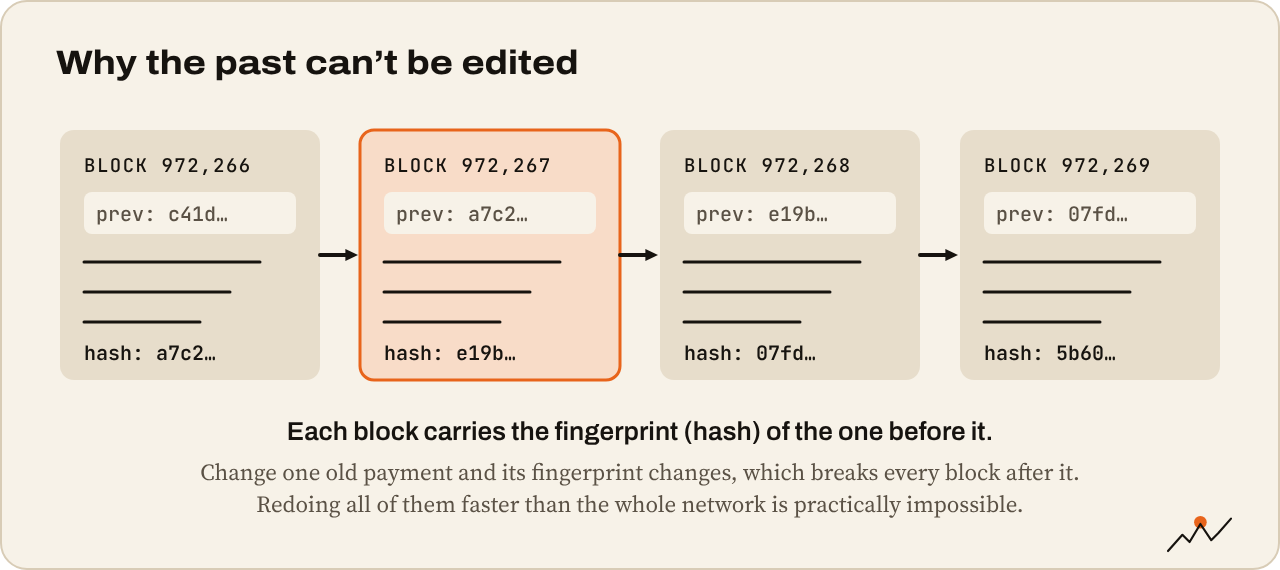
In other words, nobody has to trust one company. They only have to trust that the math works and that most of the network follows the rules.
Bitcoin, the first one
Bitcoin launched in January 2009, created by someone using the name Satoshi Nakamoto. Who that is remains unknown to this day. The idea was laid out in a nine-page white paper titled “Bitcoin: A Peer-to-Peer Electronic Cash System.”
A few things make Bitcoin different from normal money:
- Fixed supply. There will only ever be 21 million bitcoin. Around 20.1 million are already out there. No central bank can print more.
- No owner. No company runs Bitcoin. The rules change only when the people running the network agree, which is slow on purpose.
- Open to anyone. You don’t need permission, a credit score or even a bank account. You need an internet connection.
- Divisible. One bitcoin splits into 100 million pieces called sats. You can buy $10 worth.
Bitcoin has had a wild ride. It was worth fractions of a cent in 2010, and it hit an all-time high of about $126,000 in October 2025. It has also fallen 70% to 80% several times along the way. Both facts matter.
How new coins are made (mining)
Who adds the new pages to the blockchain? On Bitcoin, they’re called miners. Miners run powerful computers that race to solve a math puzzle. The winner gets to add the next block and earns freshly created bitcoin plus the fees people paid. That’s mining, and the system is called proof of work.
The puzzle is hard to solve but easy to check. That’s the trick. Cheating would cost more electricity than it could ever earn, so it pays to play fair.
Every four years or so, the reward for a new block is cut in half. This is the halving. It’s why new bitcoin get scarcer over time, and why the last coin should be mined around the year 2140. We cover it in depth in the Summit guide on Bitcoin cycles.
Not every blockchain uses mining. Ethereum, the second-biggest network, switched in 2022 to proof of stake, where people lock up coins as a deposit instead of burning electricity. Same goal, different method.
Blockchains do more than money
Bitcoin does one thing: move and store bitcoin. Ethereum, launched in 2015, added something bigger. You can run small programs on it, called smart contracts. They work like vending machines: put something in, and the rules decide what comes out, with no person in between.
Those programs power most of what you hear about in crypto:
- Stablecoins like USDT and USDC, digital dollars that move on blockchains.
- DeFi (decentralized finance): lending, borrowing and trading without a bank or broker.
- Tokens and NFTs: digital items that anyone can create on top of a blockchain.
That’s also why there are thousands of coins. We sort them into groups in the next guide.
Where do you keep crypto?
Here’s the part that trips up most beginners. Your coins aren’t stored in an app. They sit on the blockchain, recorded next to an address, a long string of letters and numbers a bit like an account number.
What you actually own is the private key: a secret code that proves the coins at that address are yours and lets you move them. A wallet is just the tool that holds your keys and signs payments.
When you leave coins on an exchange, the exchange holds the key. When you use your own wallet, you do. Crypto people have a saying for this: not your keys, not your coins. There’s a full guide on setting up a wallet safely later in this series.
Watch out. Nobody legitimate will ever ask for your private key or seed phrase. Not support staff, not a “wallet validator,” not a friendly stranger on Telegram. Anyone who asks is trying to steal from you.
Why it matters (and why it’s risky)
People use crypto for different reasons. Some see Bitcoin as digital gold, a savings asset no government can print. Some use stablecoins to send money home cheaply or to escape a currency that keeps losing value. Others trade it, because it moves faster than almost anything else.
Big money has noticed. US spot Bitcoin ETFs launched in January 2024, letting pension funds and ordinary brokerage accounts buy exposure, and the EU now regulates crypto companies under its MiCA rules.
Now the honest part. Crypto is volatile: a 10% move in a day is normal, and most small coins go to zero eventually. There’s no bank to call if you send coins to the wrong address or click a scam link. Mistakes are usually final.
That’s not a reason to stay away. It’s a reason to learn the basics first, which is exactly what this path is for.
Tip. Want to see it explained visually? 3Blue1Brown’s But how does bitcoin actually work? is the best 25 minutes on the subject. For a six-minute version, try Simply Explained’s How does a blockchain work. More in our Videos list.
Words you’ll keep seeing
| Word | What it means |
|---|---|
| Blockchain | A public record book of every transaction, copied across thousands of computers |
| Wallet | The app or device that holds your keys and lets you send and receive |
| Private key | The secret that controls your coins. Lose it and the coins are gone; share it and they’re stolen |
| Exchange | A company where you buy and sell crypto with normal money |
| Altcoin | Any coin that isn’t Bitcoin |
| Stablecoin | A token meant to stay at $1 |
| Gas | The fee you pay the network to process a transaction |
The whole list lives in our Glossary, with 289 terms.
Where to go next
You now know more than most people who own crypto. The next step is telling the coins apart, because Bitcoin, a stablecoin and a memecoin are very different bets. That’s Part 2: Bitcoin vs altcoins vs stablecoins vs memecoins.

On the climb since 2017. Trades futures and reads onchain data. Automates the boring parts.
More from VikingXBT →