
The short version
- Bitcoin is the original and the biggest: one job, fixed supply, the market’s anchor.
- Altcoins are every other coin. Some are serious networks, most fade away.
- Stablecoins are digital dollars. They’re for parking and moving money, not for gains.
- Memecoins run on attention alone. Fun, fast and mostly headed to zero.
There are tens of thousands of coins out there, and every one of them has a community calling it the future. That’s a lot of noise for someone who just wants to know what they’re buying.
Here’s the good news. Almost every coin fits into one of four buckets, and each bucket has its own kind of risk. Know the bucket and you already know most of what matters.
Bitcoin: the anchor
Bitcoin (BTC) is the first cryptocurrency and still the largest by far. It usually makes up more than half of the whole crypto market’s value, a share traders call Bitcoin dominance.
Bitcoin does one thing: it’s money nobody controls. There will only ever be 21 million coins, the rules almost never change, and it has run since 2009 without being shut down. That’s why people call it digital gold.
It’s also the coin big institutions buy. US spot Bitcoin ETFs, public companies and even some governments hold it. When people talk about “the crypto market,” they mostly mean Bitcoin, because when it moves, nearly everything else follows.
How it fails you: price. Bitcoin has dropped more than 70% from its peak several times. The network has kept working through all of it, but your balance hasn’t felt that way.
Altcoins: everything else
An altcoin is simply any coin that isn’t Bitcoin. That covers a huge range, from billion-dollar networks to projects run by three people on Discord.
The serious ones are usually Layer 1 blockchains, networks other apps are built on:
- Ethereum (ETH): the second-biggest coin and home of most DeFi, stablecoins and NFTs. Its smart contracts are what made crypto programmable.
- Solana (SOL): a fast, cheap network popular for trading and memecoins.
- Others like BNB, XRP, Cardano and Avalanche, each with its own pitch and fan base.
Below them sit thousands of tokens built on top of those networks: tokens for DeFi apps, games, AI projects and much more. A token runs on someone else’s blockchain, while a coin has its own. People mix the words up all the time, and that’s fine.
How altcoins fail you: most of them don’t last. Altcoins tend to fall harder than Bitcoin in a downturn, many lose 90% or more, and new coins keep arriving, which splits the money between more and more projects. A few become giants. Picking them in advance is much harder than it looks on X.
Tip. Before buying any altcoin, ask three questions. What does it do? Who uses it today, not someday? And who holds most of the supply? If you can’t answer all three, you’re guessing.
Stablecoins: digital dollars
A stablecoin is a token built to stay at a fixed price, almost always $1. The two big ones are USDT (Tether) and USDC (Circle). Together they make up most of a stablecoin market worth more than $300 billion in 2026.
Most stablecoins work like a bank receipt. The company holds a real dollar (in cash or short-term US government bonds) for every token it issues, and you can swap the token back. The US now regulates these issuers under the GENIUS Act, signed in July 2025, and the EU does the same under MiCA.
What are they for?
- Parking money between trades without cashing out to your bank.
- Sending money across borders in minutes, any day of the week.
- Trading: most crypto is priced in USDT or USDC, not dollars.
- Earning interest in DeFi, with extra risk attached.
How stablecoins fail you: a depeg, when the token slips below $1. That happens if people stop trusting the reserves. USDC briefly fell to about $0.88 in March 2023 when one of its banks failed, then recovered. The worst case was TerraUSD (UST), an algorithmic stablecoin with no real reserves, which collapsed to almost nothing in May 2022 and wiped out about $40 billion. Stick to big, fully backed coins.
Tip. Whiteboard Crypto’s What is a Stablecoin? explains in seven minutes how the peg holds and how it can break.
Memecoins: pure attention
A memecoin is a token with no product behind it. Its value comes from a joke, a mascot, a celebrity or simply a crowd deciding to pump it. Dogecoin started this in 2013 as a parody of Bitcoin. Since then we’ve had Shiba Inu, PEPE, BONK and a new batch every week.
Making one now takes a minute and a few dollars. Launch sites on Solana and other chains let anyone create a token from a phone, and millions have been made that way. Research firm Solidus Labs looked at one of the biggest launch sites in 2025 and found the vast majority of its tokens showed signs of a pump and dump or rug pull.
Some memecoins do go up 100x, and those are the stories you hear. You don’t hear about the thousands that went to zero the same week.
How memecoins fail you: almost every way at once. Insiders and sniper bots buy first and sell into your purchase. Developers can pull the liquidity and vanish. Some tokens are honeypots, coded so you can buy but never sell.
Watch out. If you play memecoins, treat it like a night at the casino. Use money you’re ready to lose completely, never borrow for it, and check who holds the supply before you buy.
Side by side
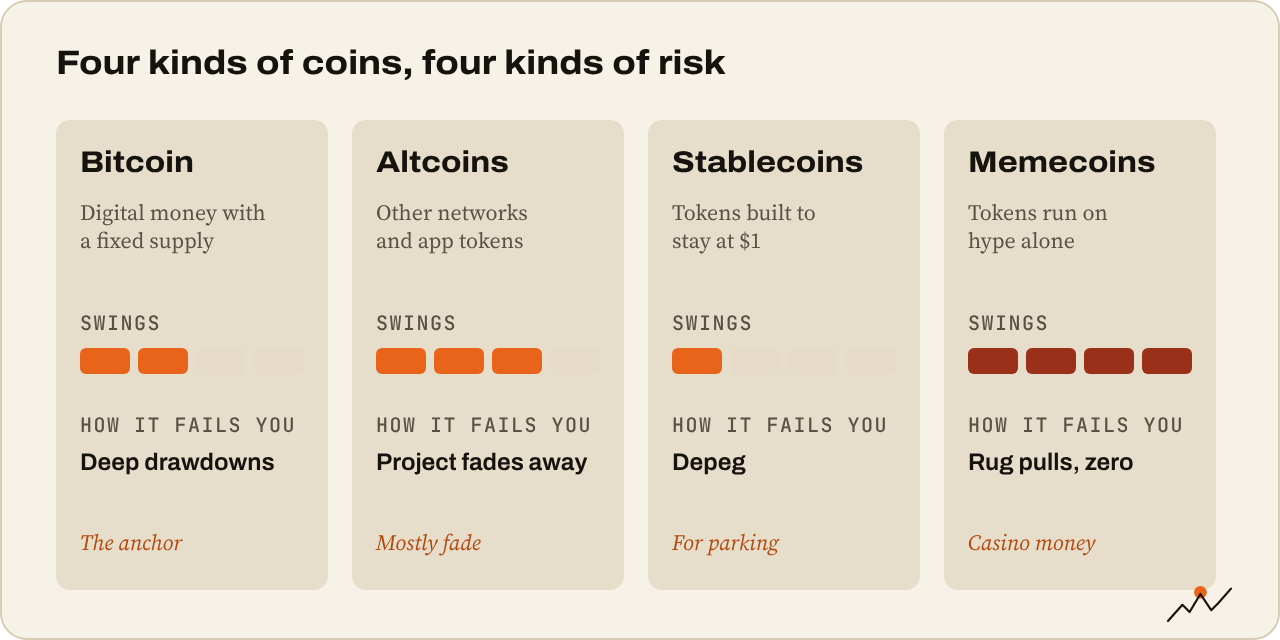
| Bitcoin | Altcoins | Stablecoins | Memecoins | |
|---|---|---|---|---|
| What it is | Digital money with a fixed supply | Other networks and app tokens | Tokens pegged to $1 | Tokens built on hype |
| Main use | Saving, long-term holding | Using apps, betting on growth | Parking and moving money | Speculation |
| Typical swings | Big | Bigger | Tiny (when working) | Extreme |
| Biggest risk | Deep drawdowns | Project fades away | Depeg | Rug pulls, going to zero |
How beginners usually start
There’s no single right mix, and nothing here is advice on what to buy. But you’ll notice a pattern among people who stick around for years: they learn on the boring stuff first.
Many start with Bitcoin, maybe some Ethereum, and keep a little in stablecoins for flexibility. Smaller altcoins come later, once they can read a project and a chart. Memecoins, if at all, are a small side bet. The most common beginner story goes the other way round, and it rarely ends well.
Want to understand why a coin at $0.0001 isn’t “cheap”? That’s covered in Market cap, supply and why “cheap” coins aren’t cheap.
Where to go next
Now you know what’s on the shelf. Part 3 shows you how to actually buy it, step by step, without paying silly fees: How to buy your first crypto.

On the climb since 2017. Trades futures and reads onchain data. Automates the boring parts.
More from VikingXBT →