The short version
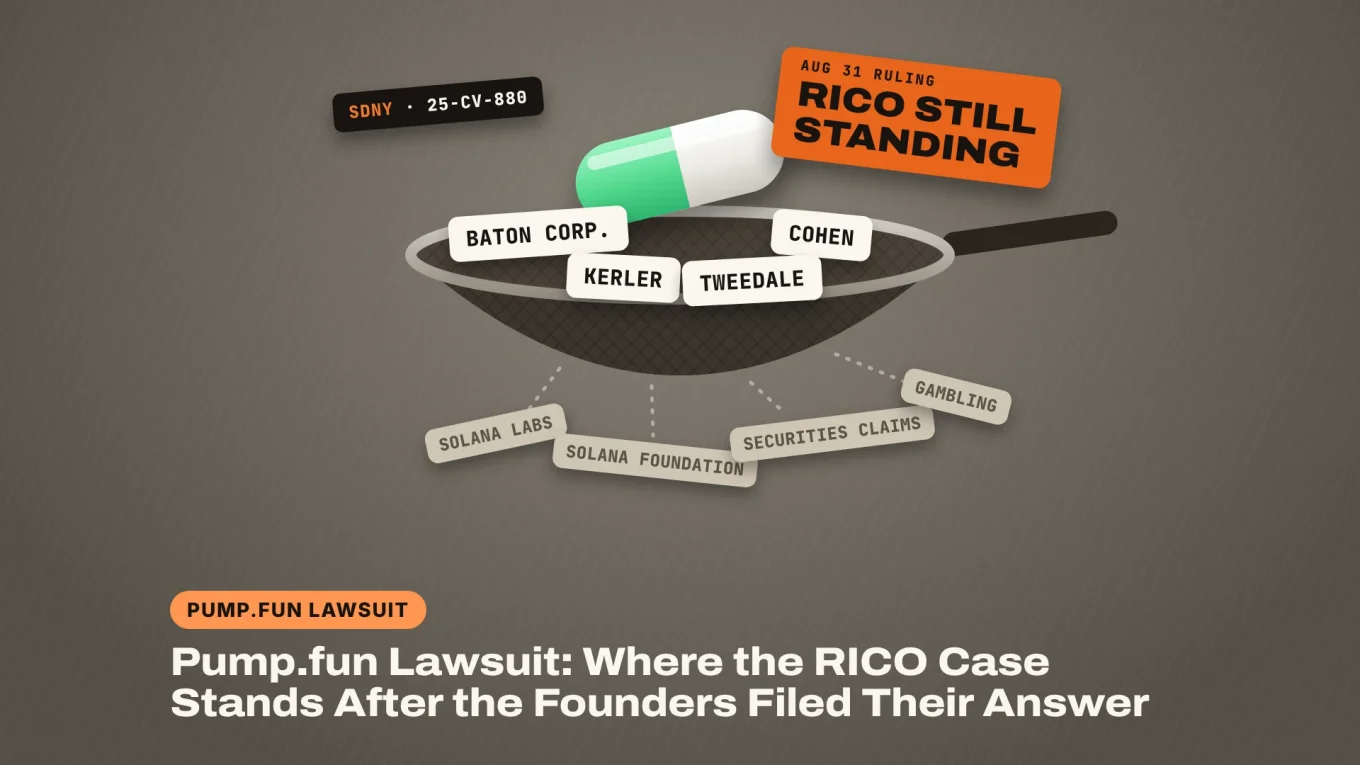
- Pump.fun lawsuit: operator Baton Corporation and founders Alon Cohen, Dylan Kerler and Noah Tweedale filed a 78-page answer on October 15, after a New York judge let two RICO counts against them go ahead on August 31.
- The same ruling threw out every claim against Solana Labs and the Solana Foundation, the securities claims and the gambling theory, and limited the surviving claims to trading fees and worse fills, not the $4 billion to $5.5 billion in losses the complaint cites.
- The crew is watching for a discovery schedule, any fight over the nearly 5,000 internal chats, and whether the plaintiffs ask to certify a class of Pump.fun traders.
The Pump.fun lawsuit just moved into its slow, expensive phase. On October 15, Pump.fun operator Baton Corporation and its three founders filed a 78-page answer to the class action in New York, six weeks after a judge let the racketeering claims against them go ahead.
That answer closes the motion-to-dismiss chapter. The Pump.fun RICO case started as a bet that every memecoin on Pump.fun is a security, grew into a RICO suit against Solana’s builders too, and has now been cut down to its core: two traders against Pump.fun and its founders. So what is left, and what did the judge throw out?
Plaintiffs’ firm Burwick Law posted the ruling’s outcome in September:

Burwick Law's RICO Claims Against Pumpfun Survive Motion to Dismiss
Burwick Law's civil RICO claims on behalf of two clients against the crypto memecoin platform Pumpfun and its co-founders have survived the defendants' motions to dismiss. On August 31, 2026, Judge Colleen
What Is the Pump.fun Lawsuit About?
It is a class action that says Pump.fun’s “fair launches” were rigged for insiders. The case, Aguilar v. Baton Corporation Ltd., No. 1:25-cv-00880, sits before Judge Colleen McMahon in the Southern District of New York.
According to the plaintiffs, insiders bought selected tokens before anyone else, paid promoters (KOLs, or “key opinion leaders”) to make the hype look organic, and then sold into the retail buying that followed. They put retail losses on Pump.fun at $4 billion to $5.5 billion. Pump.fun charges a 1% fee on every buy and sell, and the complaint says that fee kept flowing whether traders won or lost.
These are allegations. Nothing in the case has been proven, and at this stage the judge had to treat the complaint’s facts as true.
Sponsored · Affiliate link
Save 20% on fees trading on WEEX
Base Camp may earn a commission if you sign up. It never affects what we write.
How Did the Case Get Here?
It took three versions of the complaint. Diego Aguilar sued on January 30, 2025, saying Pump.fun sold unregistered securities, and the court merged his case with a PNUT buyer’s suit that June. In July 2025 the plaintiffs added Solana Labs, the Solana Foundation, Jito Labs and their executives, and switched to racketeering claims. The Jito side was later dropped by the plaintiffs themselves.
In September 2025 an informant handed the plaintiffs’ lawyers nearly 5,000 internal chat messages. McMahon let them rewrite the complaint around those chats, and the second amended complaint landed on January 8, 2026: 186 pages and 653 numbered allegations.
That filing is where the screenshot now doing the rounds on X comes from. On page 104, the complaint shows a message it says Pump.fun co-founder Alon Cohen sent in the team chat on April 27, 2024:
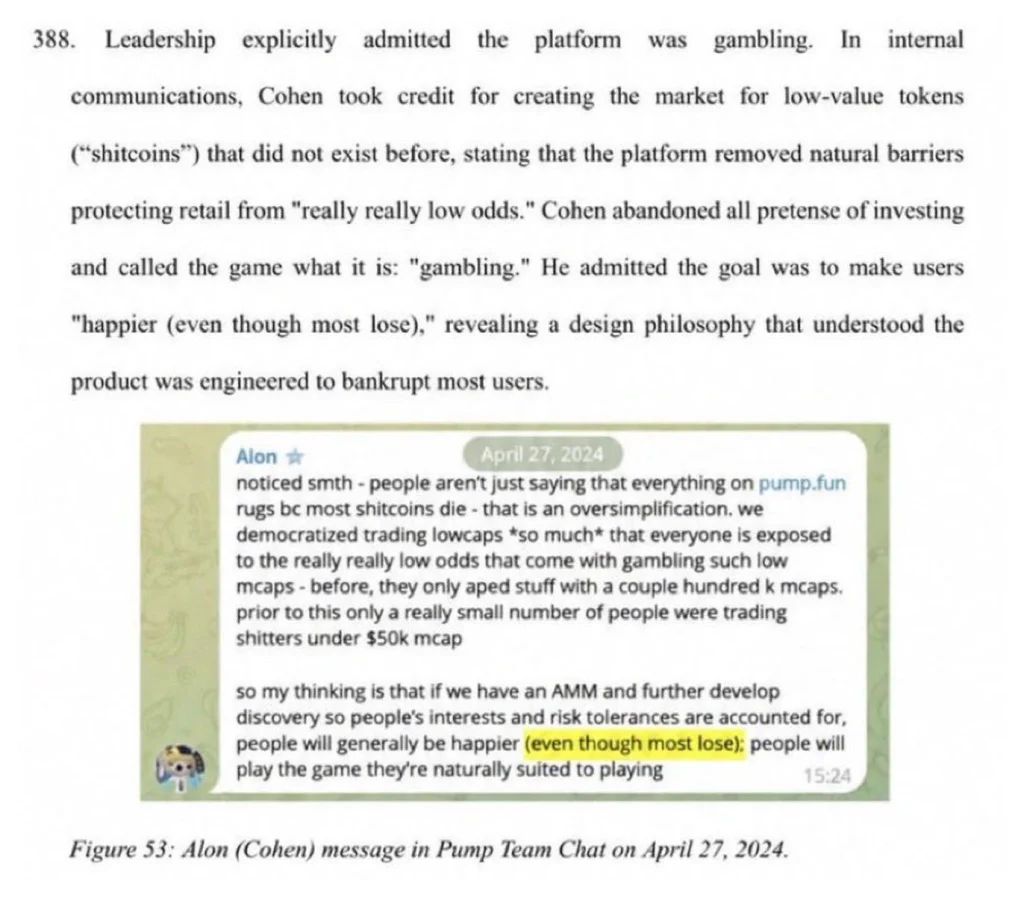
“people will generally be happier (even though most lose),” the message reads. The complaint calls this proof that Pump.fun was built as gambling. The judge saw it differently, at least on the gambling part.
What Did the Judge Throw Out?
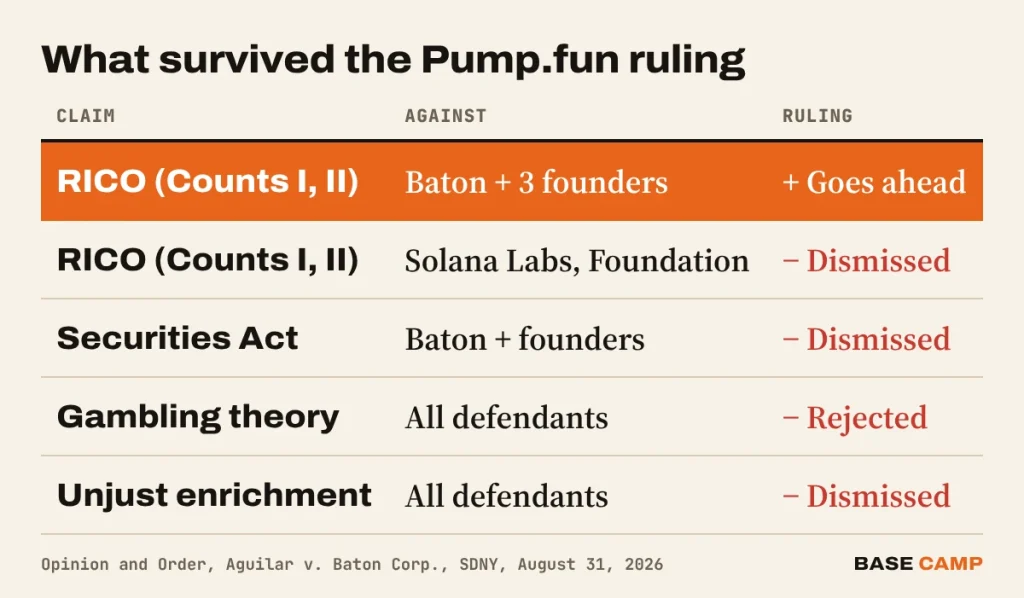
Most of it. In her 79-page opinion of August 31, McMahon dismissed every claim against Solana Labs, the Solana Foundation and their five named executives, including Anatoly Yakovenko and Raj Gokal. She found no fraud or other racketeering act pleaded against any of them.
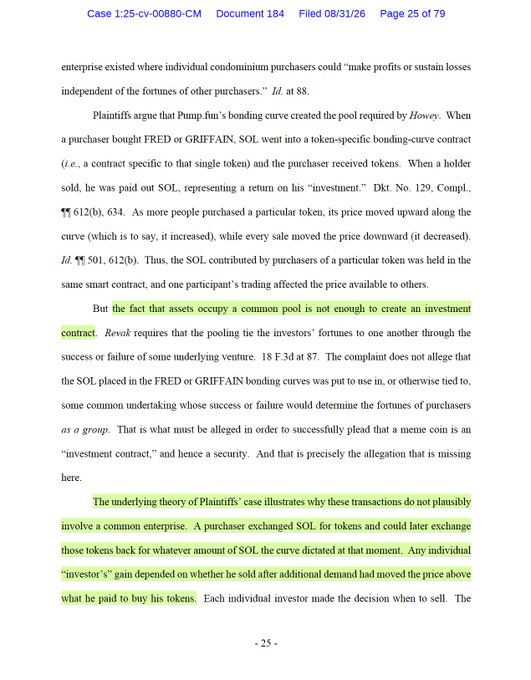
Pump.fun’s founders also beat the securities claims. The plaintiffs could only sue over the two tokens they bought, FRED and GRIFFAIN, and the judge found neither was an investment contract under the Howey test, because buyers’ money was never pooled into a common venture. The claims over 18 other tokens fell for lack of standing.
And the gambling theory went nowhere. Buying a memecoin isn’t a bet under New York law, McMahon wrote, just because its resale price depends on future demand. Otherwise volatile stocks and collectibles would count as gambling too.
What Survived, and Why It Matters
Two racketeering counts survived, brought by plaintiffs Kendall Carnahan and Michael Okafor against Baton, Cohen, Dylan Kerler and Noah Tweedale. Aguilar, who started the case, is out of the RICO claims: he never said he traded from the United States.
McMahon found the complaint plausibly describes wire fraud through the “fair launch” pitch, and an unlicensed money-transmitting business. But the surviving claims are narrower than the headline number. McMahon rejected the idea that the plaintiffs can recover their trading losses through RICO, because that would mean rebuilding how every token would have traded without the alleged fraud.
What she kept are two smaller injuries. One is the 1% fee paid on trades the plaintiffs say they were tricked into. The other is “execution losses”: worse fills and slippage the complaint blames on priority lanes it says Kerler built for insiders. RICO triples proven damages, but the base for now is fees and fills, not the $5.5 billion.
DISCOVER: Pump.fun’s Kimchi Coin Is Down 75% From Its Peak: Who Made Money?
What Happens Next in the Pump.fun Lawsuit?
Discovery comes next, the stage where both sides swap documents and question witnesses. Filed by law firm Brown Rudnick, the founders’ October 15 answer is their formal reply to each of the 653 allegations. Anyone can follow the Pump.fun lawsuit on the court docket.
Two loose ends remain. The 25 unnamed promoters in the complaint were never identified or served, and the judge gave the plaintiffs until September 10 to explain why their claims shouldn’t be dropped. The plaintiffs also still have to win class certification before the case speaks for Pump.fun traders at large.
Lawyer Ariel Givner broke the ruling down for traders within hours:

🚨 Big Pumpfun ruling out of SDNY today and every claim against Solana Labs, the Solana Foundation, and the executives named alongside them got dismissed.
Judge McMahon decided the motions to dismiss in the Pump fun class action, here's what it says:
The two memecoins involved
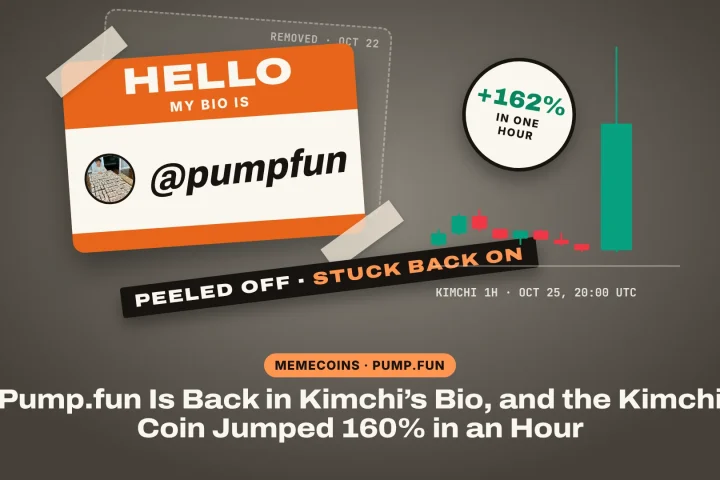
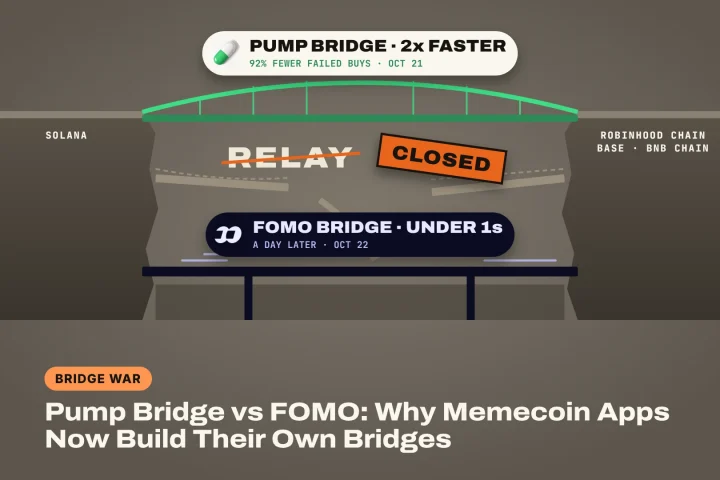
None of this has stopped Pump.fun’s business. The PUMP token trades at $0.004265 at the time of writing, about 52% below its September 2025 high, and the platform launched its own Pump Bridge last week. Its name still moves coins too: the Kimchi bio comeback sent the KIMCHI coin up 160% in an hour.
EXPLORE: Pump.fun Revenue Briefly Topped Hyperliquid, but Hyperliquid Still Owns the Week
The crew is watching for a discovery schedule, any fight over the internal chats, and whether the plaintiffs move to certify a class.

In crypto since 2016. Trades the macro picture and reads the market on the high timeframes.
More from TheCryptoMonk →