
The short version
- DCA means buying a fixed amount on a fixed schedule, say $100 every week, no matter the price.
- It takes timing out of the equation. You buy more when it’s cheap and less when it’s expensive, automatically.
- Someone who started $100 a week into Bitcoin at the November 2021 top had about doubled their money by October 2026.
- DCA doesn’t make a bad asset good. It works best on assets you believe in for years, with money you won’t need soon.
Most people who lose money in crypto don’t lose it because they picked the wrong coin. They lose it because they bought after a big run, panicked in the drop and sold near the bottom. Then they did it again.
Dollar-cost averaging, or DCA, is the cure for that. It’s the simplest strategy in crypto and one of the hardest to beat. You decide once, set it up, and let the calendar do the work.
What DCA is
DCA means buying a fixed dollar amount of an asset at regular intervals, regardless of price. For example:
- $100 of Bitcoin every Monday;
- $250 of Bitcoin and Ethereum on the 1st of every month;
- 10% of every paycheck into BTC.
That’s it. No charts, no predictions, no staring at your phone at 3 a.m.
Why it works
Because you spend the same amount each time, you automatically buy more coins when the price is low and fewer when it’s high.
Say you put $100 in every month for three months:
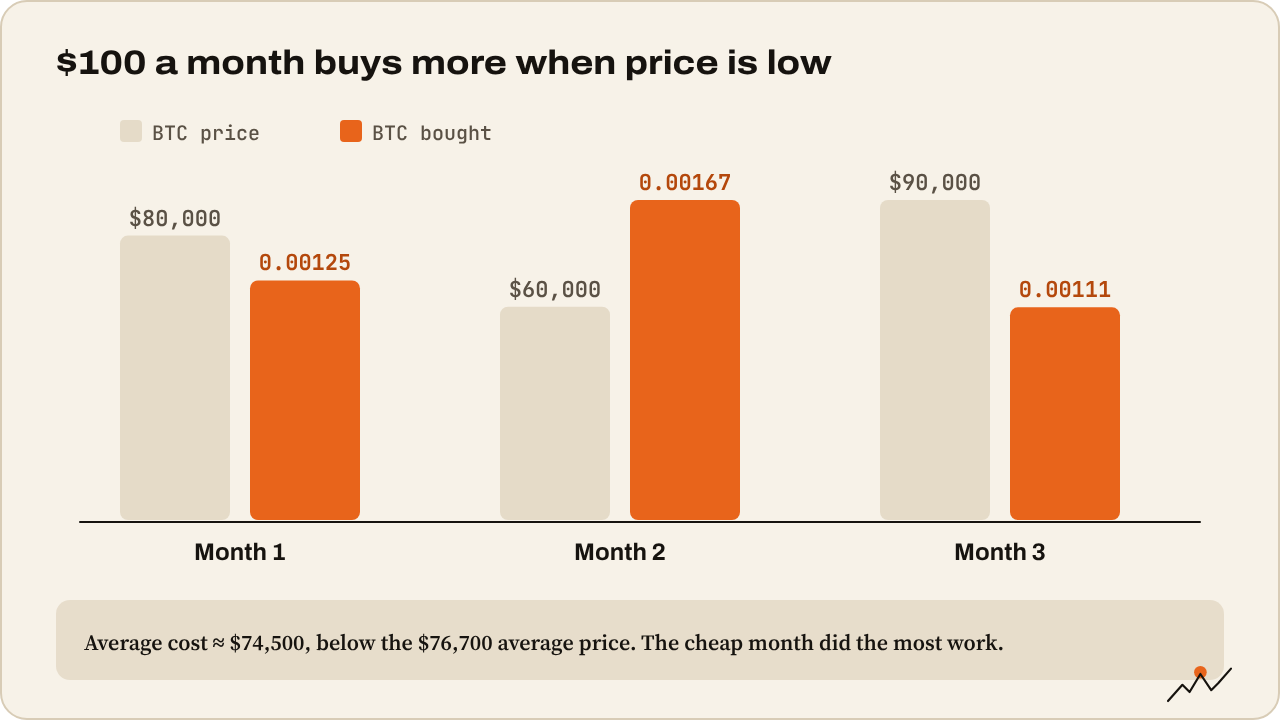
| Month | BTC price | $100 buys |
|---|---|---|
| 1 | $80,000 | 0.00125 BTC |
| 2 | $60,000 | 0.00167 BTC |
| 3 | $90,000 | 0.00111 BTC |
You spent $300 and own 0.00403 BTC, an average cost of about $74,500. The simple average of the three prices is about $76,700. You paid less than the average price without trying, because the cheap month bought the most coins.
The bigger benefit is in your head. A drop stops being a disaster and becomes a discount. You never have to decide “is now the time?” The answer is always “it’s Monday.”
What it would have done: real Bitcoin numbers
We ran $100 a week into Bitcoin on daily closing prices from Binance, up to October 19, 2026, when BTC closed at $81,938:
| Started | BTC price that day | Invested | Worth on Oct 19, 2026 | Same money as one lump sum on day one |
|---|---|---|---|---|
| Nov 10, 2021 (cycle top) | $64,882 | $25,800 | $49,431 | $32,582 |
| Jan 11, 2024 (ETF launch) | $46,339 | $14,500 | $15,587 | $25,639 |
| Oct 6, 2025 (all-time high) | $124,659 | $5,500 | $5,789 | $3,615 |
Two lessons jump out.
Starting at the top wasn’t fatal. The person who began right at the 2021 peak lived through a 75% crash, kept buying, and roughly doubled their money. The same for the October 2025 peak: a lump sum there was down about a third, while the weekly buyer was slightly up.
Lump sum often wins when you buy early in a rise. Whoever put everything in at the 2024 ETF launch beat the weekly buyer. Markets that go up over time favor getting in sooner. DCA trades a bit of that upside for protection against terrible timing, and most of us can’t time the market.
Try it yourself
Pick a coin, an amount, how often and a start date. Our DCA calculator runs it on real daily prices for BTC, ETH and SOL, all in your browser:
Base Camp tool
DCA calculator
What buying a fixed amount on a schedule would have turned into, using real past prices.
Daily closing prices from Binance (USDT pairs), updated now and then; fees not included. Past results do not predict future ones. For learning only, not financial advice.
DCA vs lump sum
If you already have a big sum, should you invest it all at once or spread it out?
- Lump sum tends to win when prices rise over time, because more of your money is in the market sooner. Studies on stock markets find it ahead about two times out of three.
- DCA wins when prices fall after you start, and it’s much easier to stick with emotionally.
A practical middle ground many people use: spread a lump sum over a few months instead of a few years. And for money you earn every month, DCA isn’t really a choice. It’s just investing as you get paid.
How to set it up
- Choose the asset. DCA works best on assets you expect to be worth more in five or ten years. For most people that means Bitcoin, maybe Ethereum. DCA into a memecoin is just buying a falling knife on a schedule.
- Choose an amount you can keep up for years, even if the price halves. Consistency matters more than size.
- Choose the interval. Weekly or monthly both work. Weekly smooths more, but check that fees don’t eat you alive.
- Automate it. Most exchanges offer “recurring buys.” Check the fee first: some charge 1.5% or more for convenience. A manual limit order on the trading screen can be much cheaper (see How to buy your first crypto).
- Move it to your own wallet every few months. See Your first wallet, set up safely.
- Write down when you’ll stop or take profit. Some people never sell. Others sell a slice when price is far above their average cost. Decide now, when you’re calm.
Tip. Fees matter more than you think on small amounts. A 1.5% fee on $25 a week is $19.50 a year gone before the market moves at all. Fewer, bigger buys on the cheap trading screen often beat small daily ones.
Where DCA goes wrong
- Stopping in the bear market. The drops are where DCA does its best work. Most people stop exactly then.
- DCA into anything. Buying a dying coin every week just makes the loss smoother.
- Using money you need. If you might need it within a year or two, it shouldn’t be in crypto at all.
- Checking every day. Once it’s automated, check monthly. That’s the whole point.
Watch out. DCA reduces timing risk. It doesn’t remove market risk. If the asset falls and never recovers, a perfect schedule won’t save you. Only put in what you could hold through a 70% drop without selling.
Where to go next
That completes the Base level. You understand what you’re buying, how to keep it safe and how to read a chart. Ready for more? Ridge starts with the one skill every trader needs before anything else: Risk management: the 1% rule and position sizing.

On the climb since 2017. Trades futures and reads onchain data. Automates the boring parts.
More from VikingXBT →