The short version
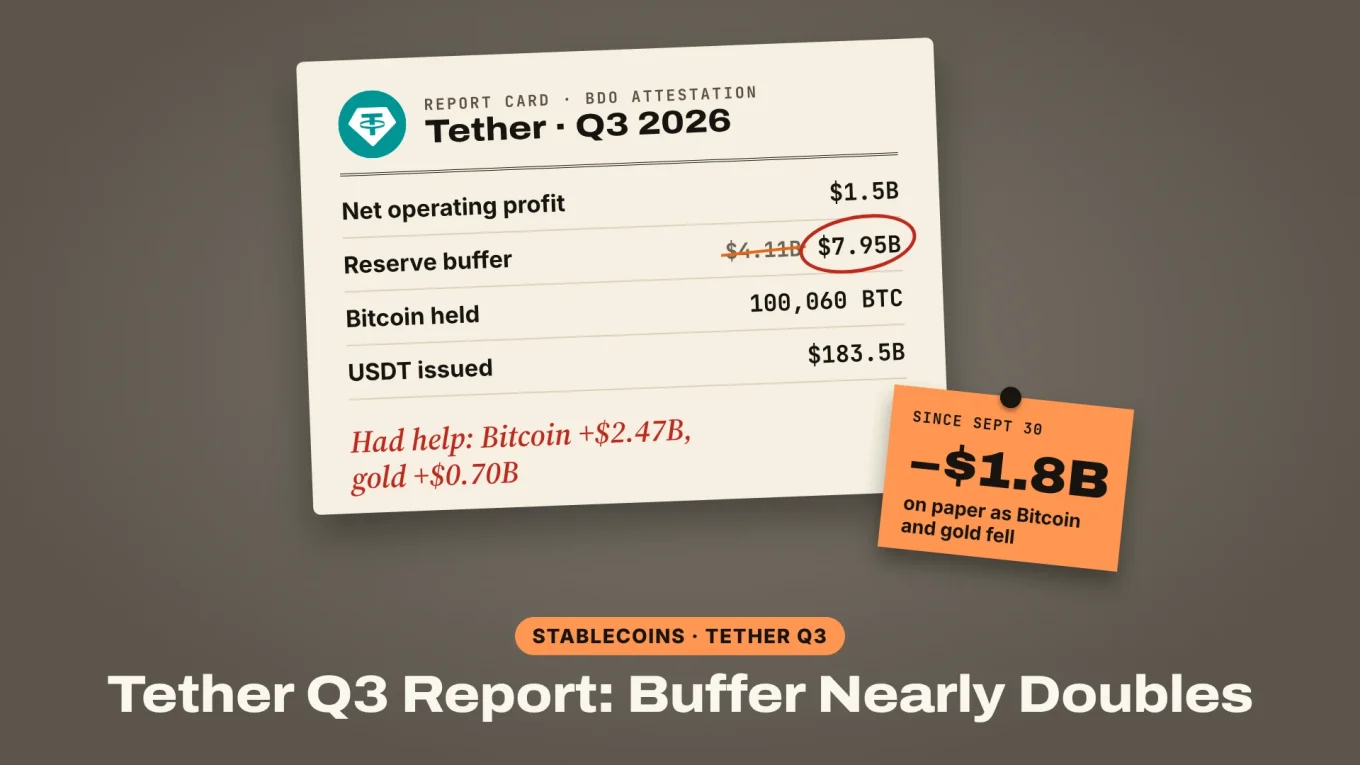
- The Tether Q3 report shows about $1.5 billion in net operating profit and a reserve buffer of $7.95 billion on September 30, up from $4.11 billion in June.
- Bitcoin and gold prices did most of the lifting: Tether’s 100,060 BTC gained about $2.5 billion in value in the quarter, and the all-in nine-month result is $1.66 billion, not $4.5 billion.
- The crew is watching USDT supply, down about $3.7 billion since September 30, and the $1.77 billion of hacked Binance USDT that Tether froze but hasn’t burned yet.
The Tether Q3 report reads like a record quarter, and most of the lift came from the price chart. The USDT issuer made about $1.5 billion in net operating profit and its reserve buffer nearly doubled to $7.95 billion. Bitcoin’s rally did more for that buffer than the profit did.
The BDO attestation, published Friday, puts total assets at $191.5 billion on September 30 against $183.5 billion in liabilities, nearly all of it USDT. So how much of that cushion is real money, and how much was already gone by the time the report came out?
Tether CEO Paolo Ardoino shared the numbers on X:

Tether just released its quarterly USDT attestation for Q3 2026.
Tether had a great third quarter of 2026, with ~1.5B in net operating profit. Tether’s reserve buffer continued to strengthen, nearly doubling to $7.95 billion from $4.1 billion at the end of Q2, an increase of
What Does the Tether Q3 Report Show?
A steady business with a swinging balance sheet. Tether made $1.5 billion in net operating profit in Q3, the same as in Q2, and $4.5 billion over nine months, according to its own release. Most of it is interest on U.S. Treasury bills and repo deals, and USDT supply barely moved at about $184 billion.
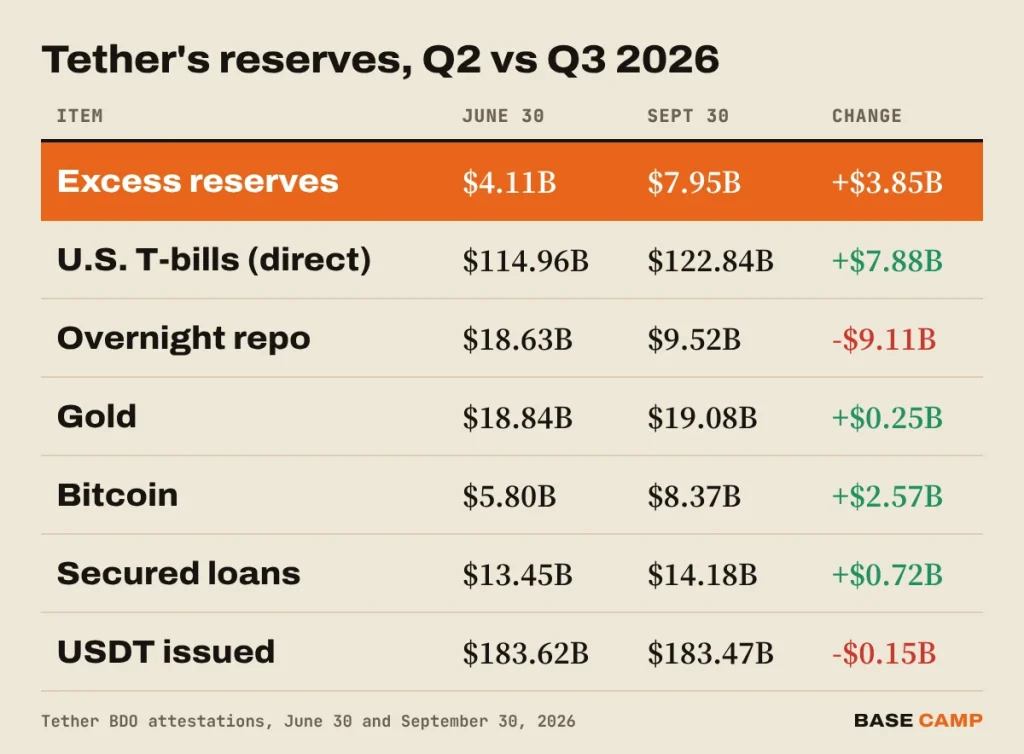
The buffer is where the drama is. Assets above liabilities hit a record $8.23 billion at the end of March, fell to $4.11 billion in June and bounced back to $7.95 billion in September.
Sponsored · Affiliate link
Save 20% on fees trading on WEEX
Base Camp may earn a commission if you sign up. It never affects what we write.
Why Did Tether’s Reserve Buffer Double?
Mostly because Bitcoin went up. Tether values its Bitcoin reserves at the Bloomberg close on the last day of the quarter: $58,642 in June and $83,621 in September. On the 98,933 BTC it held in June, that move alone is worth about $2.47 billion. Gold rose from $4,008 to $4,157 an ounce, adding roughly $700 million more.
The headline profit doesn’t count those swings. The report’s own equity table does, and it tells a rougher story: the all-in “financial result” for the first nine months is $1.66 billion, after a $3.17 billion loss in the first half when Bitcoin and gold fell. That’s the number that moves the buffer.
Two smaller details stand out in the Tether reserves. It added about 1,128 BTC in the quarter, to 100,060 BTC. Its gold went the other way: at the report’s own gold price, the $19.08 billion in bars works out to about 142.8 tonnes, down from about 146.2 tonnes in June. Tether’s release doesn’t mention it.
How Much of the Buffer Is Left?
Less than the Tether Q3 report says, on paper. Bitcoin is trading at about $77,200 at the time of writing and gold near $3,900, both below Tether’s September 30 marks. If nothing else changed, its Bitcoin is worth about $640 million less and its gold about $1.2 billion less, which would shrink the $7.95 billion buffer to roughly $6.1 billion.
That’s still a cushion. USDT is backed first by about $132.4 billion in direct and indirect T-bill exposure, and the stablecoin holds its peg through redemptions, not through the buffer. But the buffer is what absorbs a bad quarter, and it now rides on two assets that can move 10% in a week.
SIDE TRAIL: Can Crypto Be Frozen? Who Froze $2.7B of the Binance Hack
What the Binance Hack Means for Tether
The report stops on September 30, a month before the $6.3 billion Binance hack. Tether froze about $1.77 billion of the stolen USDT on Thursday night, more than a full quarter’s operating profit.
Those coins are still sitting in the attacker’s main wallet, 1.175 billion USDT on Ethereum, frozen but not burned. Frozen USDT stays a liability on Tether’s books, fully backed, until Tether destroys it and issues new tokens to whoever a court decides owns it. That step doesn’t cost Tether anything: it swaps one holder for another.
Supply is the number to watch now. DefiLlama counts about $180.1 billion USDT in circulation, down about $3.7 billion since September 30 and about $900 million since the day of the hack.
TRAIL MAP: Stablecoin Supply Falls to $301.6B as USDC Drops $4.15B
The next test comes when Binance withdrawals restart and traders decide whether to keep their USDT on exchanges or cash it out. Tether’s Q4 report, due early next year, will show whether the buffer held through both.

In crypto since 2017. A technical trader with years of experience in DeFi and onchain data.
More from TANG →