The short version
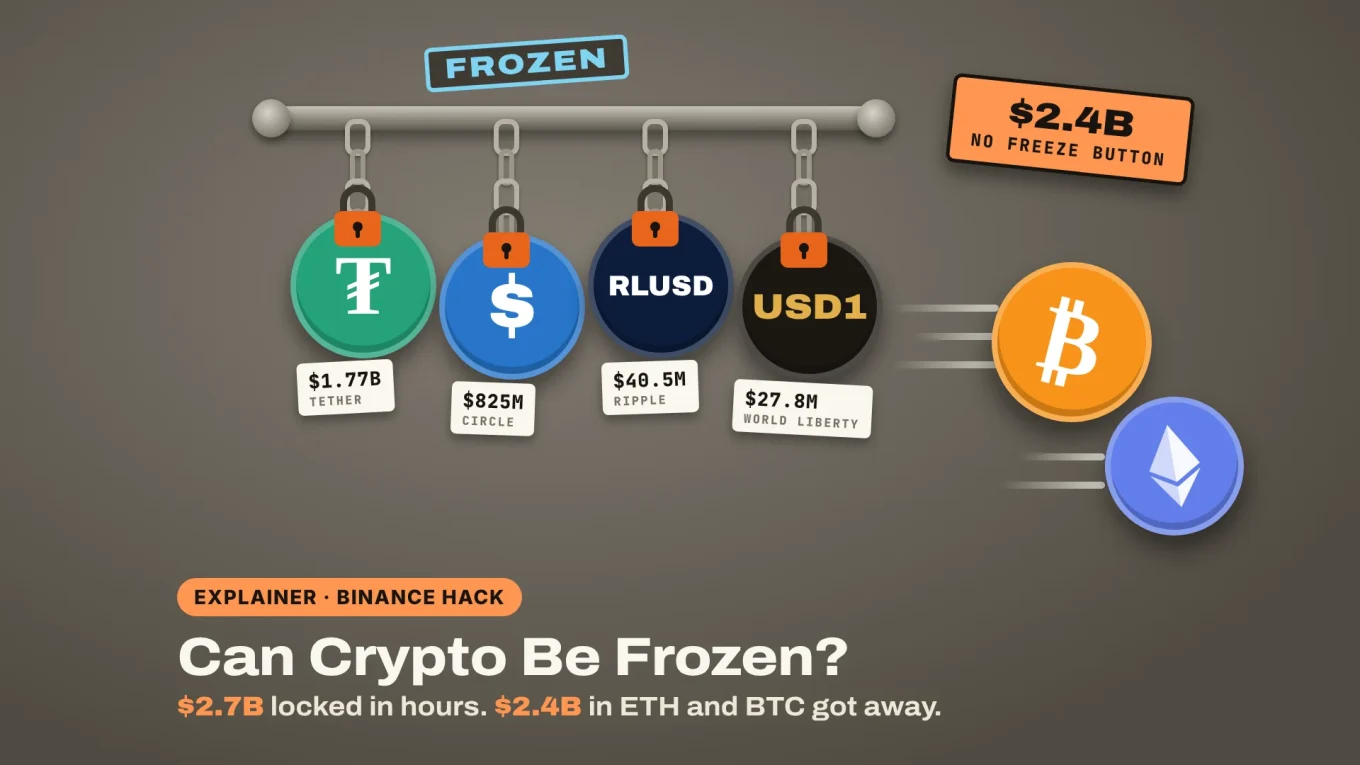
- Can crypto be frozen? Stablecoins can: Tether, Circle, Ripple and World Liberty froze about $2.67 billion of the $6.3 billion Binance hack, Tether alone about $1.77 billion in USDT.
- Bitcoin and Ethereum can’t: no issuer holds a switch, so the more than 420,000 ETH and 18,270 BTC the attacker kept, about $2.4 billion, is beyond anyone’s reach.
- The crew is watching where that $2.4 billion goes next, because exchanges, swap services and OTC desks are the last places that can still freeze it.
Can crypto be frozen? Ask the hacker who just robbed Binance. Within about three hours of Thursday’s $6.3 billion Binance hack, stablecoin issuers had locked more than $2.5 billion of the loot where it sat, and the attacker could do nothing about it.
The rest is a different story. More than 420,000 ETH and 18,270 BTC, about $2.4 billion, is still in the attacker’s hands, and nobody on earth has a switch for it. So who can freeze stolen coins, how does it work, and why does it only work on some of them?
Tether moved first and biggest:

Tether froze more than 1.567B USDT related to a potential Binance exchange hack.
Protecting the industry and our partners is our main priority.
Stay safe everyone.
Who Froze the Binance Hacker’s Coins?
Four stablecoin issuers and one network council. Blockchain analytics firm TRM Labs counts about $2.7 billion frozen, and we checked each issuer’s freeze on Ethereum and TRON ourselves:
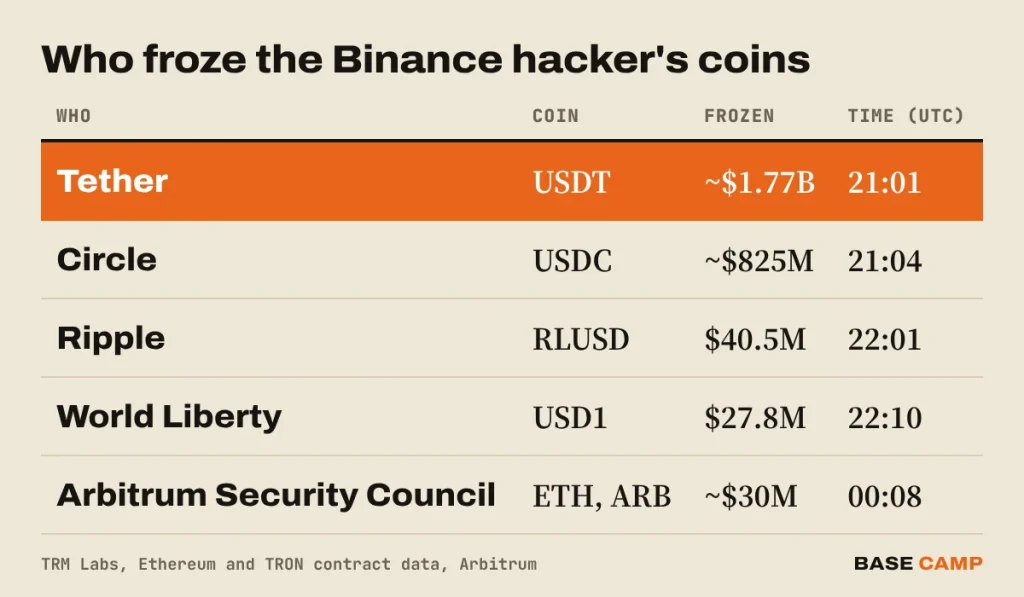
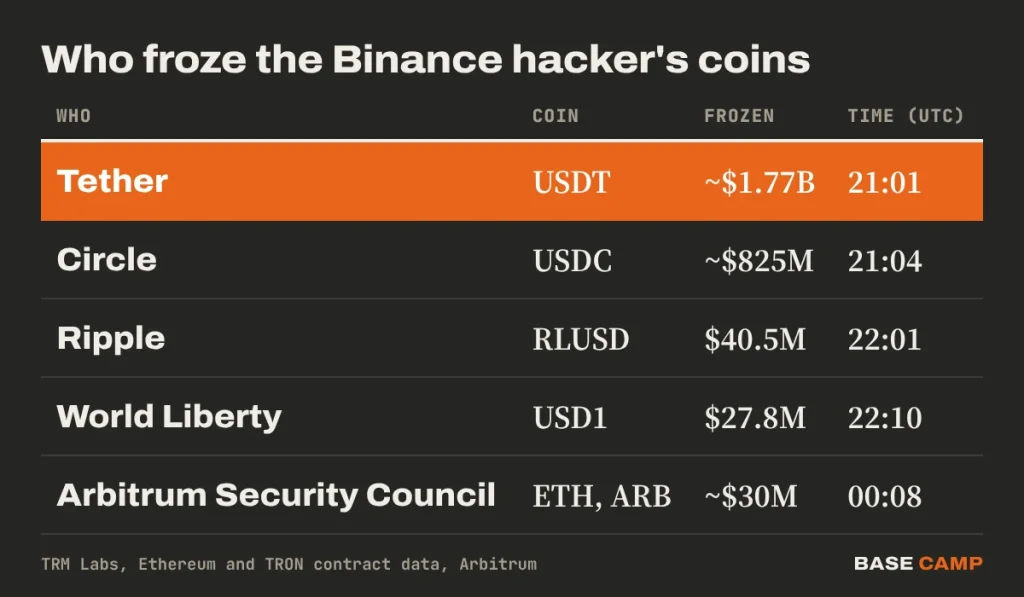
The first Tether freeze landed 37 minutes after the main sweep. That one wallet still holds 1.175 billion USDT, and Circle locked 823 million USDC in the same address three and a half minutes later.
Ripple’s number is smaller than the $200 million doing the rounds. Binance co-CEO Yi He credited Ripple with helping stop about $200 million from moving, but the frozen RLUSD on-chain comes to 40.5 million tokens, after the attacker had already sold 48 million of it on decentralized exchanges.
Sponsored · Affiliate link
Save 20% on fees trading on WEEX
Base Camp may earn a commission if you sign up. It never affects what we write.
How Does Tether Freeze USDT?
So can Tether freeze USDT in any wallet? Yes, with a blacklist written into the token itself. A stablecoin like USDT is a smart contract that keeps a ledger of who owns what, and Tether holds an admin key to it. Calling one function adds an address to the list, the contract logs an “AddedBlackList” event, and from that moment every transfer out of the address fails. The coins don’t move. They just can’t leave.
Tether can go one step further and destroy blacklisted balances, then issue fresh USDT to the victim. That’s how frozen money gets back to its owner, usually after a court or police request.
Can USDC be frozen too? Yes, through a “blacklister” role at Circle. Circle CEO Jeremy Allaire said the freeze came “in coordination with law enforcement”, which is how Circle usually frames it. Ripple’s RLUSD and World Liberty’s USD1 have the same switch, and both used it on Thursday night.
One detail shows how blunt a stablecoin blacklist is. Tether, Ripple and World Liberty also froze a well-known Binance hot wallet, so new customer deposits arriving there couldn’t be swept out by the attacker. The victim’s own wallet went on the list.
Can Crypto Be Frozen Without an Issuer?
No. Can Bitcoin be frozen? Not by anyone. BTC and ETH have no issuer, no admin key and no blacklist function, so there’s no company to call. A transaction signed with the right key goes through, whoever signed it.
That’s why the attacker spent the first hours dumping stablecoins. TRM says about 325 million USDT was sold to market makers for roughly 122,300 ETH, at a price more than 10% above the market. Paying a 10% haircut to get out of a freezable coin is a good trade when the alternative is losing all of it.
The only way to undo an ETH theft is to rewrite the chain. Ethereum did it once, after The DAO hack in 2016, and the community split in two; Ethereum Classic is the chain that refused. Nobody expects a fork for an exchange that says it can cover its own losses.
XRP is a halfway case. The XRP Ledger can freeze tokens issued on it, but not XRP itself, so the 233.46 million XRP (about $296 million) the attacker took is out of reach too. TRM says it hasn’t moved yet.
What Can Networks and Exchanges Freeze?
More than you’d think, and it’s controversial every time. On Arbitrum, an Ethereum layer 2, a 12-member Security Council can act in an emergency. Just after midnight UTC it used that power to pull 74.56 million ARB and 8,425 ETH out of the attacker’s wallet:

The Arbitrum Security Council has taken emergency action to rescue the 74,559,805 ARB and 8,425 ETH being held in the address on Arbitrum One that is identified as connected to the Binance exploit. The Security Council acted by weighing its commitment to the security and
The coins now sit in a frozen wallet that only the council or an Arbitrum DAO vote can move. Sui’s validators did something similar in May 2025, blocking $162 million from the $223 million Cetus hack, then returned it after a governance vote.
Lending protocol Aave froze the markets the attacker was using to borrow ETH against USDT. Exchanges are the last line: if stolen coins land in a deposit address, the exchange can lock the account. That’s how Binance froze $4.2 million of the XRP stolen from Ripple co-founder Chris Larsen in early 2024. TRM is now sending the attacker’s addresses to exchanges and swap services, because that’s where the $2.4 billion will have to go to become cash.
SIDE TRAIL: Biggest Crypto Hacks in History, Ranked: Binance’s $6.3B Breach Takes No. 1
Why Do Some People Hate Coin Freezes?
Because the switch that stopped a North Korean hacker can stop anyone. A company that can freeze a thief’s USDT can freeze yours, on a court order, a sanctions list or a mistake, and there’s no appeal button in your wallet.
Critics also say network-level rescues like Arbitrum’s break the promise that nobody can touch your coins. Arbitrum says its council acted without affecting any other user, and the money was stolen in the first place. Both points can be true.
And a freeze isn’t a refund. It stops the money, it doesn’t return it. Frozen USDT stays put until an issuer and a court decide who owns it, which can take months.
So can crypto be frozen? For traders, the answer runs both ways. Stablecoins are safer to lose to a hacker and riskier to hold if your wallet ever gets flagged. BTC and ETH in your own cold wallet can’t be frozen by anyone, which also means nobody can freeze them for you after a theft.
TRAIL MAP: Bitcoin vs Altcoins vs Stablecoins vs Memecoins: What You’re Actually Buying
The next test is the $2.4 billion nobody can freeze. TRM expects it to move through bridges, swap services and OTC brokers in the coming days. Each of those is a place where an exchange can still say no.

In crypto since 2017. A technical trader with years of experience in DeFi and onchain data.
More from TANG →