
The short version
- Crypto scams pulled in at least $14 billion on-chain in 2025, a record, according to Chainalysis.
- Nearly every scam needs you to do one of three things: send crypto, share your seed phrase, or sign something.
- Urgency, guaranteed returns and strangers who contact you first are the biggest red flags.
- If you’ve been scammed, anyone promising to “recover” your funds for a fee is scam number two.
If you think price action is the scariest thing in crypto, you haven’t met the people working full time to empty your wallet. Scams are a bigger threat to beginners than any bear market.
The numbers back that up. Chainalysis tracked at least $14 billion sent to crypto scams in 2025 and expects the final count to pass $17 billion. The FBI received more than 181,000 crypto complaints in the US alone, with $11.4 billion in reported losses. Impersonation scams grew more than 1,400% in a year.
The tricks change their costume all the time, but underneath there are only about ten of them. Learn these and you’ll recognize the next version too.
1. Fake trading platforms (pig butchering)
Someone friendly contacts you, often by a “wrong number” text, a dating app or LinkedIn. Over weeks they build trust, then mention how much they make trading crypto and offer to show you. They send you to a slick platform where your balance climbs fast.
The platform is fake. The profits are numbers on a screen. When you try to withdraw, you’re told to pay a “tax” or “unlock fee” first, and then another. This is called pig butchering, and it’s the most expensive scam in crypto: investment fraud alone cost Americans $7.2 billion in 2025, according to the FBI.
Red flags: a stranger who becomes a friend and then talks about money; a platform you can’t find in app stores or on license registers; fees to withdraw your own money.
2. Impersonation: fake support, fake officials
A message or call from “Coinbase security,” “Binance support,” your bank, the police or the tax office. Your account is compromised, they say, and you must move your funds to a “safe wallet” right now. Increasingly these come with spoofed caller IDs, real-looking emails and AI-cloned voices.
Red flags: they contacted you first; there’s a countdown or threat; they want you to move funds, install an app or read out a code. Real support never asks for any of that. Hang up and contact the company through its official app.
3. Phishing sites and wallet drainers
A fake version of a real site: an exchange login page, a wallet app, a DeFi app, or an “airdrop claim” page promoted by hacked X accounts and paid search ads. The login version steals your password and 2FA code. The crypto version asks you to connect your wallet and sign, and a drainer script quietly empties it.
Red flags: a link from a DM, reply, ad or email; a site asking you to sign to “verify” or “claim”; a URL that’s one letter off. Bookmark the sites you use and only go through the bookmark. More in Protecting your accounts.
4. Giveaway and “doubling” scams
“Send 1 ETH and get 2 back!” Usually on a hacked verified account or a deepfake livestream of a famous founder or CEO. The QR code on screen leads to the scammer’s wallet.
Red flag: any offer to multiply crypto you send. Nobody gives away free money in exchange for your money.
5. Address poisoning
The scammer sends a tiny or zero-value transaction from an address that looks almost exactly like one you use, same first and last characters. It now sits in your history. Next time you copy an address from that list, you copy theirs. One trader lost about $50 million this way in December 2025.
Red flags: small, odd transactions from unknown addresses. Never copy an address from your transaction history. Use saved contacts and check the whole address. Sending crypto without losing it shows the full routine.
6. Rug pulls and honeypots
A new token launches with a big story and a fast-rising chart. Then the team sells everything or pulls the liquidity and disappears: a rug pull. A honeypot is nastier: the code lets you buy but blocks you from selling.
Red flags: an anonymous team, a few wallets holding most of the supply, unlocked liquidity, and nobody able to sell. Tools like token scanners on DEX sites can show these warnings before you buy.
7. Pump-and-dump groups and paid “signals”
A Telegram or Discord group promises insider tips or VIP signals for a fee. At a set time, members buy a tiny coin together. The organizers bought earlier and sell into the rush. That’s a pump and dump, and the last people in are the exit liquidity.
Red flags: guaranteed profits, screenshots of huge wins, a paid tier, pressure to buy “before it’s too late.”
8. Fake jobs and task scams
You’re offered easy remote work: rate products, like videos, “optimize” app listings. You get paid small amounts at first. Then a task requires you to deposit crypto to unlock bigger commissions, and the deposits never come back.
Red flag: any job where you pay to get paid.
9. Fake wallets, apps and malware
Copycat wallet apps in app stores, fake browser extensions, “trading bots” and cracked software that steal your seed phrase or swap any address you copy for the attacker’s (clipboard malware).
Red flags: apps with few reviews or a developer name that doesn’t match; downloads from links instead of official stores; a pasted address that doesn’t match what you copied.
10. Recovery scams
Lost money to a scam? Within days, “recovery experts,” “blockchain lawyers” or fake agencies find you, often in the comments where you posted about it. They promise to get your funds back for an upfront fee. They won’t. Many are run by the same people who scammed you.
Red flag: anyone asking for money to recover money. Report to the police and your national fraud center instead.
Tip. Coin Bureau’s These Crypto Scams Could Wreck You walks through recent examples in 15 minutes.
The three things every scam needs
Look closely and every scam above ends the same way. It needs you to:
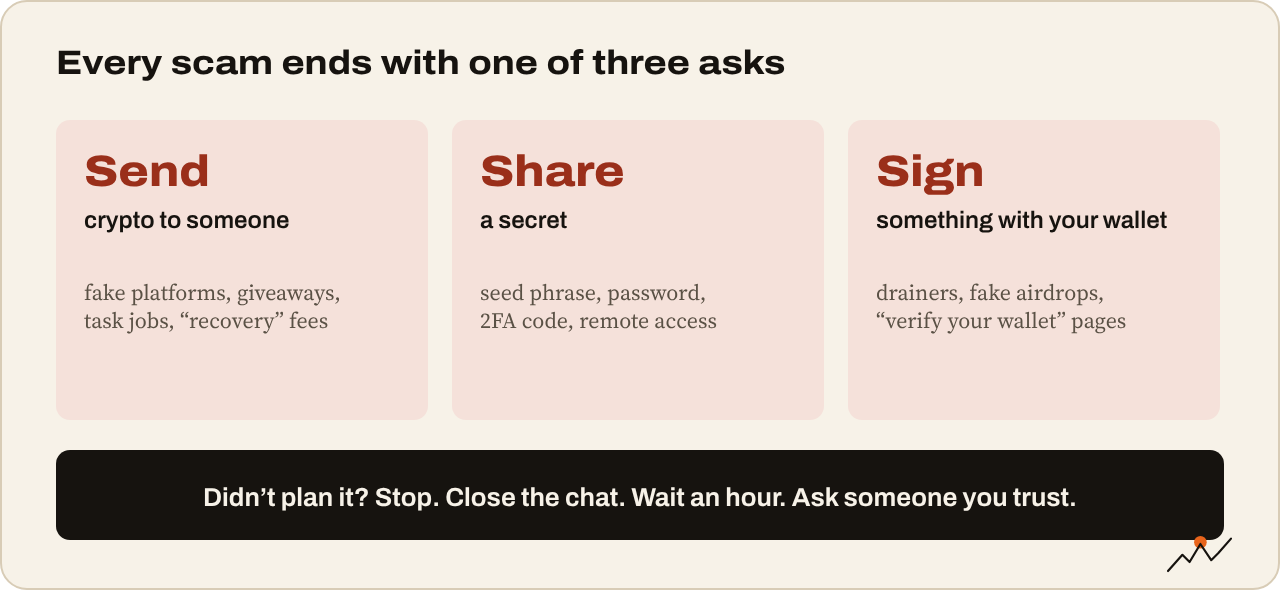
- Send crypto to someone (fake platform, giveaway, task scam, recovery scam).
- Share a secret like your seed phrase, password or 2FA code (impersonation, phishing, fake wallets).
- Sign something with your wallet (drainers, fake airdrops).
If a situation pushes you toward one of those three and you didn’t plan it, stop. Close the chat, wait an hour, ask someone you trust. Real opportunities survive a one-hour pause. Scams don’t.
The quick red-flag check
Before you send, sign or share anything, run the scam red flags checklist on our Tools page. The short version:
- Did they contact me first?
- Are they promising guaranteed or very high returns?
- Is there a deadline or pressure to act now?
- Am I being asked for my seed phrase, a 2FA code or remote access?
- Do I need to pay a fee to withdraw or to unlock something?
- Did I find this site through a link instead of typing it myself?
One “yes” is enough to walk away.
If it already happened
- Stop sending money, whatever they promise.
- Move any remaining funds to a new wallet with a new seed phrase if your phrase or device may be exposed. Revoke old approvals.
- Write everything down: addresses, transaction IDs, usernames, websites, screenshots.
- Report it to the exchange you sent from, to your police and to your national fraud center (in the US, the FBI’s IC3). Exchanges can sometimes freeze stolen funds that land on them.
- Ignore anyone who offers recovery for a fee.
Being scammed isn’t stupid. These are professional operations, often with call centers and scripts. Talking about it helps others avoid the same trap.
Where to go next
Most scams start by getting into an account. Part 2 of Stay safe locks those doors: Protecting your accounts: 2FA, passwords, phishing.

On the climb since 2017. Trades futures and reads onchain data. Automates the boring parts.
More from VikingXBT →