The short version
- Coldcard maker Coinkite says at least 15 independent review efforts and a two-month AI review missed the flaw that let thieves rebuild private keys offline.
- Galaxy Research counts at least 1,778.84 BTC stolen from more than 8,600 addresses, about $105 million at the time of writing.
- A firmware update does not repair an old seed: owners with an affected one need to make a new seed and move their coins.
Everybody looked at the lock. Nobody checked where the key came from.
Coldcard maker Coinkite published its full postmortem on Tuesday, November 24, four months after thieves began emptying Bitcoin wallets made on its devices. At least 15 independent review and research efforts between 2021 and 2026 failed to spot the Coldcard vulnerability. So did a two-month AI review.
The company’s own summary came with an apology:

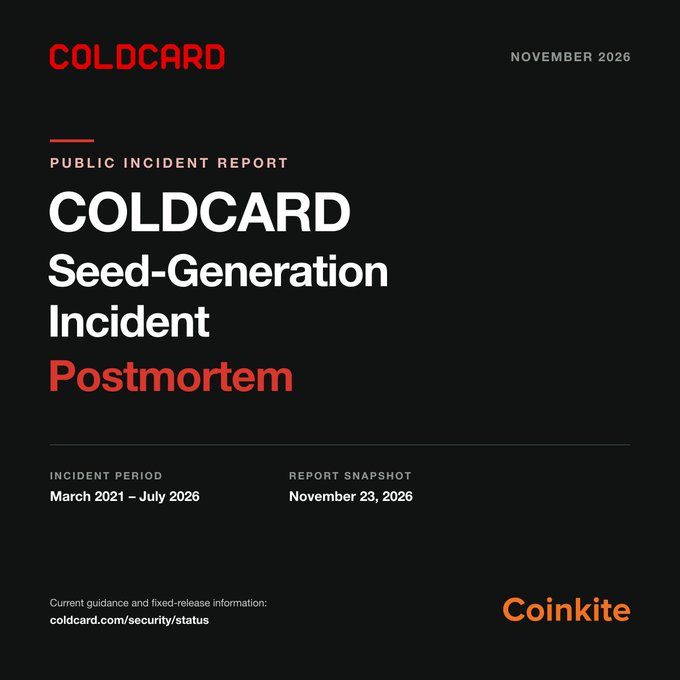
Today we are publishing our full postmortem on the COLDCARD seed-generation incident.
The failure was a firmware integration defect that caused affected releases to generate seeds from a much smaller search space than intended. Attackers reconstructed corresponding private keys
The part owners need to know is short. The fix came out in July, and it doesn’t repair an old seed. So who still has to move?
How Did the Coldcard Vulnerability Get Past 15 Reviews?
The bad output looked random. A seed phrase is only as strong as the randomness behind it, and Coldcard’s was coming from the wrong place.
Security firm Keylabs traced the cause to a firmware setting that sent seed creation to a software number generator, when it should have used the chip’s hardware one. The results stayed statistically uniform, so tests of the output had nothing to catch. The range of possible seeds was simply far smaller than it should have been.
That was enough. Thieves rebuilt the private keys offline, and Coinkite says no device was remotely accessed or taken over.
The code was public the whole time, with 54 contributors. The 15 efforts included two paid outside product reviews, although Coinkite says many were not full firmware audits.
Then came the AI. Researcher Rob Hamilton ran the firmware through the OpenAI Cybersecurity Harness from May 1 to June 26. It produced 85 candidate findings, and several led to fixes. The seed flaw wasn’t among them.
Thefts began on July 29, 33 days after that review ended. Coinkite found the defect the next day and shipped fixed firmware for all five release tracks on July 31.
Sponsored · Affiliate link
Save 20% on fees trading on WEEX
Base Camp may earn a commission if you sign up. It never affects what we write.
How Much Was Stolen
At least 1,778.84 BTC from more than 8,600 addresses, worth about $105 million at the time of writing. That high-confidence count is from Galaxy Research on August 14, when it had been in contact with 190 victims. Add the thefts it couldn’t confirm and the total rises to 2,417.35 BTC, about $143 million today.
Coinkite can see far less. It matched 300 loss tickets to 236 customer accounts, about 0.2% of its estimated users, and says the true number is likely higher.
It asked whoever holds the coins to return them, without promising immunity. Customers have no compensation plan yet. Coinkite says it is “still evaluating every option.”
SIDE TRAIL: Keystone Wallet Breach: Maker to Destroy 18,835 Devices After Key Theft
Is My Coldcard Affected?
Check the firmware that made the seed. The version on your device today doesn’t settle it.
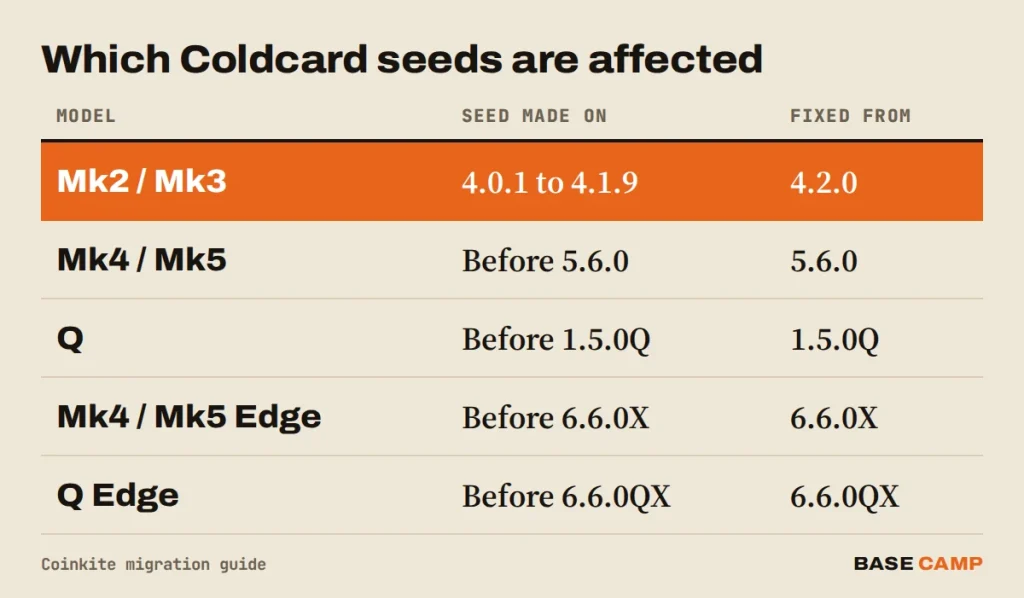
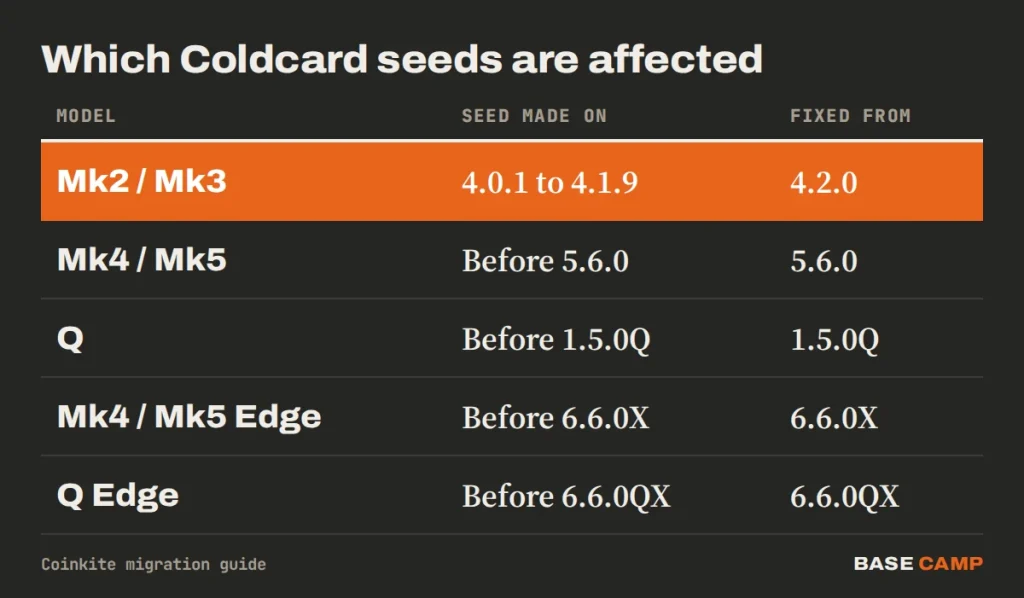
Mk2 and Mk3 seeds were hit hardest, but newer models are not in the clear. Restoring or cloning an affected seed carries the weakness along with it.
There is one dice exception: at least 50 fair rolls through Add Dice Rolls, kept private and never recorded, with the final words shown after the rolls in use. Not sure? Move. A strong passphrase buys protection, but Coinkite still tells those users to migrate as soon as practical.
What Coldcard Owners Should Do Now
- Update first. Install the current Coldcard firmware, 5.6.3 for Mk4 and Mk5 or 1.5.3Q for Q, and verify the download. Mk2 and Mk3 end at 4.2.0. Edge has its own track.
- Make a new seed. Do not clone or restore the old one. Back it up and check the backup.
- Send a small test. Verify the new address on the device screen, then move the rest.
- Empty every wallet on the old seed. That includes passphrase wallets, BIP-85 child wallets and multisig setups, which need a new policy. The migration guide covers each one.
- Keep the old backup until every coin has arrived.
- Share nothing. No seed words, passphrases, dice rolls or backups, with anyone. That includes support.
Keylabs found the fix sound and the defect closed, within its scope. That scope was four Mk5 and Q releases. Edge and Mk2/Mk3 firmware were outside it.
TRAIL MAP: How to Set Up a Crypto Wallet
Coinkite’s own line is the one to remember: “A firmware update does not repair a seed generated on affected firmware.”

TheCryptoMonk has been trading since 2017 and reads the market from the top down. The focus is macro and the high timeframes: where stocks, rates and liquidity are heading, and what the weekly and monthly charts say about Bitcoin. Short-term noise matters less than the bigger trend.
More from TheCryptoMonk