The short version
- Quantum-safe cryptography is now a priority for the Bank of England, whose November 26 report says the move has implications for decisions firms take now.
- The near-term threat is public key cryptography, including digital signatures, the same kind of maths that secures every Bitcoin transaction.
- The Bank names the October Binance hack, around $6.4 billion taken within 30 minutes, as a warning about weak operational controls.
“The immediate financial stability priority is an orderly transition to quantum-resistant cryptography.” That line sits in the Bank of England’s November Financial Stability Report, out on Thursday, November 26, and it puts quantum-safe cryptography on the same worry list as bond markets and private credit.
Few thoughts on what changed:
- Quantum: the Bank calls the move to quantum-resistant cryptography a priority, with “implications for actions and decisions firms have to take now.”
- The target: public key cryptography, the kind behind keys, logins, identity and digital signatures.
- Binance: the October hack, put at around $6.4 billion taken within 30 minutes, is the Bank’s example of weak operational controls.
- The caveat: the machine that could break this cryptography doesn’t exist yet.
So why should a central bank’s to-do list matter to anyone holding Bitcoin?
BBC economics editor Faisal Islam picked up the quantum angle within an hour of the release:

NEW
Interesting Bank of England financial stability report, leaning into cyber and quantum risks. Governor Andrew Bailey just been asked about suggestion that AI models had already broken RSA encryption…
Bank raises concerns about “circular financing” and “opaque structures”
What the Bank of England Said About Quantum Computing
It said the work has to start now, even without a date for the threat. In section 5.3 of the Bank of England Financial Stability Report, the Bank writes that “the principal near-term threat is quantum-vulnerable public key cryptography, including mechanisms used for establishing keys, authentication, identity infrastructure, and digital signatures.”
It stays careful on timing. “A cryptographically relevant quantum computer (CRQC) does not yet exist,” the report says, “but the quantum landscape continues to advance, challenging assumptions around when a CRQC could emerge.” A CRQC is a quantum computer big and stable enough to break today’s encryption in practice, not just in a lab demo.
The report also flags harvest-now-decrypt-later attacks: someone copies encrypted data today and waits for the machine to read it later. For anything that has to stay secret for years, that turns a future problem into a present one.
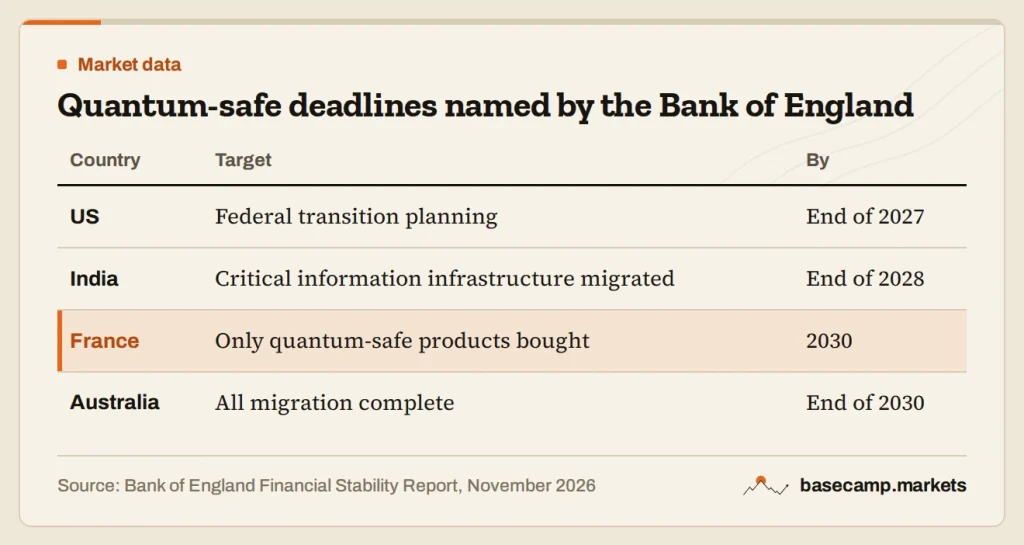
Other countries already have dates, and the Bank lists them. France goes furthest: tighter certification for security products from 2027, and organisations expected to buy only quantum-safe products by 2030.
Sponsored · Affiliate link
Save 20% on fees trading on WEEX
Base Camp may earn a commission if you sign up. It never affects what we write.
Why Quantum-Safe Cryptography Matters for Bitcoin
Because Bitcoin runs on exactly the kind of cryptography at the top of the Bank’s list. Every Bitcoin transaction is approved with a digital signature, ECDSA or Schnorr, made with a private key and checked against a public key, the half anyone can see.
Once a public key is visible on-chain, a big enough quantum computer could in theory work backwards to the private key and sign for those coins. A bank can roll out quantum-safe cryptography on a schedule set from the top. Bitcoin can’t: a move to quantum-resistant signatures needs developers, miners and holders to agree, and coins in old addresses would have to move to new ones.
That debate is already running among Bitcoin developers, from Blockstream backing Falcon lattice signatures to a plan to booby-trap old coins.
SIDE TRAIL: Bitcoin Quantum Threat: Blockstream Backs Falcon, a Core Developer Pitches Landmines
How the Binance Hack Became the Bank’s Warning
The quantum part is about tomorrow. The Binance hack is about last month. The Bank writes that “a cyberattack on cryptocurrency exchange Binance in October illustrated the risks that can arise from weaknesses in firms’ operational controls.”
In its telling, attackers “appear to have used social engineering and malware to compromise internal systems,” went after a series of Binance-controlled wallets and took around $6.4 billion within 30 minutes. Binance’s own initial findings put the theft at $6.34 billion and traced the way in back to a fake job interview.
No quantum computer needed, then. Just tricked people and malware, then half an hour of draining.
The Bank also says why the damage stayed inside crypto: “the relatively weak interconnections between cryptocurrency markets and the rest of the financial system.” That reads as reassurance today. It reads differently the more bank money ends up tied to crypto.
TRAIL MAP: Binance Hack Report: A Fake Job Interview Opened the Door
Bitcoin Price Holds Near $60,700
Bitcoin trades at $60,757 at the time of writing, up 0.13% over 24 hours and 51.8% below its October 2025 high of $126,080. The Fear & Greed Index reads 12, extreme fear. Price sits far under its 50-day moving average of $74,362. A daily close above $64,700 would be the first sign buyers are back; a drop under $58,115 would cancel that and bring the November 21 low of $55,130 back into view.
For Bitcoin, the quantum clock still has no date on it. The Bank of England’s point is that the work can’t wait for one.

TANG has been trading crypto since 2017. The focus is technicals, DeFi and onchain data. On the chart, that means high-timeframe support, moving averages and momentum divergences. Onchain, it means regular checkups on where the data puts the cycle. TANG once ran CryptoJungle, a free community for researching and trading together, and brings that same spirit to Base Camp as one of its co-founders.
More from TANG