The short version
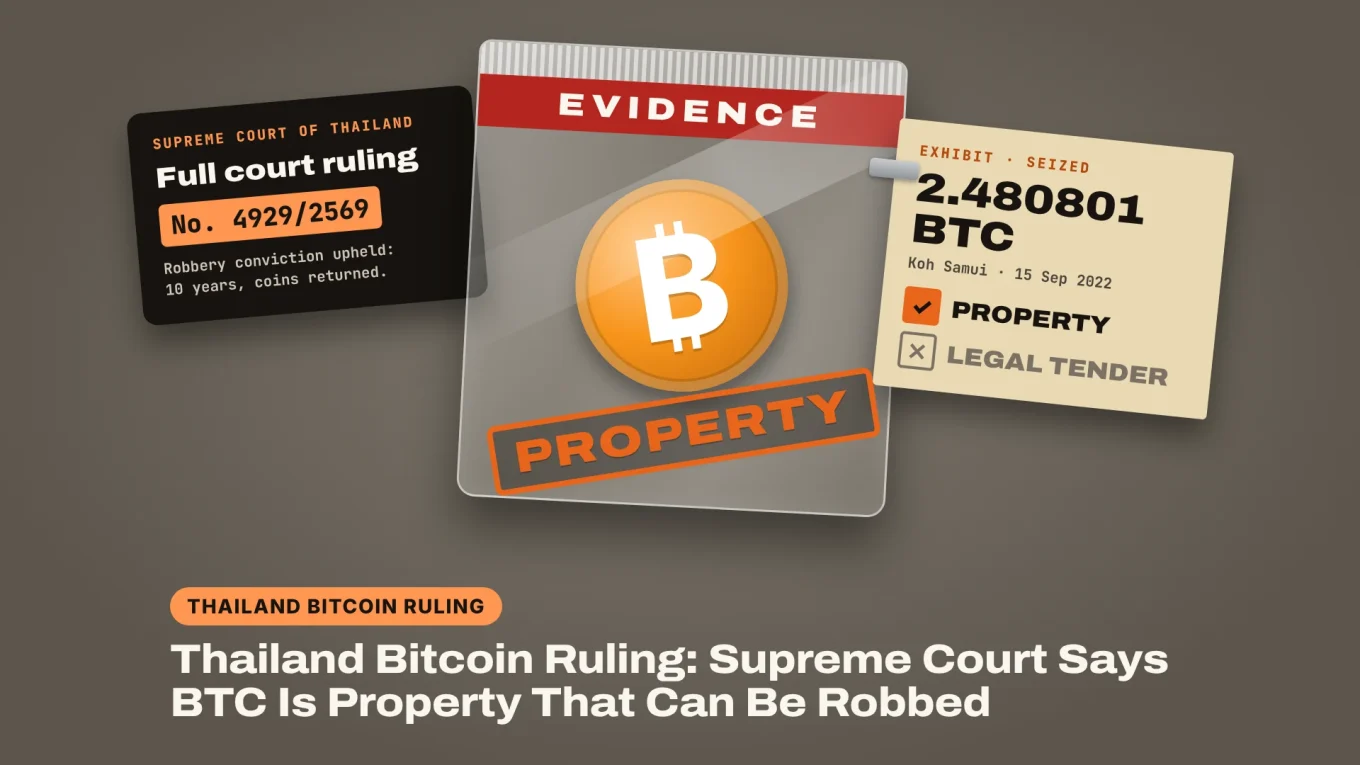
- Thailand Bitcoin ruling: the full Supreme Court, in judgment No. 4929/2569, says BTC is property, so taking it by force is robbery.
- It upheld a 10-year sentence for a 2022 Koh Samui robbery of 2.480801 BTC, about $50,000 then and roughly $201,700 today, and ordered the coins returned.
- The crew is watching how lower courts use it: the ruling covers theft law, and the Bank of Thailand still says crypto isn’t legal tender.
Thailand Bitcoin holders got a clear answer from the country’s top court. In judgment No. 4929/2569, decided by the full Supreme Court, the judges ruled that Bitcoin counts as property under Thai law, so taking it by force is robbery like any other.
The case goes back to a 2022 robbery on Koh Samui, where a gang forced a visitor to send them 2.480801 BTC. One of the robbers argued that crypto has no value of its own and so can’t be robbed. The court threw that out.
The news that spread the ruling on X:

JUST IN: 🇹🇭 Thailand's Supreme Court officially recognizes Bitcoin as legal property.
What Happened on Koh Samui?
A gang robbed a tourist of his Bitcoin. On the morning of September 15, 2022, a group of foreign men confronted him on the island, used a van in the crypto robbery and forced him to transfer 2.480801 BTC to their wallet. That was about $50,000 at the time. At today’s price of $81,295, the same coins are worth roughly $201,700.
A trial court convicted the accomplice of robbery with a vehicle and gave him 15 years, cut by a third to 10 years. It also ordered him to hand back the Bitcoin or pay its value. He appealed on one point: that Bitcoin isn’t property at all.
Sponsored · Affiliate link
Save 20% on fees trading on WEEX
Base Camp may earn a commission if you sign up. It never affects what we write.
Is Bitcoin Property? Why the Thai Supreme Court Says Yes
Yes, because it has a price and someone can own it. Judges leaned on the Civil and Commercial Code, which counts intangible things as property when they have a value and can be held, and on Thailand’s 2018 Digital Asset Business Emergency Decree, which already treats crypto as an asset traded under the SEC’s watch. Bitcoin can be bought, sold and swapped for cash, so it fits.
Judges upheld the 10-year sentence and the order to return the coins. A ruling of the full court carries extra weight with lower courts in future cases. You can look it up by number in the Supreme Court’s judgment database.
SIDE TRAIL: Bloom Trading Bot Wallets Drained of $954K in SOL
What the Thailand Bitcoin Ruling Does Not Say
It doesn’t make Bitcoin money. The Bank of Thailand still says crypto isn’t legal tender, and nobody can be forced to accept it as payment. The ruling is about theft and robbery law: if someone takes your BTC, Thai courts can treat it like taking your car or your cash.
That matters for anyone who holds Bitcoin in Thailand. A robber who forces someone to unlock a wallet, a so-called wrench attack, faces the same robbery law as any other thief.
TRAIL MAP: Your First Crypto Wallet, Set Up Safely: Hot vs Cold and the Seed Phrase
For holders, the takeaway is plain. In Thailand a stolen Bitcoin is stolen property, and a court can order it given back.

On the climb since 2017. Trades futures and reads onchain data. Automates the boring parts.
More from VikingXBT →