The short version
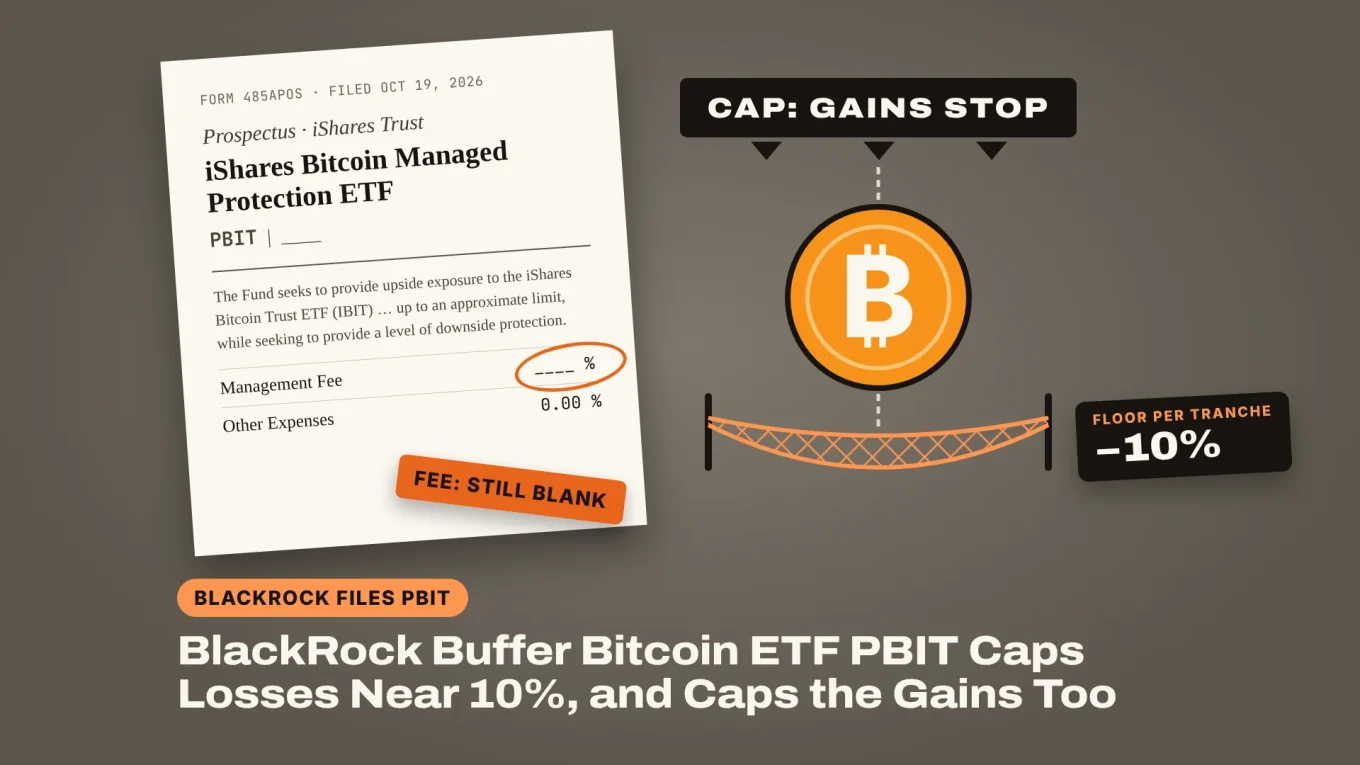
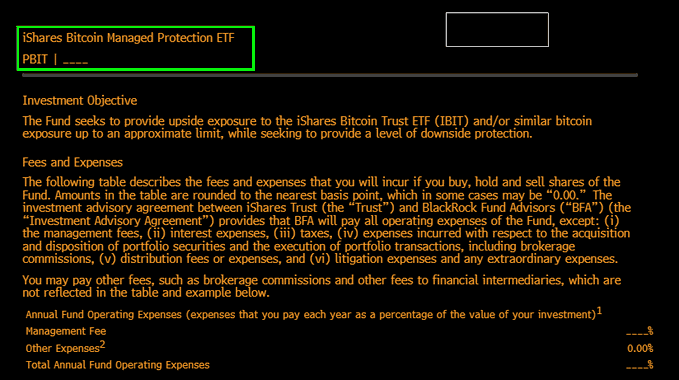
- The BlackRock buffer Bitcoin ETF, PBIT, was filed with the SEC on October 19 and aims to limit each three-month slice of losses to about 10% by trading options on IBIT instead of holding bitcoin.
- The catch is a cap on gains set each month and a fee that is still blank, so in a quarter like Q3, when BTC rose 42.6%, holders would keep only the slice up to the cap.
- The crew is watching the first cap and the fee when PBIT can launch in early January, and whether BTC holds $80,394 in the meantime.
The BlackRock buffer Bitcoin ETF is built for people who can’t sit through a 50% drawdown. The fund, the iShares Bitcoin Managed Protection ETF (PBIT), was filed with the SEC on October 19 and aims to limit each slice of losses to about 10%, in exchange for a ceiling on the upside.
The fund holds no bitcoin. It trades options on IBIT, BlackRock’s spot Bitcoin ETF, and parks the rest in cash and short-term bonds. The fee is still blank and there is no launch date. BTC trades at $80,693 at the time of writing, 36% below its October 2025 high, which is exactly the kind of chart this product is built for. So who is it for, and what do you give up?
Bloomberg ETF analyst James Seyffart spotted the filing first:

BREAKING🚨 @BlackRock just filed for another Bitcoin ETF. This one will be a "buffer" Bitcoin ETF which will means it will offer downside protection but investors will give up some upside to get that protection. Ticker will be $PBIT.
How Does the BlackRock Buffer Bitcoin ETF Work?
It buys a floor and pays for it by selling the top. The preliminary prospectus describes three overlapping “tranches” of IBIT call options. One expires and a new one starts every month, so each runs for about a quarter.
Each tranche is a call spread. The fund buys calls with a strike near 90% of IBIT’s price on the day the tranche starts, and sells calls further up. Say IBIT is at $46. The bought calls sit near $41.40. If IBIT falls to $32, those calls expire worthless and the tranche loses about 10%, not 30%. The sold calls set the “Tranche Cap Value”: above that strike, the tranche stops gaining. Interest from the cash pile helps pay for the options.
The filing doesn’t name the cap. BlackRock says it will be set by market conditions at the start of each tranche and posted on iShares.com. Seyffart counts PBIT as the firm’s third Bitcoin ETF filing, after IBIT and the BITA income fund, and notes it will be a 40 Act fund, the same rulebook as a regular mutual fund or stock ETF.
Sponsored · Affiliate link
Save 20% on fees trading on WEEX
Base Camp may earn a commission if you sign up. It never affects what we write.
Is PBIT a Buffer or a Floor?
A floor, going by the filing. The prospectus never uses the word “buffer”. It calls the 10% level the “Floor”, and the difference matters if you plan to buy it.
A classic buffer ETF absorbs the first 10% or 15% of losses and leaves you everything beyond that. PBIT does the opposite. You eat roughly the first 10%, and the options cover the drop below that. In a crash, that is the better deal. In a dull 8% dip, you get no help at all.
Three more catches sit in the small print:
- The floor doesn’t follow the price. If IBIT climbs from $46 to $55 after a tranche starts, the floor stays near $41.40, so a fall back there costs that tranche about 25% from the top.
- Fees come on top. The 10% is “before taking into account fees and expenses”, and the management fee is still a blank line.
- Wild markets shrink both sides. The filing warns that extreme volatility “may significantly reduce” the upside and the protection.
Because the tranches overlap, no holder gets one clean result either. The prospectus says outright that investors “should not expect” the outcome of a single tranche.
What Would a 10% Floor Have Done in the Past Year?
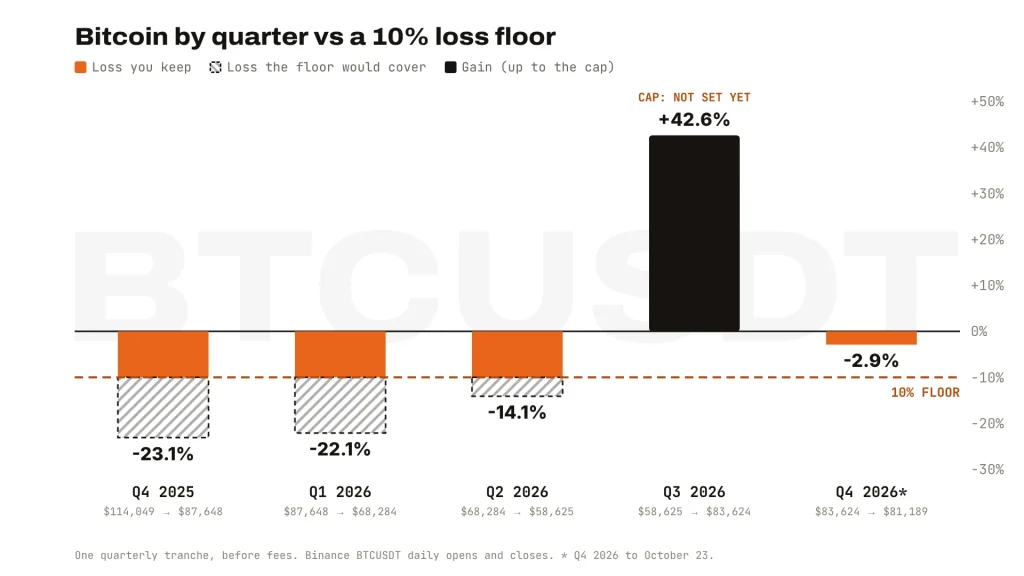
It would have earned its keep, then missed the bounce. Bitcoin lost 23.1% in the fourth quarter of 2025, 22.1% in the first quarter of 2026 and 14.1% in the second, on Binance’s daily closes. A single quarterly tranche with a 10% floor would have stopped each of those at roughly 10%, before fees.
Then came the third quarter, when BTC rallied 42.6% from $58,625 to $83,624. A capped tranche would have kept only the slice up to its cap. For context, Calamos’s CBOJ, which protects 100% of losses, started its current year with a cap of 8.36%.
In other words, the BlackRock buffer Bitcoin ETF and its rivals trade the best quarters for sleep. That suits an adviser adding Bitcoin to a retirement account, or a holder who knows they would panic-sell the next 50% drop. It suits a trader far less: anyone with an options account can build a similar call spread on IBIT without paying a management fee.
The shelf is not empty, either. Calamos, First Trust and Innovator already run protected Bitcoin funds, and Innovator is closing its uncapped 20% floor fund QBF: trading stops on December 31 and the fund liquidates around January 8, 2027.
DISCOVER: Bitcoin ETF Inflows Hit $527M as IBIT Takes $665M
Bitcoin Price Analysis: Where Is BTC as BlackRock Pitches Protection?
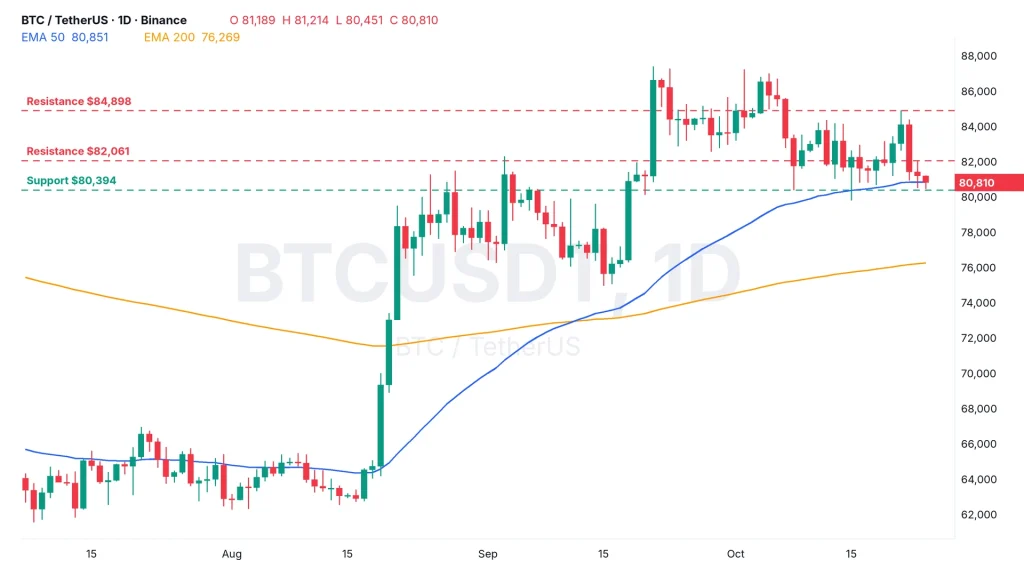
Right on its 50-day average, and wobbling. The BTC price trades at $80,693, a hair under its 50-day EMA at $80,850 after a 1.3% slip over 24 hours.
- The first ceiling: $82,061. Friday’s high, where the bounce after Thursday’s drop ran out.
- The bigger ceiling: $84,898. Wednesday’s high, the top of last week’s range.
- The floor to defend: $80,394. The October 8 low, with the $79,800 wick from October 15 just under it.
- The deeper support: $76,269. The 200-day EMA, about 5.5% below the price.
In the bull case, BTC holds the 50-day, clears $82,061 and retests $84,898. In the base case, it chops between $80,394 and $82,061 into the Fed meeting on October 28. In the bear case, a daily close under $79,800 opens the way to the 200-day near $76,300.
EXPLORE: Risk Management: The 1% Rule and Position Sizing That Keeps You in the Game
PBIT can’t trade before early January: the filing asks to take effect 75 days after October 19. Two blanks decide whether it’s worth a look, the fee and the first cap. A cap in single digits per quarter would make this a product for the nervous. Anyone hoping for the next 40% quarter should look elsewhere.

On the climb since 2017. Trades futures and reads onchain data. Automates the boring parts.
More from VikingXBT →