The short version
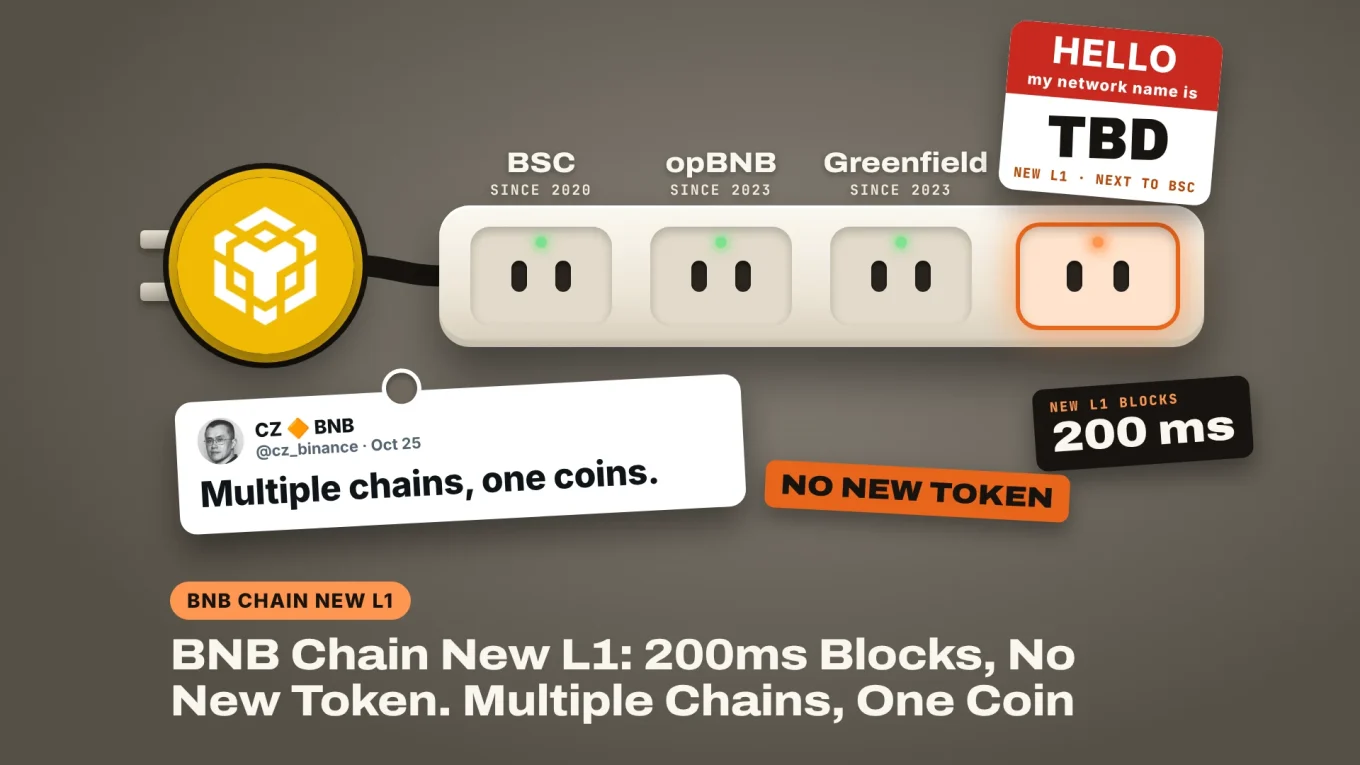
- BNB Chain New L1 is a second blockchain that will run next to BNB Smart Chain, with 200ms blocks, about 20ms pre-confirmations and finality in under a second, per docs BNB Chain updated on October 22.
- It gets no token of its own: BNB pays gas, secures it through staking and carries the governance votes, which CZ summed up on October 25 as “Multiple chains, one coins.”
- The crew is watching the public testnet BNB Chain targets for the end of 2026, ahead of a mainnet in early 2027, and whether fast traders actually move there.
The BNB Chain New L1 is a whole second blockchain. The BSC you already use isn’t going anywhere. BNB Chain published the plan in its developer docs on October 22: a chain with 200-millisecond blocks that runs next to BNB Smart Chain, joined to it by a native bridge. It gets no token of its own.
That last part is what CZ picked up on Sunday evening. He quote-posted a thread about the docs with four words, and BNB trades at $741 at the time of writing, down 0.6% on the day. So what is the new chain for, and what does it change for people who hold BNB?
CZ’s post, 19:44 UTC on October 25:

What Is the BNB Chain New L1?
A fast, EVM-compatible blockchain built for trading, payments and AI agents, the kind of traffic that needs answers in milliseconds. It doesn’t have a name yet. The docs call it “New L1” and list the network name as TBD.
BNB Chain first put it on the H2 2026 roadmap in July with a target of more than 100,000 transactions per second. The new docs add the details. Blocks come every 200 milliseconds, and a trader gets a pre-confirmation in about 20 milliseconds. That is a signed promise from the validator building the block that the trade is in it, at a set position. Finality, the point where the order can’t change, comes in under a second.
BSC stays where it is. The docs call BSC the “broad-base chain for the existing ecosystem” and New L1 a clean-slate design “for the workloads that outgrow it”. Contracts written for BSC run on it unchanged.
Sponsored · Affiliate link
Save 20% on fees trading on WEEX
Base Camp may earn a commission if you sign up. It never affects what we write.
How Is New L1 Different From BSC?
Mostly in what happens before a trade lands in a block. Both chains use the same Parlia proof-of-staked-authority family with BLS fast finality, but New L1 takes several things out and adds others:
| BNB Smart Chain | New L1 | |
|---|---|---|
| Block time | 0.45 seconds | 0.2 seconds |
| Pre-confirmation | none | about 20 ms |
| Public mempool | yes | no, transactions go straight to the block producer |
| Gas and staking token | BNB | BNB |
| Accounts | standard wallets | native account abstraction: passkeys, sponsored gas, batched calls |
| Privacy | none | optional shielded pool (zk proofs) |
| Status | live since 2020 | internal devnet |
The missing mempool is the big one for traders. On most chains, a pending trade waits in a public queue where bots can see it and jump in front. On New L1 it goes straight to the current and next block producer. BNB Chain’s roadmap says that blocks front-running “by design.”
The chain also runs the EVM off the critical path. Validators agree on the order of transactions first and execute them right after, so a slow block of contracts can’t hold up the next block. It keeps state in a flat database with a lattice hash (LtHash) instead of the usual Merkle tree, and builds execution on Reth and Revm, the Rust clients many teams already use for Ethereum.
Builders can also reserve space. Under Multi-Lane, a contract registered through governance gets a fixed share of every block’s gas, so an oracle or a liquidation engine isn’t crowded out when a memecoin goes viral.
Fees work differently, too. The base fee is pinned at zero (BEP-222), so the tip is the whole price, and users pay for the gas limit they declare, not the gas the trade ends up using. Wallets that pad the limit by 50% will overpay.
DISCOVER: Reading Order Books, Funding and Open Interest Together
Does New L1 Have Its Own Token?
No. BNB is its only coin: it pays gas, it’s what validators stake and it carries the governance votes. “BNB is the native asset of New L1, and no new token is issued,” the overview says. Users bridge BNB over from BSC. Staking it mints govBNB 1:1, a voting balance that can’t be sold or sent.
That is the idea behind “multiple chains, one coin”, and it’s what CZ’s post is about. “Multiple chains, one coins,” he wrote, typo included, quoting Chinese crypto writer KuiGas, who had read the October 22 docs. BNB already pays gas on BSC, opBNB and Greenfield. New L1 would make it four chains and one coin.
So there is no New L1 airdrop to farm, and no new ticker to buy before it lists. Any account that offers one is a scam.
For BNB holders, that makes the BNB Chain New L1 one more place where BNB gets spent, with no second coin to split the demand. Whether that matters depends on traffic. A chain built for high-frequency trading only adds demand for BNB if the trading actually moves there, and that is at least a year away.
When Does New L1 Launch?
Testnet by the end of 2026 and mainnet in early 2027, according to BNB Chain’s roadmap. Today it runs as an internal devnet with several validators, and the docs warn that the network is “highly unstable and subject to breaking changes.”
Several pieces aren’t finished. The BSC bridge is “designed and under development but not live”, there is no public RPC, chain ID or block explorer yet, and the shielded pool’s circuits are unaudited. The docs say outright not to treat it as safe for real value.
What It Means for the BNB Price
Not much this week. BNB is at $741, above its 50-day EMA at $734, and the October 21 high at $751.86 still caps it, the same levels we covered in BNB Price Holds Up in a Red October. A docs page and a four-word post from CZ don’t move a $97 billion coin on their own.
The longer story is simple. New L1 is aimed at the fast trading that has gone to chains like Hyperliquid and Solana, and BNB Chain wants that trading to pay its gas in BNB. The testnet at the end of the year is the first chance to see if 200-millisecond blocks hold up outside a devnet.
EXPLORE: DeFi Basics: Swaps, Liquidity Pools and Impermanent Loss

In crypto since 2016. Trades the macro picture and reads the market on the high timeframes.
More from TheCryptoMonk →