The short version
- Crypto market structure bill odds of a law before 2028 rose to 32% on Kalshi from 19% on October 23, as Democrats won the House and all but sealed the Senate.
- The current CLARITY Act is likely dead: it needs 60 Senate votes before January 3, Kalshi gives it 6%, and the next version will be written by Maxine Waters and Elizabeth Warren, who want ethics limits on crypto profits by officials.
- Next: the Senate returns next week and government funding runs out on December 11, which comes first. We’ll post any move on the bill on Base Camp on X.
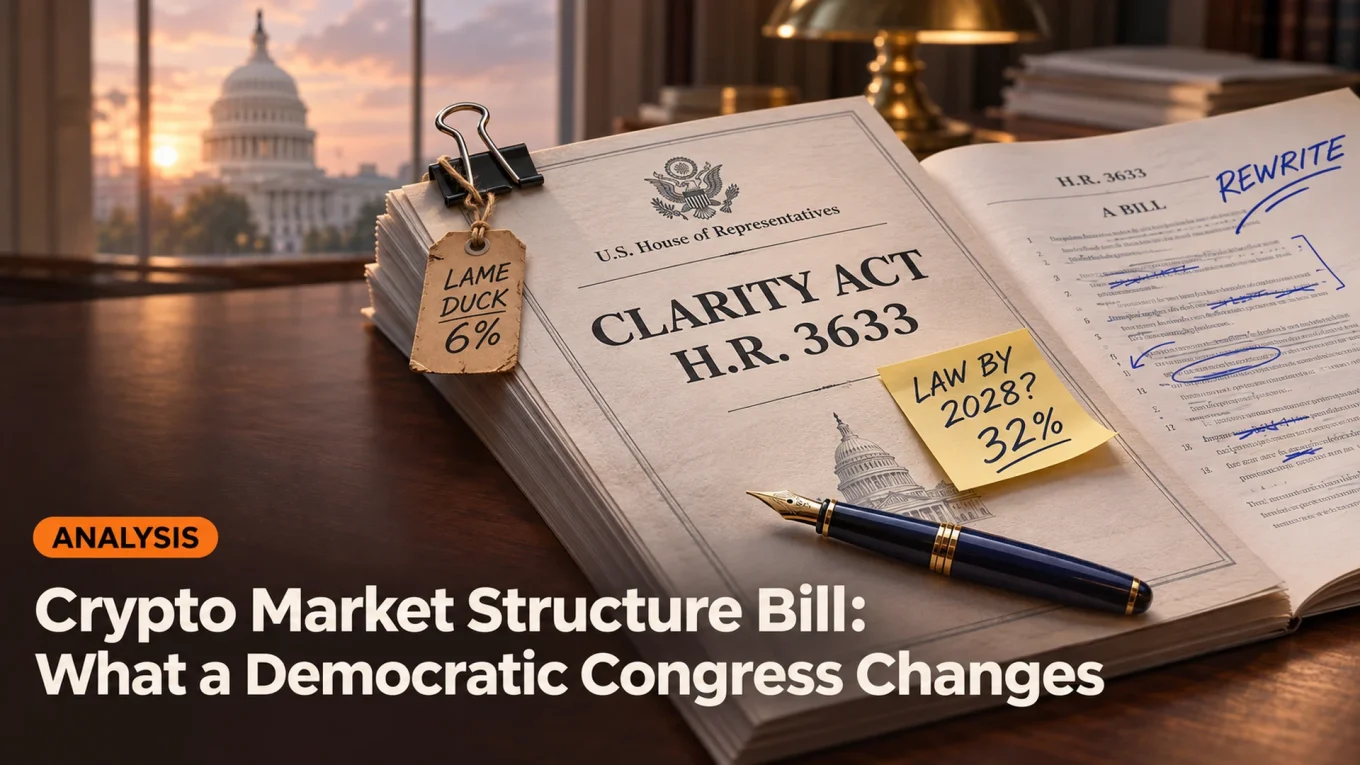
The crypto market structure bill lost its majority overnight, and oddly, the odds of it ever becoming law went up. Democrats won the House and are all but sure of the Senate, with Kalshi at 99.6% for Democratic control at the time of writing. The same traders now give a market structure law before 2028 a 32% chance, up from 19% on October 23.
The current bill, the CLARITY Act, is a different story. It has until January 3, when this Congress ends, and Kalshi gives it 6%. So what actually changes for crypto now that Democrats hold the pen?
Stand With Crypto, the voter group Coinbase started, spent the night counting its winners on both sides of the aisle:

Congratulations to the pro-crypto champions elected tonight.
Meet the Stand With Crypto endorsed candidates who will bring a strong voice for crypto to office. 🧵⬇️
What Happens to the Crypto Market Structure Bill Now?
It most likely dies on January 3 and starts over in a Democratic Congress. Republicans still run both chambers until then, but they need 60 Senate votes, and the September 15 cloture vote failed 49–50 with no Democrat voting yes.
The calendar makes it worse. The Senate returns next week with about five working weeks left, and government funding runs out on December 11. That deadline comes first. A bill that couldn’t find 60 votes before the election is unlikely to find them after Democrats won the right to write their own version.
Kalshi agrees. A market structure law before December 1 trades at 1–2%, and before January 1 at 6%, the same as two weeks ago. The blue wave changed nothing about the lame duck because the lame duck was already priced as dead.
Sponsored · Affiliate link
Save 20% on fees trading on WEEX
Base Camp may earn a commission if you sign up. It never affects what we write.
Who Writes the Next Crypto Bill?
Most likely Maxine Waters in the House and Elizabeth Warren in the Senate, so Democrats’ crypto market structure plans now start with them. Both are the top Democrats on the committees that write crypto law, Financial Services and Banking, and the majority party picks the chairs in January.
Neither is a fan of the current text. Warren called it “a bill written by the crypto industry for the crypto industry” when Senate Banking passed it 15–9 in May, Roll Call reported. Only two Democrats, Ruben Gallego and Angela Alsobrooks, voted for it.
Waters went further after the September vote. “Until Congress passes legislation to end the President’s crypto profiteering and recoup his ill-gotten gains, any legislation in the crypto space would only serve to validate and condone his worst actions,” she said in a statement. Her own bill, the Stop TRUMP in Crypto Act, would block Trump’s memecoin and bar future presidents, vice presidents, members of Congress and their families from similar crypto deals.
SIDE TRAIL: Midterm Election Results: Democrats Sweep Congress, Bitcoin Dips First
Why Did the Odds for a Law Go Up?
Because the fight that killed the CLARITY Act was never about crypto rules. The bill failed over ethics: whether officials, the president included, can keep earning money from crypto. Stablecoin yield was the other sore point. The split between the SEC and the CFTC, the core of the bill, had support from both parties.
A Democratic Congress can put those ethics rules in the bill itself. That is the deal Democrats asked for all along, and it would remove the main reason they voted no. President Trump would then face a choice in 2027: sign a crypto bill with limits on his family’s businesses, like World Liberty Financial and its USD1 stablecoin, or veto the law his own White House wanted.
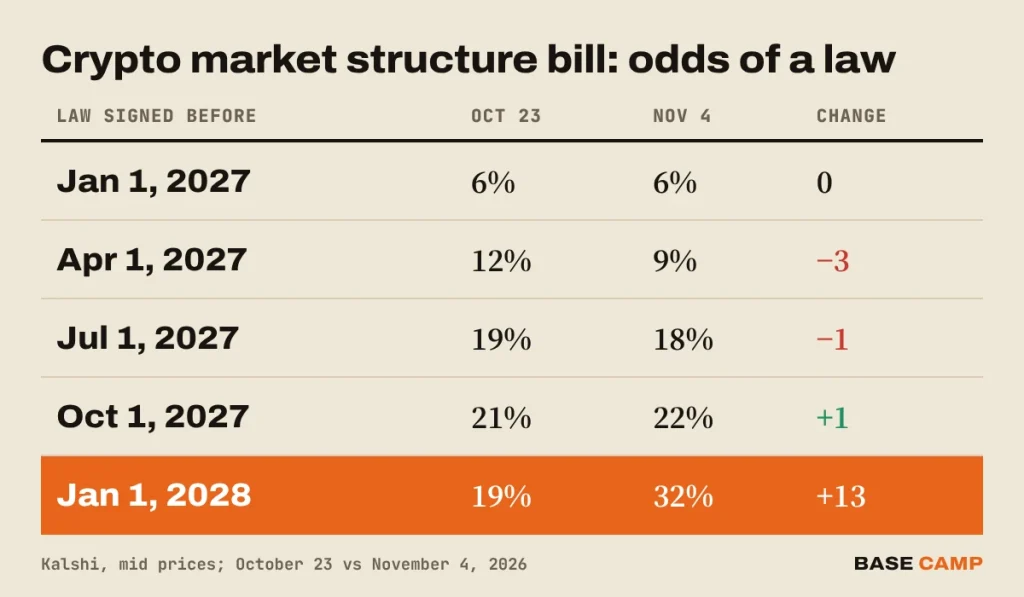
That is the latest crypto market structure bill update from traders. Nothing moves in the first half of 2027, which fits a new Congress starting from committee hearings. The jump sits in late 2027, the last stretch before the 2028 campaign takes over. These Kalshi markets are thin, so treat the numbers as a rough direction.
Alsobrooks, one of the Democrats who negotiated the Senate text, warned against waiting. “Now is the time to get it done,” she told Puck. Asked whether a Democratic Congress would make the bill a priority next year, she said: “No, absolutely not.”
What a Democratic Congress Can’t Change
The regulators. The SEC under Paul Atkins and the CFTC keep writing crypto rules with the powers they already have, and none of that needs Congress. The SEC’s proposed crypto rules closed for comments on October 20, the CFTC’s sit at the White House for review, and SEC staff added three DeFi answers to their crypto FAQ only on Monday.
White House crypto adviser Patrick Witt said in September there was “no holding them back in hopes of a lame duck passage of the bill.” The agencies didn’t wait then and won’t now.
Democrats can slow that work with hearings, letters and, in the House, subpoenas. They can’t undo a rule on their own, because a resolution to overturn it needs the president’s signature or a two-thirds vote to beat his veto. The catch is the reverse: a rule can be rewritten by the next SEC chair, and only a law can’t. That is why the industry still wants a bill, and why the 2028 line matters more than the lame duck.
TRAIL MAP: Most Crypto Assets Are Not Securities, SEC Chair Says. Treasury Won’t Wait for Congress
Bitcoin Price: Does the Bill Still Move the Market?
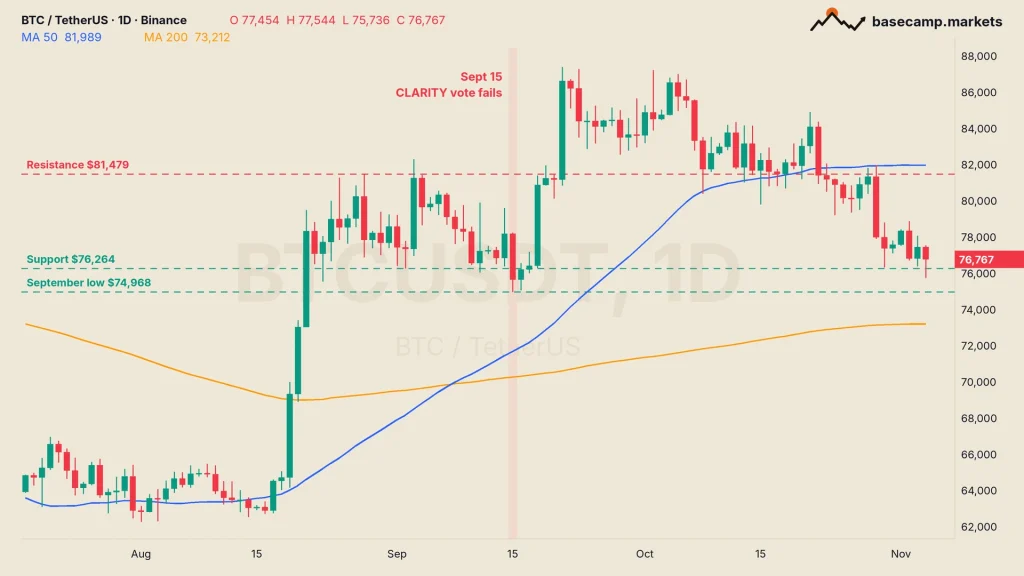
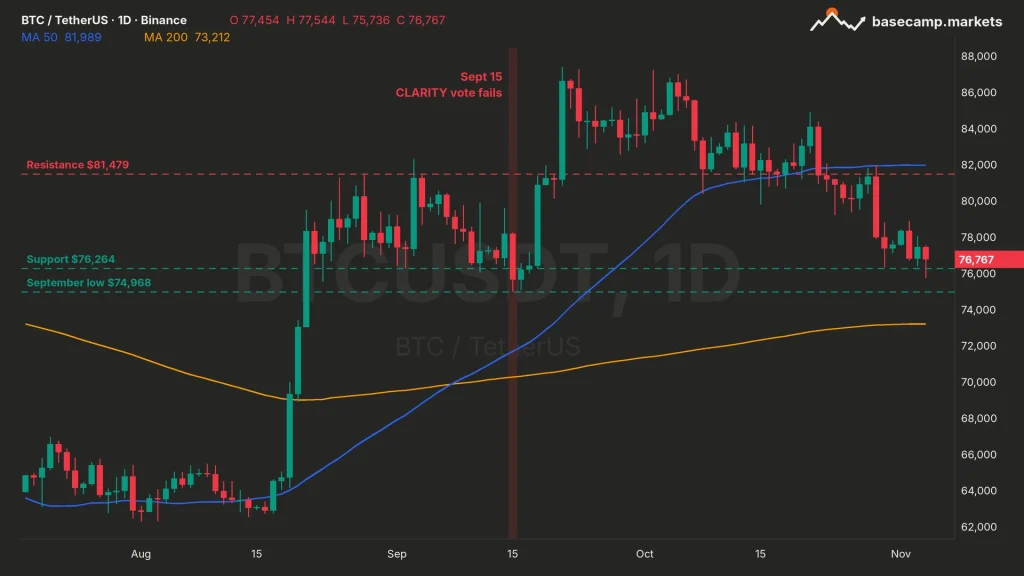
Less than it did. When the cloture vote failed on September 15, Bitcoin fell 3.3% in a day, then closed at $86,620 within a week. The blue wave drew a smaller reaction: BTC slid from $77,966 to $75,695 overnight and trades at $76,443 at the time of writing, down 0.3% in 24 hours.
That leaves it just above the $76,264 support and 39% below its $126,080 all-time high. The 50-day moving average sits at $81,989 and the 200-day lower at $73,212, with the Fear & Greed Index at 34. A daily close under $76,264 opens the September low at $74,968; on the way up, $81,479 is the first wall.
The crypto market structure bill is a 2027 story now. What decides the price before then is the Fed’s December meeting and the December 11 funding deadline, not the committee chairs who take over in January.

VikingXBT has been trading crypto since 2017. The focus is futures, onchain data and automation. Onchain flows get checked before a chart is trusted, and anything repetitive gets automated. VikingXBT built Base Camp's own onchain scanner, which flags bundlers, snipers, dev holdings and wallet clusters in one view, and backtests strategies before trading them.
More from VikingXBT