
The short version
- South Korean crypto exchanges will be allowed to halt deposits and withdrawals when a hack is only suspected, the FSC said on November 12.
- Today the law allows a freeze only once a hack has clearly happened; the FSC will issue a no-action letter, citing the Binance hack, to cover pre-emptive pauses.
- Next: the letter itself, with conditions, scope and a start date still unannounced, plus new exchange security inspection criteria by the end of the year.
South Korea’s Financial Services Commission (FSC) said on Thursday it will allow South Korean crypto exchanges to halt deposits and withdrawals when a hack is only suspected, before anyone has proved coins are gone.
An emergency brake, in other words. Today, the law says wait.
The decision came out of a security meeting in Seoul at 07:30 UTC (4:30 p.m. in Seoul), chaired by FSC Vice Chairman Shin Jin-chang, with Upbit operator Dunamu, Bithumb, Coinone and other exchanges at the table. The FSC’s press release points straight at the Binance hack as the reason speed matters.
So what can exchanges do now that they couldn’t last week? And what does it mean for anyone holding coins on one?
Yonhap, Korea’s national news agency, carried it as the meeting began. The headline reads “Authorities allow pre-emptive blocking of exchange deposits and withdrawals on suspected hacks”:

What Changes for South Korean Crypto Exchanges?
The timing of a freeze. Under the Virtual Asset User Protection Act, an exchange may not block deposits or withdrawals without a justified reason, and the FSC says the law allows it only once a hack has clearly happened.
That leaves a gap. An exchange that spots something odd at 3 a.m. has to choose between pausing early and risking a breach of the law, or waiting for proof while coins walk out the door. The exchanges told the FSC they didn’t know whether a pause at the suspicion stage was allowed.
The fix is a no-action letter, a written promise from the regulator that it won’t take action against firms that follow it. With one, exchanges can pause deposits and withdrawals pre-emptively when a hack or security incident is suspected, “under certain conditions.”
Which conditions? The release doesn’t say. It gives no triggers, no time limit on a freeze and no date for the letter.
For users, that means one thing. A withdrawal pause on a Korean exchange may soon arrive before any hack is confirmed, and it may turn out to be a false alarm. Plan for that. Don’t keep coins you might need in a hurry on any exchange, Korean or not.
Sponsored · Affiliate link
Save 20% on fees trading on WEEX
Base Camp may earn a commission if you sign up. It never affects what we write.
Why the Binance Hack Changed the Rules
Because Binance showed how fast it goes. Hackers drained about $6.3 billion from the world’s biggest exchange in late October, the biggest crypto theft on record. Every minute between the first sign and a full stop counted.
South Korean crypto exchanges already had a test case. On November 6, Gopax paused withdrawals and trading after one threat email from a group calling itself hackers, with nothing stolen. That is exactly the kind of call the new letter is meant to cover.
SIDE TRAIL: North Korean Hackers Mint Memecoins to Launder Stolen Binance NEAR
The Rest of the FSC Security Package
The freeze was one of three items. The others put more work on the exchanges.
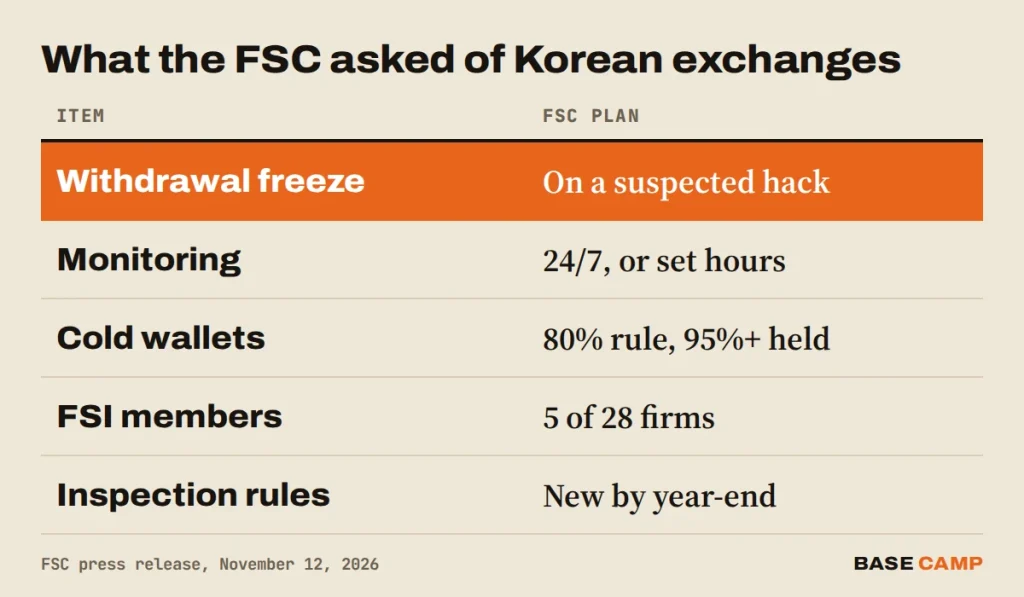
Exchanges must keep staff on duty around the clock and act at once on large abnormal trades. Those that can’t must limit deposits and withdrawals to the hours their monitoring runs, and tell users first.
Cold storage is already high. The rules require 80% of customer coins offline, and the FSC says exchanges hold more than 95% there. It still wants hot wallets kept to the minimum, split across several wallets, with bigger insurance and reserves.
Then the checks. Only 5 of the country’s 28 virtual asset firms have joined the Financial Security Institute, the finance industry’s security body. The FSC wants the rest in, and will rewrite the security inspection criteria for exchanges by the end of the year.
Longer term, the FSC is preparing a Digital Asset Act that would put exchanges under IT safety duties on par with banks and make them liable for damages. It is still a draft, so the guideline fills the gap until then.
Bitcoin Price Check
The news lands with Bitcoin under pressure. BTC trades at $72,853 at the time of writing, down 1.45% in 24 hours and 9.3% on the week.
It now sits just under the 200-day moving average (MA), the average daily close of the last 200 days, at $73,144. That line is the one to win back on the higher timeframe.
TRAIL MAP: Crypto Wallet Setup: Hot vs Cold, Seed Phrase
The FSC’s new inspection criteria for exchanges are due before December 31.

TheCryptoMonk has been trading since 2017 and reads the market from the top down. The focus is macro and the high timeframes: where stocks, rates and liquidity are heading, and what the weekly and monthly charts say about Bitcoin. Short-term noise matters less than the bigger trend.
More from TheCryptoMonk