The short version
- Prediction markets insider trading is now on the record: a House Oversight staff memo released November 13 reviewed nearly 1,700 pages and five platform briefings.
- It says platforms like Polymarket and Kalshi caught most suspicious trades themselves, and that officials in all branches need tighter limits.
- Next: Congress should consider a full ban or limits on which contracts officials and staff can trade, but no bill or hearing is set and this Congress ends January 3.
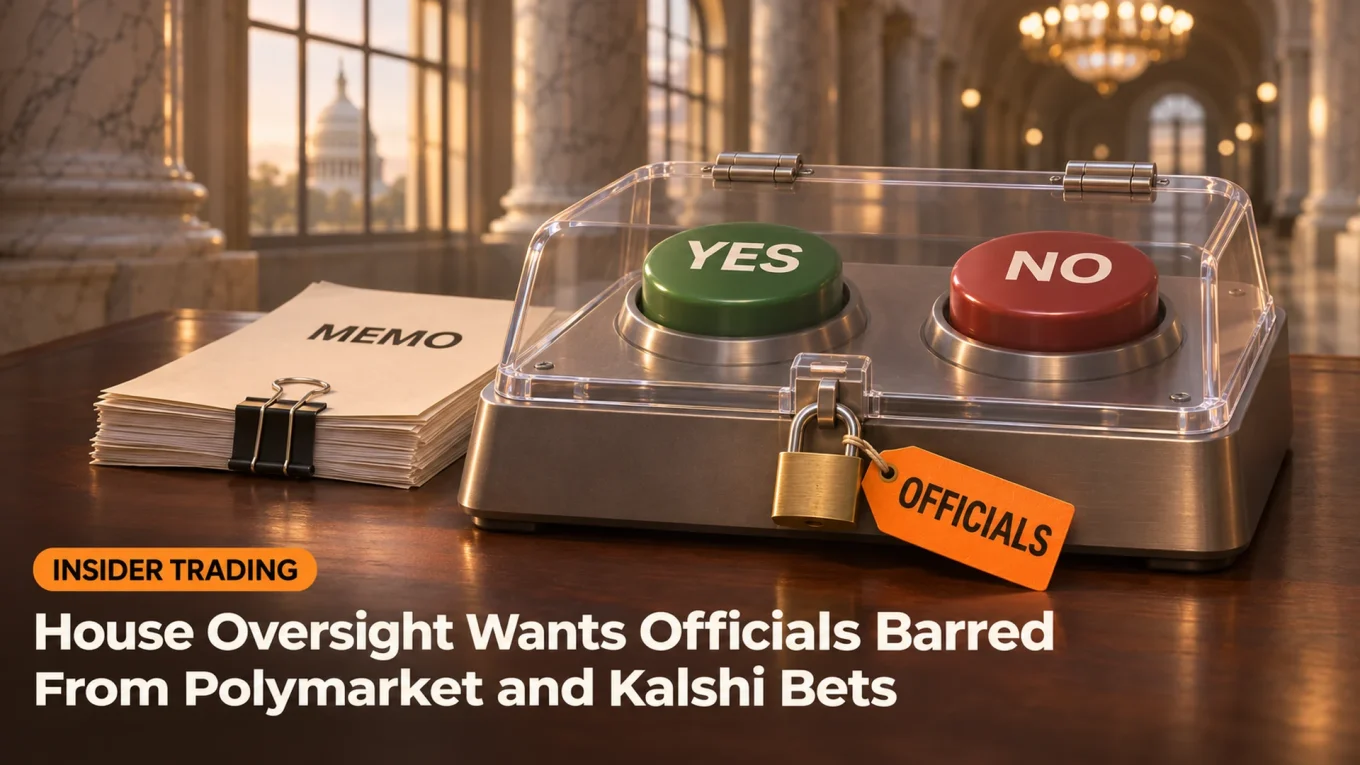
“Americans are rightly concerned about public corruption.” That is how Chairman James Comer (R-Ky.) introduced the House Oversight Committee’s staff memo on prediction markets insider trading, released on Friday, November 13. The committee went through nearly 1,700 pages of documents and held five bipartisan staff briefings with the platforms, and its ask is simple: government officials shouldn’t be betting on these markets, or at least not on contracts tied to their work.
No bill came with it. So what did the committee find, and what could change for people who trade on Polymarket and Kalshi?
The committee shared the memo on X with Comer’s call for reform:

NEW: Our memo on insider trading in prediction markets is out.
Chairman @RepJamesComer: “Congress must consider additional reforms to prevent public corruption.”
We reviewed nearly 1,700 pages and held five bipartisan staff briefings. 👇🏻oversight.house.gov/release/house-…
What Did the House Oversight Memo Find?
Suspicious trading, mostly caught by the platforms themselves. In the committee’s press release on the memo, staff say prediction markets found trades “indicative of insider trading”, and that political candidates and people close to major policy decisions have engaged in potential insider trading too.
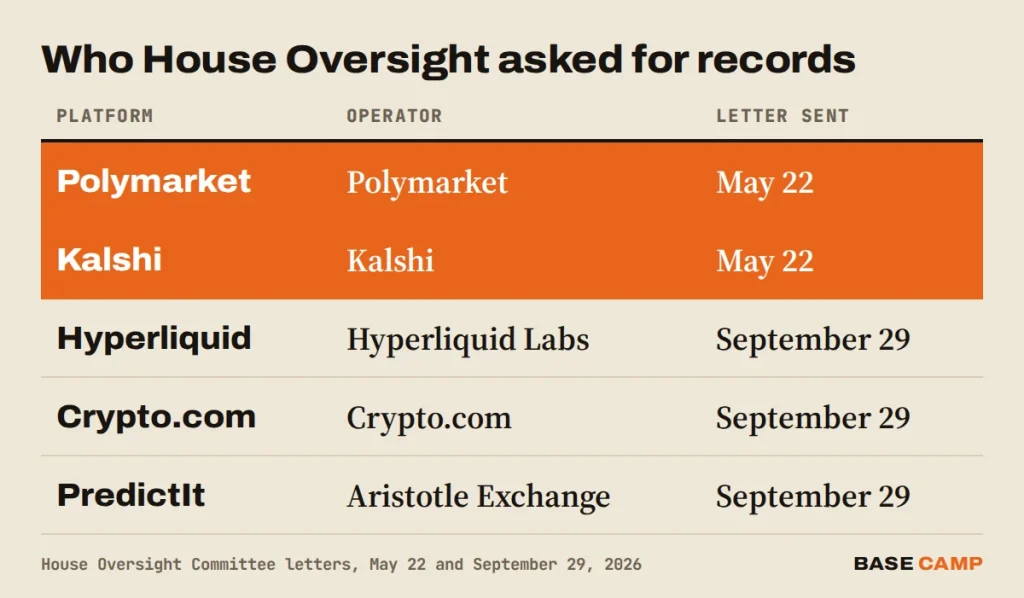
Those five platforms are the ones Comer wrote to this year: Polymarket and Kalshi in May, then Hyperliquid Labs, Crypto.com and PredictIt’s operator Aristotle Exchange on September 29. Four of the five handed over documents or briefed staff on how they spot suspicious trade patterns. The release doesn’t say which one didn’t.
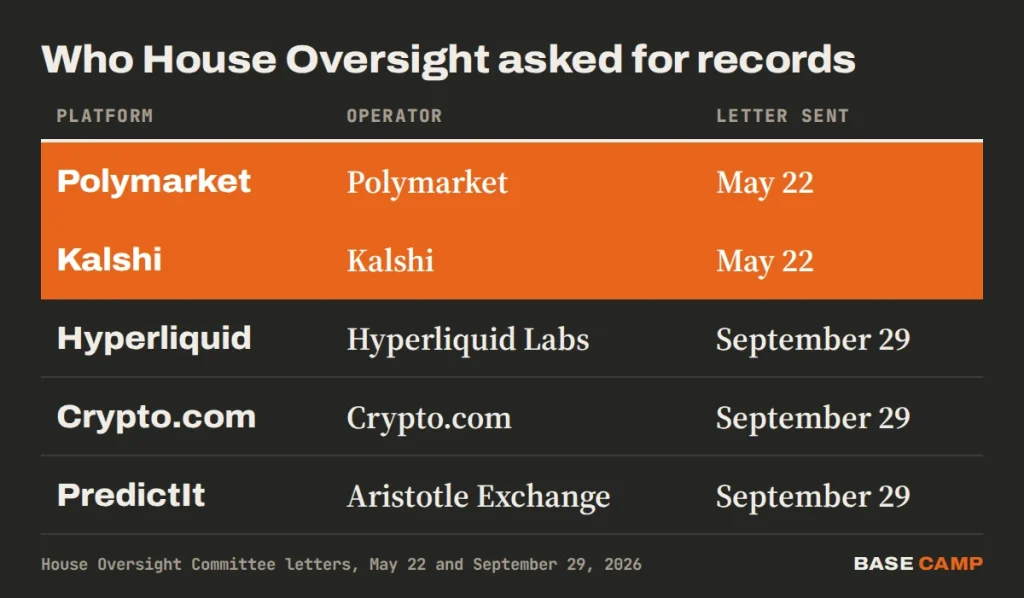
Most reported cases were first flagged to regulators and law enforcement by the markets, not by the government. Polymarket and Kalshi get credit for “robust improvements” in surveillance. Polymarket hired a former law enforcement expert to run a detection team and built a tool called PolyGraph with the analytics firm Chainalysis.
Sponsored · Affiliate link
Save 20% on fees trading on WEEX
Base Camp may earn a commission if you sign up. It never affects what we write.
Do Insider Trading Laws Already Cover Prediction Markets?
Yes. The memo says federal insider trading rules apply to event contracts just as they do to securities and derivatives. Section 4c(a)(3) of the Commodity Exchange Act, as amended by the STOCK Act, bars federal employees, Members of Congress, their staff and judicial officers from trading futures, options or swaps on nonpublic information from their jobs. Section 4c(a)(4) bars them from tipping off someone else who trades.
The Washington Times read the memo the same way, as a call for new laws on top of the old ones:

The Republican-controlled House Oversight Committee is calling for new laws to crack down on insider trading in prediction markets. trib.al/YfGaw0R
This all started with a Polymarket insider trading case. When Comer opened the probe on May 22, he pointed to a federal indictment unsealed on April 24 that alleges Army Master Sgt. Gannon Ken Van Dyke used classified information about the operation that captured Nicolás Maduro to bet on Polymarket, making more than $409,000. The Kalshi insider trading example in the same letters is tiny by comparison: gubernatorial candidate Kyle Langford placed a $200 bet on his own race in May 2025.
In other words, prediction markets insider trading laws already exist. What’s missing is a rule for officials who bet without any inside information at all.
SIDE TRAIL: Prediction Markets Under Pressure: Pentagon Bans Insider Bets, Polymarket Reportedly Fires Its CMO
Prediction Markets Insider Trading Rules: What Could Change
For most traders, nothing directly. The proposals target people on the government payroll, and they go further than today’s law in one way: they would apply whether or not someone uses inside information.
The memo gives Congress two routes, for officials in all three branches of government:
- An outright ban: federal personnel, Members of Congress and congressional staff can’t trade on prediction markets at all.
- A narrower limit: they can’t trade a subset of contracts, such as government-related markets.
It also wants platforms and regulators to share the information needed to enforce the rules.
Here is the chain worth watching. A ban on officials only works if platforms know who is an official. That means tighter identity checks for everyone, and identity checks were the first thing Comer asked both CEOs about in May. So even traders who never worked a day in government could feel it at sign-up.
This is a staff memo, though. Nothing becomes law until a bill passes both chambers, and none of these ideas has a bill number or a hearing date yet. The current Congress ends on January 3, and Democrats take the Senate majority after that.
TRAIL MAP: What Is a Prediction Market? The Base Camp Glossary
That leaves about seven weeks for a lame-duck Congress to act on a memo it only just received.

Teddy has been trading crypto since 2016. The focus is altcoins and EMA setups: finding coins sitting on key levels, waiting for support to hold or a range to be reclaimed, and trading the move from there. Bitcoin sets the tone, but the opportunities are usually in the alts.
More from Teddy