The short version
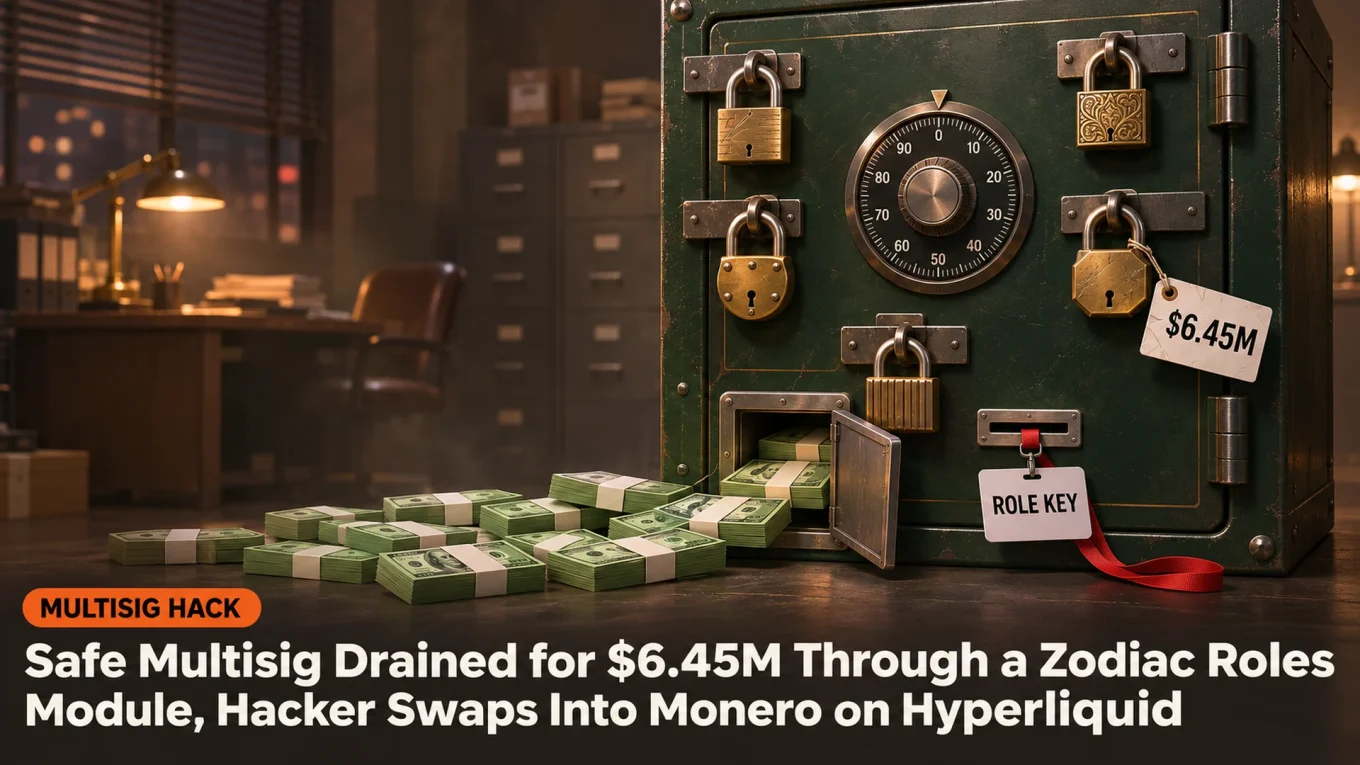
- Safe multisig drained: one Safe lost about $6.45 million in USDC and syrupUSDC on November 16, PeckShield says, and no owner signed the transaction.
- A role member key, likely compromised, moved the funds through a third-party Zodiac Roles module; Safe and Zodiac both say their contracts have no bug.
- The hacker has spent about $813,000 buying Monero on Hyperliquid, where the money is far harder to trace than in freezable USDC.
“No owner signed it.” That is how Safe described the transaction that emptied one of its multisig wallets on Monday, November 16, and it is the whole story in four words. A Safe multisig lost about $6.45 million in USDC and syrupUSDC, and the owners’ keys never moved.
The money left through a side door. A role member key, likely compromised, used a Zodiac Roles module the Safe had installed to send the funds out in one transaction. The hacker then started buying Monero (XMR) on Hyperliquid. So who held that key, and what was it allowed to do?
Blockchain security firm PeckShield flagged the drain at 14:46 UTC, citing the analyst Specter:

#PeckShieldAlert Specter has reported that a Gnosis Safe may have been compromised, resulting in $6.45M being drained, including $4.3M in $USDC and $1.7M in $syrupUSDC. The hacker has spent ~$813K to buy $XMR on Hyperliquid.
How Did a Role Key Drain a Safe Multisig?
Through permissions it was given on purpose. A multisig like Safe needs several owners to sign before money moves. A Zodiac Roles module (Zodiac calls it the Zodiac Roles Modifier) adds a shortcut: it lets the Safe hand chosen addresses, called role members, the right to make certain calls on their own, inside rules set in a policy.
That is handy for a treasury that rebalances every day. It also means one key can move money without the owners.
Here, that is exactly what happened. Safe said a role member’s key sent the transaction through a third-party Zodiac Roles module installed outside the Safe{Wallet} app. Safe’s own smart contracts and Safe{Wallet} were not affected, and only one multisig was hit.
Zodiac, the team behind the module, checked its code and came back clean:

We were informed of a potential theft from a Safe using the Zodiac Roles Modifier.
We found no contract vulnerability. A role member key, probably compromised, sent a transaction that a custom policy allowed but likely never intended.
In other words, the lock worked as built. The rules written into it allowed a transfer nobody meant to allow, and a stolen key used that gap.
Sponsored · Affiliate link
Save 20% on fees trading on WEEX
Base Camp may earn a commission if you sign up. It never affects what we write.
Where the Money Went
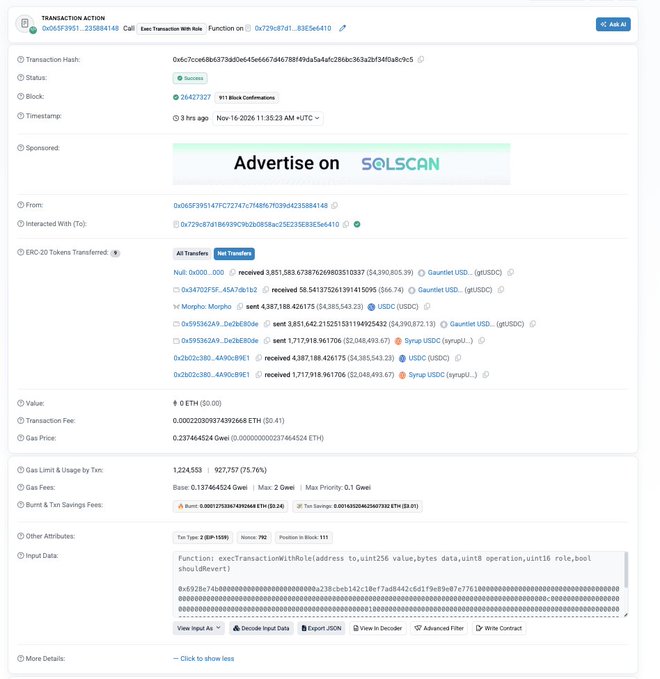
To one address, in one shot. The transaction hit Ethereum at 11:35 UTC on November 16, more than three hours before the first public alert.
It did three things at once. It redeemed the Safe’s vault shares on Morpho, a lending protocol, for USDC, then sent that USDC and a stack of syrupUSDC, Maple’s yield-bearing USDC token, to the hacker’s address.
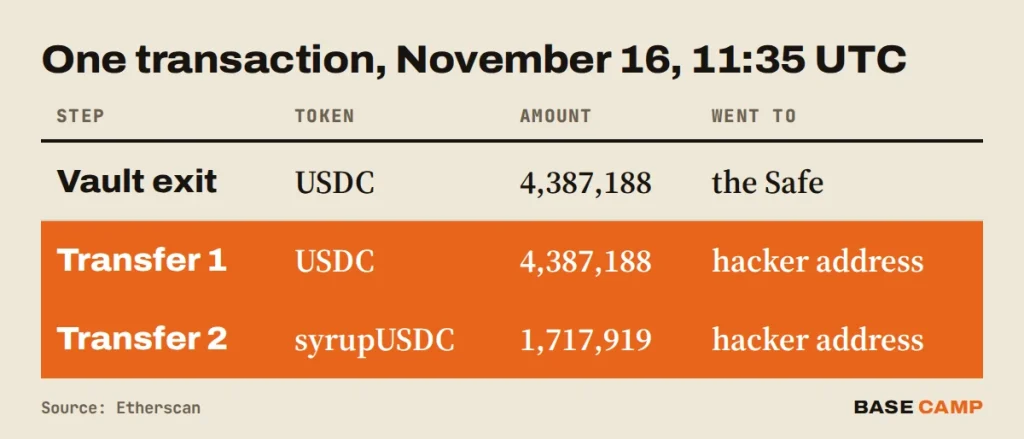
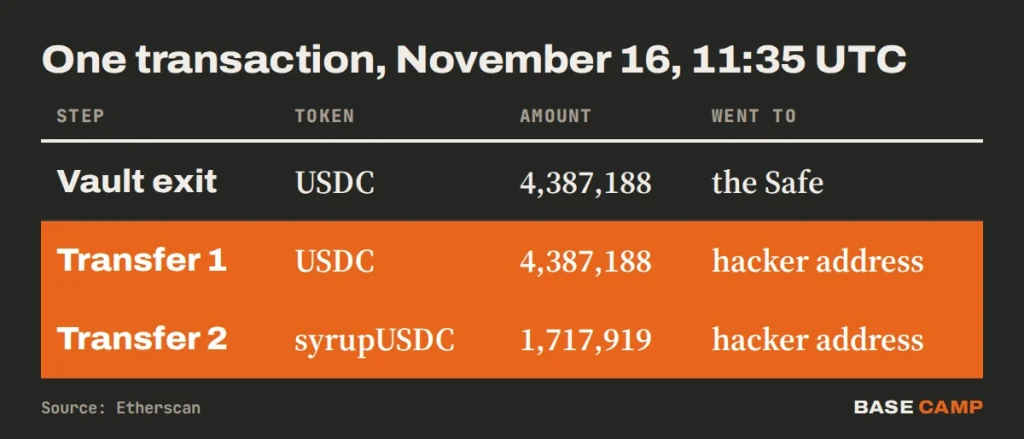
PeckShield puts the full haul at $6.45 million, with $4.3 million in USDC and $1.7 million in syrupUSDC. The hacker has since spent about $813,000 buying XMR on Hyperliquid, by PeckShield’s count.
Why Monero? It is a privacy coin. Senders, receivers and amounts are hidden by default, so once the money lands there, tracers mostly lose the trail. USDC is the opposite: Circle can freeze it at an address, which gives the hacker every reason to swap out fast.
SIDE TRAIL: Lighter Exploit Was Not a Protocol Hack: Compromised Account Lost $10.39M, Withdrawals Paused
What It Means for Teams Using Zodiac Roles
A Safe multisig is only as strict as the modules plugged into it. DAOs and funds use Roles so a manager or bot can farm yield without dragging every owner into every trade. That works until a role key leaks and its policy is wider than anyone thought.
The fix is not new code. Teams can read their own policies line by line: which tokens a role can touch, which addresses it can send to, and how much. A role that can move stablecoins to any address is, in practice, a single key with a multisig wrapped around it.
The victim has not been named. Nobody has said how the role key was compromised, either.
Monero trades at $503.53 at the time of writing, up 1.11% in 24 hours and down 9.16% over the week. An $813,000 buy barely shows up next to $202.4 million in daily XMR volume. The level to watch is the 24-hour low at $489.82.
As for the rest of the money, $6.45 million left that Safe, and the owners signed nothing.
TRAIL MAP: Biggest Crypto Hacks in History, Ranked: Binance’s $6.3B Breach Takes No. 1

Satoshi Flipper has more than 20 years of trading experience, starting in stocks before moving into crypto in 2017, and holds an MBA from the Kellogg School of Management. The edge is reading the economic data: rate decisions, inflation, jobs numbers, earnings and the US markets that move Bitcoin.
More from Satoshi Flipper