The short version
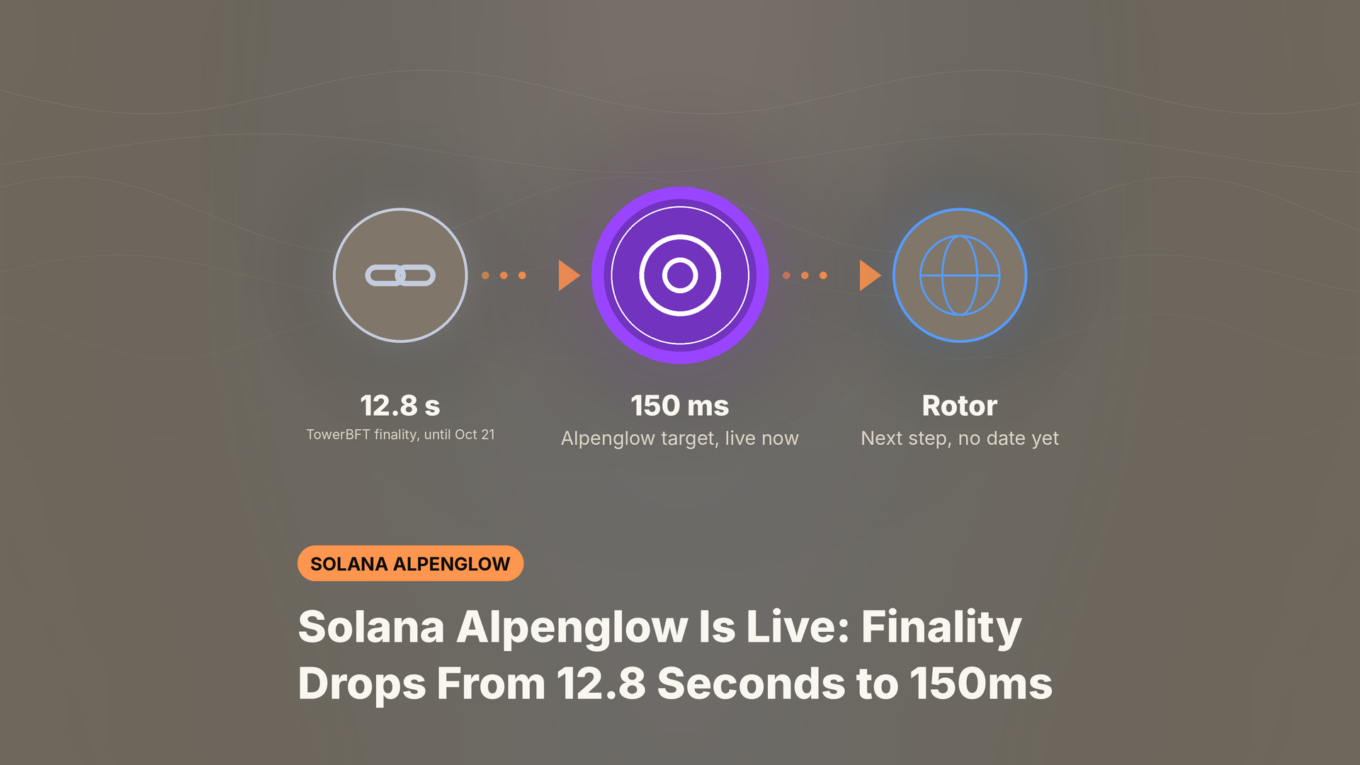
- Solana Alpenglow went live on mainnet on October 21, replacing a voting system that needed about 12.8 seconds to finalize with one that targets 150 milliseconds.
- The 150ms figure is still a target: the Solana Foundation’s dashboard showed 6.6-second finality shortly after launch, and Rotor, the second half, has no date.
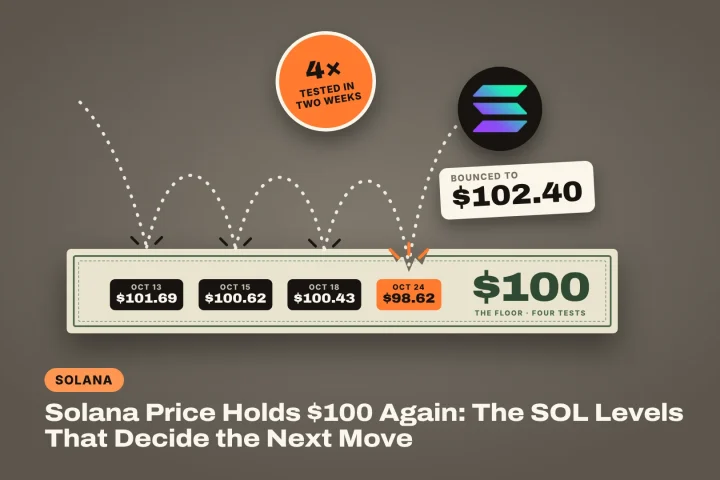
- SOL faded from $109.20 back to about $105, and the crew is watching for a daily close above $109.20 or below $100.40.
Solana Alpenglow went live on mainnet on Wednesday, October 21, and it is the biggest change to how the network agrees on anything since it launched. The old voting system, TowerBFT, needed about 12.8 seconds before a transaction was final. Alpenglow aims for about 150 milliseconds.
SOL barely blinked. The SOL price sits at $105.32 at the time of writing, down 0.36% over 24 hours, after a quick pop to $109.20 on launch day faded overnight. So what did the upgrade actually change, and why didn’t the price care?
Solana announced it on X:

Alpenglow is now live on Solana mainnet. ⛰️
Finality just went from ~12.8 seconds to ~150ms.
The biggest consensus upgrade in Solana’s history, built by @anza_xyz.
What Did Solana Alpenglow Change?
It changed how validators vote. How Solana runs transactions stays the same: programs, fees and wallets work exactly as before, according to the Solana Foundation’s upgrade page.
The live part is called Votor. Validators, the computers that confirm blocks, used to send their votes as ordinary transactions inside the blocks. Now they send them straight to each other and bundle them into certificates. If 80% of stake agrees in the first round, the block is final at once. A second round catches the rest. Slots, the network’s heartbeat, were also cut from 400 to 200 milliseconds this month.
Three details nobody puts in the headline:
- TPS charts just dropped, and that’s fine. Vote transactions are gone from blocks, so dashboards that count transactions per second now show a lower number. Real activity didn’t fall.
- “Confirmed” and “finalized” are now the same thing. That matters for apps and exchanges that wait for the safer of the two before crediting a deposit. How fast your exchange actually credits SOL is still its own call.
- Validators pay a flat fee now. Each one burns 0.8 SOL per epoch for the right to vote, instead of the roughly 1 SOL in vote fees it used to pay.
The second half, Rotor, isn’t here yet. It will replace Turbine, the system that spreads new blocks across the network, and the foundation hasn’t given it a date.
Is 150 Milliseconds Real Yet?
Not proven yet. The 150ms figure is Anza’s design target, and the Solana Foundation calls it “an expectation, not a constant.” Shortly after launch, the foundation’s own dashboard showed 6.6-second finality. That is already about half the old 12.8 seconds, but far from 150ms. Nobody outside Anza has published a mainnet measurement of Solana finality so far.
The switch itself went smoothly. That wasn’t a given: two days before launch, validator operator Pumpkin’s Pool counted 45.2% of staked SOL as “not fully ready,” and a day later about 20.3% was still unprepared, FinanceFeeds reported. Firedancer, a second validator client, wasn’t supported for the move. Still, the network kept producing blocks.
DISCOVER: What Is a Validator? Base Camp Glossary
Solana Price Analysis: Can SOL Break $109 After Alpenglow?
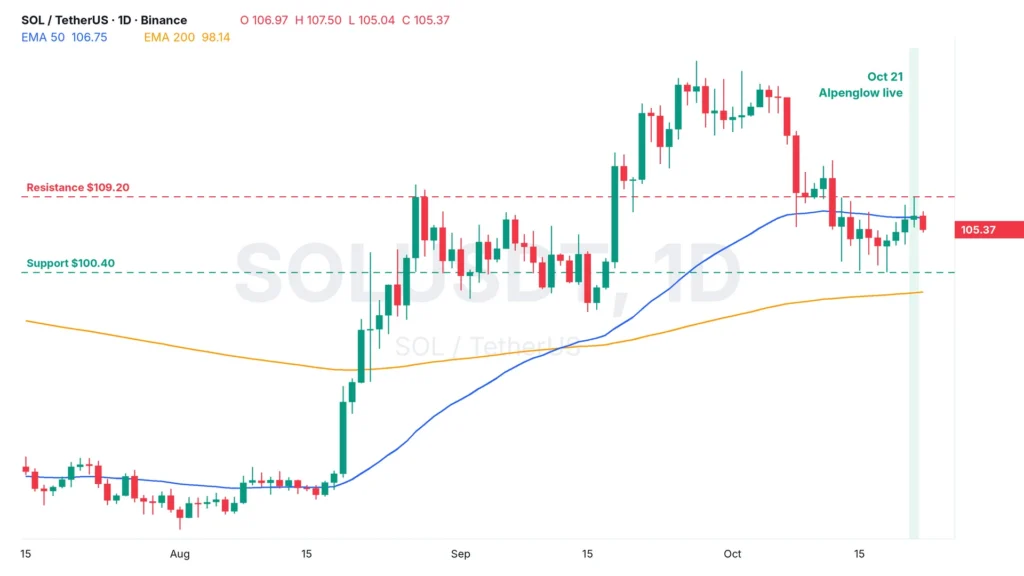
Not on this news alone. SOL has been stuck between about $100 and $109 since October 13, and Alpenglow day ended right back in the middle of that box. For context, the token is down roughly 42% over the past year, and a faster chain hasn’t changed that trend in a single day.
The price sits just under the 50-day exponential moving average (EMA), a trend line that gives recent prices more weight, at $106.75. The 200-day EMA at $98.14 is still below, so the bigger trend hasn’t broken.
- In the bull case, a daily close above the launch-day high of $109.20 would open the way to the October 12 high near $113.40.
- In the base case, SOL keeps chopping between $100.40 and $109.20 while traders wait for the first real finality numbers.
- In the bear case, a daily close below $100.40 would put the 200-day EMA at $98.14 back in play.
Sponsored · Affiliate link
Save 20% on fees trading on WEEX.
Base Camp may earn a commission if you sign up. It never affects what we write.
EXPLORE: Trendlines, Ranges and Breakouts: Drawing Them Right and Trading Them Better
The upgrade did its job: Solana switched consensus without stopping. What the market wants now is proof. If the dashboard numbers move toward 150ms over the coming weeks, Solana Alpenglow becomes a selling point. If they stay in the seconds, it was a good engineering day and nothing more.

On the climb since 2017. Trades futures and reads onchain data. Automates the boring parts.
More from VikingXBT →