The short version
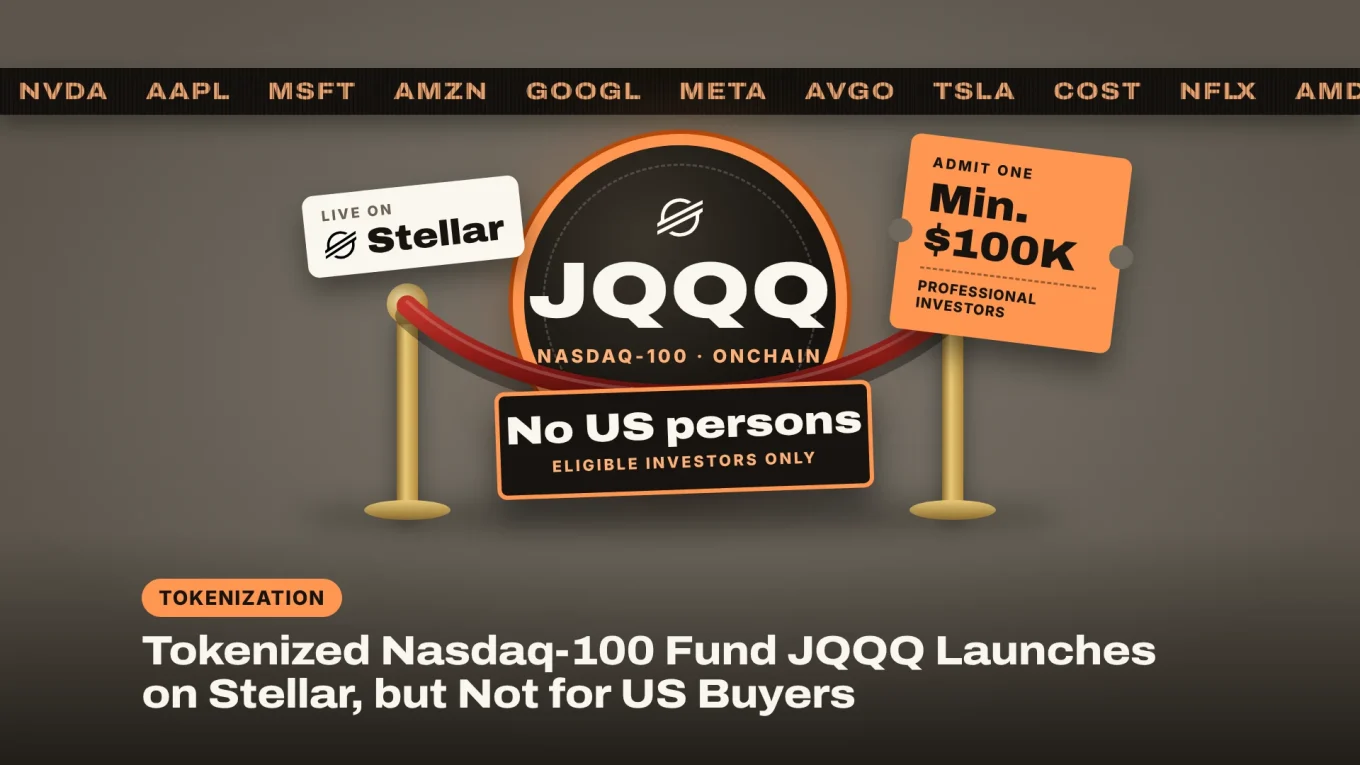
- Tokenized Nasdaq-100 fund JQQQ launched on Stellar on October 27, run by Janus Henderson and Centrifuge under a license from Nasdaq itself.
- It is closed to US persons and aimed at professional investors, with a $100,000 minimum, and holders own fund shares, not the 100 stocks.
- The crew is watching for a subscription start date, how much money the fund gathers, and XLM at $0.172, still below its 200-day average.
The first tokenized Nasdaq-100 fund with a license from Nasdaq is here, and American investors can’t buy it. Janus Henderson and Centrifuge launched JQQQ on Tuesday, October 27, a fund that tracks the 100 biggest non-financial companies on Nasdaq and lives on the Stellar blockchain from day one.
The catch sits in the fine print: no US persons, professional investors only. So what is JQQQ, who can buy it, and why did it land on Stellar instead of Ethereum or Solana?
Centrifuge announced the fund on X with a short launch video:

Introducing Janus Henderson Nasdaq-100 Index® Fund (JQQQ), the first blockchain-native Nasdaq-100® fund.
Launched by Janus Henderson Investors @JHIAdvisors and Centrifuge, the fund brings one of the world's most recognized equity benchmarks onchain through an issuer-sponsored
What Is JQQQ, the Tokenized Nasdaq-100 Fund?
JQQQ is a fund whose shares are tokens. Its full name is the Janus Henderson Nasdaq-100 Index Fund, and it is a segregated portfolio of Anemoy Capital SPC, a company in the British Virgin Islands, Centrifuge said in its announcement. Anemoy, Centrifuge’s asset manager, runs it; Janus Henderson’s US arm manages the portfolio as sub-manager; Nasdaq licenses the index but doesn’t sell or back the fund.
That license is the new part. Tokens that copy the price of Nvidia, Apple or a Nasdaq ETF already trade on several chains. JQQQ is a real fund built to track the index under Nasdaq’s own license, issued onchain rather than wrapped after the fact.
Holders don’t own the 100 stocks. They own fund shares with indirect exposure to the index, with no shareholder rights in the companies and no promise the fund matches the index exactly.
Who can buy it:
- Not US persons. Only eligible investors in places where the fund can legally be offered.
- Professionals with size. The Wall Street Journal reported a $100,000 minimum.
- No start date yet. The announcement gave no date for subscriptions and no fee rate.
Sponsored · Affiliate link
Save 20% on fees trading on WEEX
Base Camp may earn a commission if you sign up. It never affects what we write.
Why Is JQQQ on Stellar?
Because Stellar is chasing exactly this business, and the timing was picked with care. The Stellar Development Foundation’s Meridian conference runs in Lisbon on October 28 and 29, and the Centrifuge team speaks there about the launch.
Stellar holds about $3.8 billion in tokenized real-world assets, according to RWA.xyz. It already carries funds from Franklin Templeton and Spiko, and in May the DTCC, the plumbing behind US stock settlement, said it will connect its tokenization service to Stellar, with tokenized stocks, index ETFs and Treasuries expected in the first half of 2027.
Janus Henderson, which manages about $500 billion, has done this before. Its tokenized Treasury fund JTRSY and AAA credit fund JAAA came first, then the Janus Henderson Anemoy S&P 500 Fund on Base in September 2025. Nick Cherney, the firm’s head of innovation, says its onchain strategies now top $1 billion.
Centrifuge’s Anil Sood pitched the use case: tokenization “becomes much more powerful when the assets investors want to own can also become building blocks.” In plain words, a token can be posted as collateral or dropped into an automated portfolio. The release is careful there: any lending or collateral use would come from independent third parties, not from Janus Henderson.
The license itself only became possible this year. In April, Nasdaq ended Invesco’s decades of exclusivity on the Nasdaq-100, the index behind its QQQ ETF, and opened licensing to a select group of new partners.
SIDE TRAIL: Tokenized SpaceX Stock: How Crypto Traders Buy SPCX Onchain, and What They Really Own
Is XLM Price Reacting?
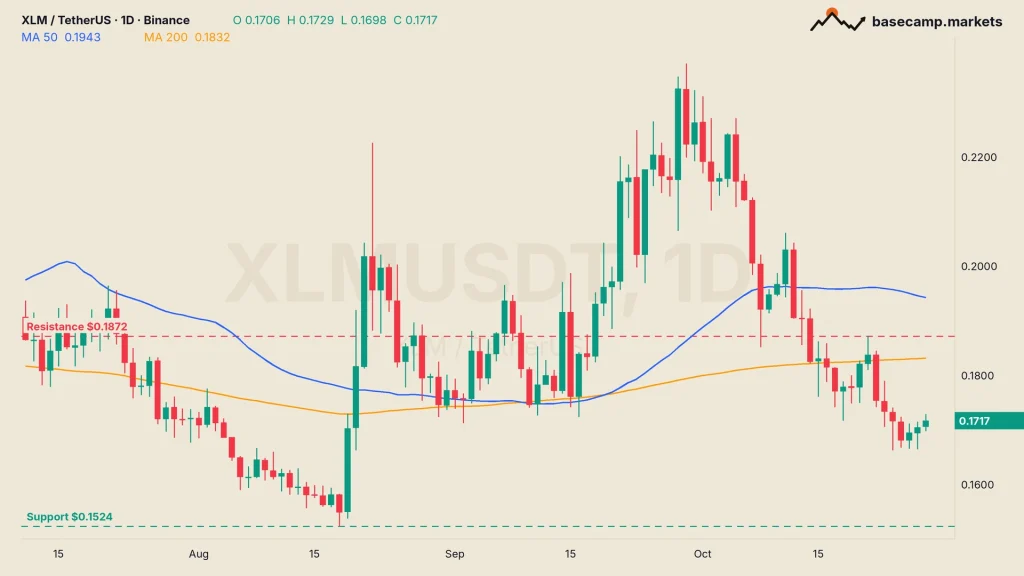
Barely. The XLM price is about $0.172 at the time of writing, up 2.7% over 24 hours but still 19% lower than a month ago. Price sits under both the 200-day moving average at $0.1832 and the 50-day at $0.1943, so the trend is still down; $0.1872 is the first real resistance, and the August low at $0.1524 is the support that matters.
Fund launches rarely move a token, and a tokenized Nasdaq-100 fund doesn’t need anyone to buy XLM. What would matter for Stellar is volume: a fund that gathers real money onchain, and the DTCC link going live next year.
TRAIL MAP: DeFi Basics: Swaps, Liquidity Pools and Impermanent Loss

In crypto since 2017, trading stocks for over 20 years. MBA. Follows the economic data and US markets closely.
More from Satoshi Flipper →