
The short version
- Futures let you bet on price going up (long) or down (short) without owning the coin. Perpetual futures (“perps”) never expire.
- Leverage lets you open a bigger position with less money. It does not change your risk if you size by your stop. It changes how close your liquidation is.
- At 10x, a move of roughly 10% against you wipes out your margin. At 50x, about 2%.
- Use isolated margin, set your stop well before your liquidation price, and size by risk, not by leverage.
On October 10, 2025, more than $19 billion of leveraged crypto positions were force-closed in about a day, the biggest liquidation event on record. Most of them were longs. Many of those traders were right about the long-term direction. It didn’t matter. Their leverage gave them no room to be early.
Futures and leverage are powerful tools, and plenty of professional traders use them every day. But they punish beginners faster than anything else in crypto. This guide explains how they work, so that if you use them, you do it on purpose.
Spot vs futures
When you buy on the spot market, you own the coin. If it falls 50%, you still own the coin and can wait.
A futures contract is an agreement about price, not the coin itself. You profit or lose on the price change. Two big differences:
- You can short: profit when price falls.
- You can use leverage: control a position bigger than your money.
Traditional futures have an expiry date. Crypto’s most popular product, the perpetual future or “perp,” doesn’t. You can hold it as long as you like, but you pay or receive a regular fee called funding that keeps its price close to spot. We cover funding in the next guide.
How leverage works
With 10x leverage, $1,000 of your money (the margin) controls a $10,000 position. Every 1% move in price is a 1% move on $10,000: $100, or 10% of your margin.
| Leverage | Margin for a $10,000 position | 1% move against you costs | Margin gone after roughly… |
|---|---|---|---|
| 1x | $10,000 | 1% of margin | 100% move |
| 3x | $3,333 | 3% of margin | 33% move |
| 10x | $1,000 | 10% of margin | 10% move |
| 25x | $400 | 25% of margin | 4% move |
| 50x | $200 | 50% of margin | 2% move |
| 100x | $100 | 100% of margin | 1% move |
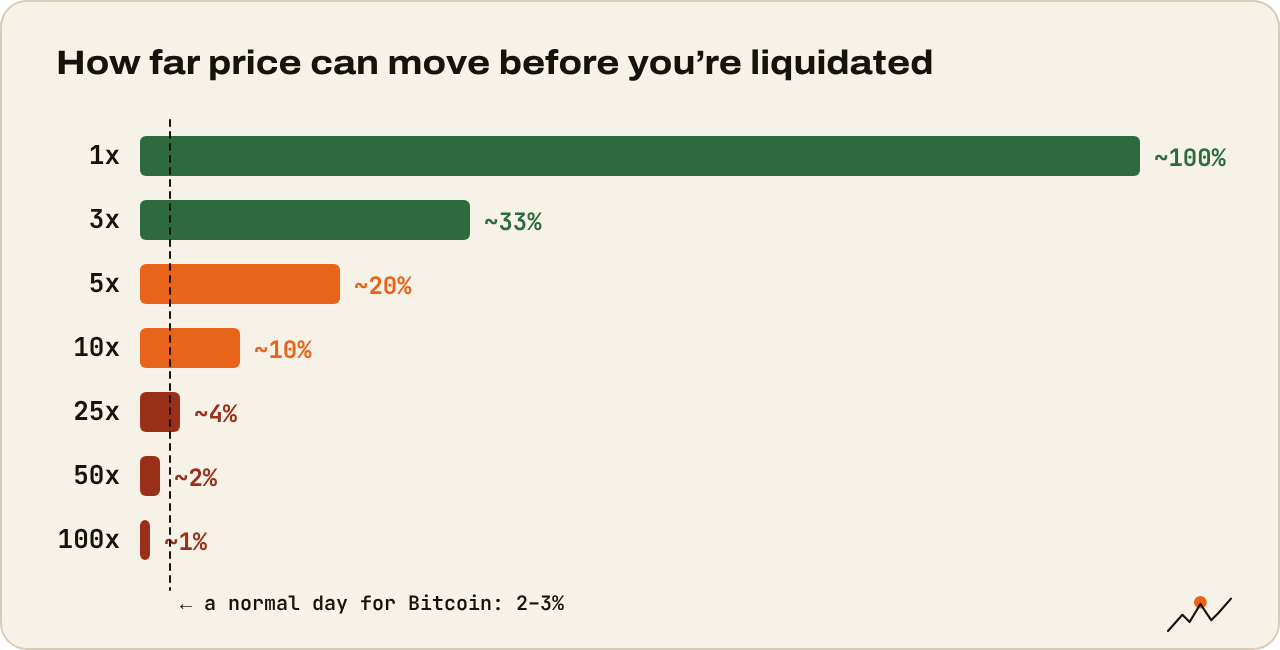
Bitcoin moves 2% on an ordinary afternoon. At 50x, that’s your whole margin.
Margin and liquidation
Two margin numbers matter:
- Initial margin: what you post to open the position (position size ÷ leverage).
- Maintenance margin: the minimum the exchange requires to keep it open, usually a small percentage of the position (around 0.4% to 1% for Bitcoin on major exchanges, higher for small coins and large positions).
When losses eat your margin down to the maintenance level, the exchange closes your position for you. That’s a liquidation. You lose the margin, often plus a liquidation fee.
A rough formula for an isolated long:
Liquidation price ≈ entry × (1 − 1/leverage + maintenance margin rate)
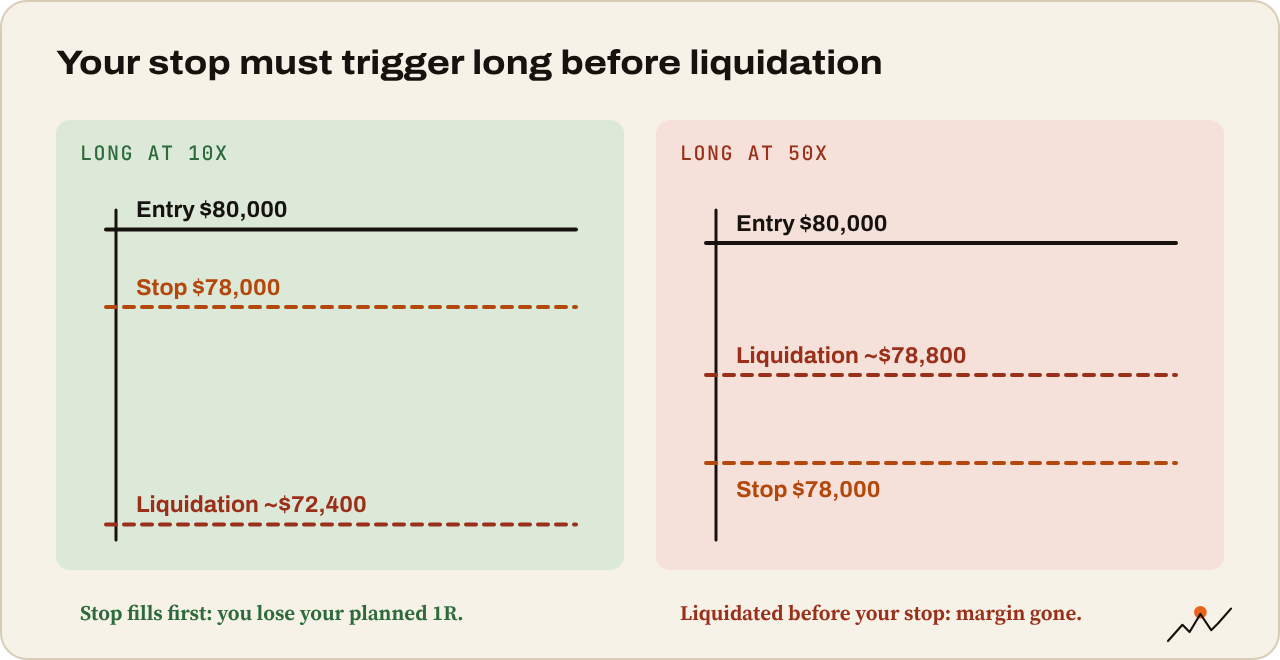
Example: long Bitcoin at $80,000 with 10x and a 0.5% maintenance rate. $80,000 × (1 − 0.10 + 0.005) = about $72,400, a 9.5% drop.
For a short it flips: entry × (1 + 1/leverage − maintenance rate). Exchanges add fees and use their own tiers, so always check the exact number on the order screen. Our calculator gives you a quick estimate:
Base Camp tool
Liquidation price calculator
Where a leveraged position gets force-closed. More leverage puts it closer to your entry.
A simplified estimate. Exchanges also count fees, funding and tiered margin, so always check the liquidation price your exchange shows. For learning only, not financial advice.
Mark price, not last price
Exchanges liquidate based on the mark price, a fair price built from several spot exchanges, not the last trade on their own order book. This protects you from one weird spike on a single exchange. It doesn’t protect you from a real move across the whole market, which is what happened in October 2025.
Isolated vs cross margin
- Isolated margin: each position has its own margin. If it’s liquidated, you lose only that margin. Simple and contained.
- Cross margin: all your positions share your whole futures balance. A losing position can draw on everything in the account before it’s liquidated. Liquidation is further away, but you can lose much more.
Beginners should use isolated margin. Cross margin is for traders who manage several positions as one book and know exactly what they’re doing.
Leverage doesn’t set your risk. Size does.
This is the most misunderstood idea in futures. Two traders:
- Trader A has $10,000 and opens a $5,000 long at 2x with a stop 2% below entry. Loss at the stop: $100.
- Trader B opens the same $5,000 long at 20x, posting only $250 of margin, with the same stop. Loss at the stop: still $100.
Same risk. Trader B just keeps less money on the exchange. Leverage is dangerous when people size by margin (“I’ll put $500 in at 20x” is a $10,000 position) or skip the stop and let the liquidation price be their exit.
The safe way to use leverage:
- Decide your risk per trade (say 1%). See Risk management.
- Put your stop where the trade idea is wrong.
- Calculate position size from risk and stop distance.
- Choose leverage only so that your liquidation price sits far beyond your stop. Your stop should always trigger first, with plenty of room.
Insurance funds and auto-deleveraging
When a liquidation can’t be filled at a price that covers the trader’s losses, the exchange’s insurance fund pays the difference. In extreme moves, when the fund isn’t enough, some exchanges use auto-deleveraging (ADL): they close profitable positions on the other side to balance the books. In October 2025, many traders who were in profit had their winning positions cut this way. Even being right has risks in a crash.
Where you can (and can’t) trade futures
Rules vary a lot. The UK has banned crypto derivatives for retail customers since 2021. In the US, most offshore perp exchanges don’t accept customers, though regulated futures exist. In the EU, they’re offered under financial-market rules with leverage limits. Decentralized perp exchanges also exist, with their own smart-contract risks. Check what’s legal where you live before signing up.
Watch out. The October 2025 wipeout is the normal outcome of high leverage, not a freak event. Exchanges make money from your fees and liquidations whether you win or lose. If you’re new to trading, start on spot. If you use futures, stay at low leverage, use isolated margin, and never trade without a stop.
Before every leveraged trade
- I sized the position from my risk and stop, not from my margin
- I’m using isolated margin
- My liquidation price is far beyond my stop-loss
- The stop is placed on the exchange, not in my head
- I know the funding rate and how much holding costs per day
- I’m not using leverage to win back a loss
Tip. dYdX Academy’s What Are Perpetual Contracts and How Funding Rates Work covers perps in five minutes.
Where to go next
Every perp has a heartbeat called funding, and every market has a measure of how much leverage is in it. Next: Funding rates and open interest.

On the climb since 2017. Trades futures and reads onchain data. Automates the boring parts.
More from VikingXBT →