The short version
- USD1 stablecoin: World Liberty Financial’s $2.8 billion coin fell to $0.94 on Binance on November 28 and trades at $0.987 at the time of writing.
- The break came hours after the WLFI crash, with Binance trading about $364 million of USD1 in 24 hours.
- Supply was already shrinking: DefiLlama shows $2.81 billion in circulation, down 27% from $3.87 billion a month ago.
- Next: whether USD1 gets back above $0.997 or slips under Saturday’s $0.94 low.
“Better safe than sorry,” Liberty Swap wrote as it pulled the USD1 stablecoin from its exchange on Saturday morning. A few minutes earlier, World Liberty Financial’s $2.8 billion coin had dropped to $0.94 on Binance. It trades at $0.987 at the time of writing.
That’s a 6% drop for a coin built to sit at exactly $1, and the bounce since hasn’t closed the gap. Binance alone traded about $364 million of USD1 against Tether over the past 24 hours, most of it after the slide began.
So what knocked it off, and is the money behind USD1 actually at risk?
Liberty Swap, a small PulseChain exchange, still said USD1 hadn’t depegged when it suspended it:

Although USD1 has not depegged, given the sharp decline in World Liberty Financial–associated tokens and ongoing asset liquidations, we have temporarily suspended support for USD1 as a precautionary risk management measure.
We may reinstate support for the stablecoin once we
When Did USD1 Lose Its Peg?
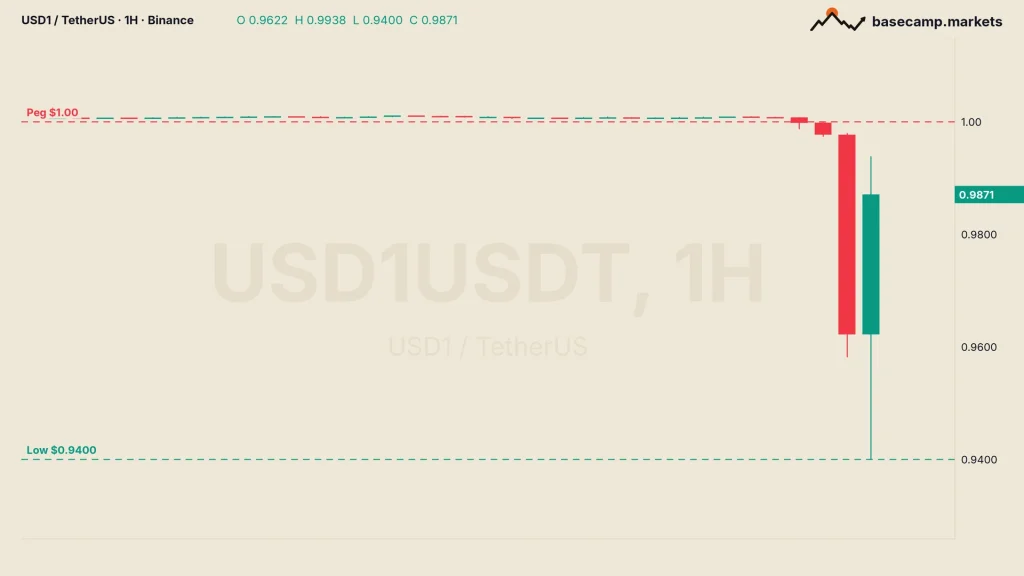
Hours after the WLFI crash, not during it. Binance’s hourly candles show the discount growing in steps:
- Until 04:00 UTC: USD1 held between $1.0007 and $1.0009, where it had sat all night.
- 04:00 to 06:00 UTC: the first small slips, to $0.9987 and then $0.9973.
- 06:00 to 07:00 UTC: the real break, down to $0.9582, with the hour closing at $0.9622.
- 07:00 UTC onwards: a wick to $0.94, then a bounce back toward $0.99.
By the time USD1 hit its low, World Liberty’s governance token, WLFI, had already crashed overnight. The stablecoin took the second hit, once the selling moved from the project’s token to its dollar.
Sponsored · Affiliate link
Save 20% on fees trading on WEEX
Base Camp may earn a commission if you sign up. It never affects what we write.
Why the USD1 Stablecoin Slipped
The chain from one wallet to a stablecoin discount is short:
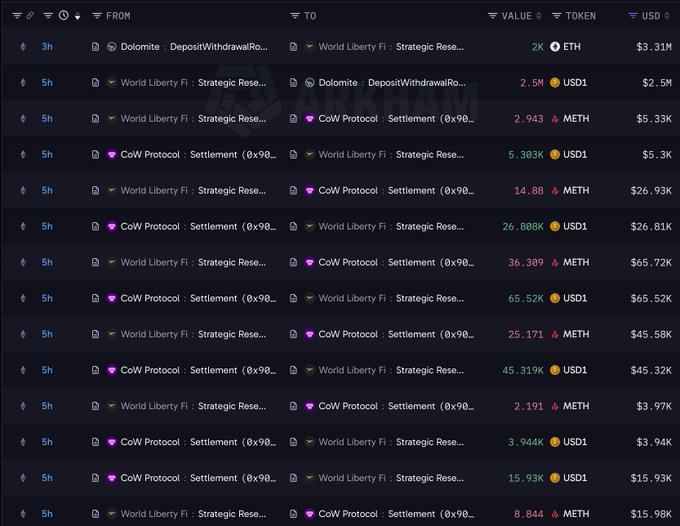
- A reserve wallet sold at a loss. Late on November 27 UTC, a World Liberty wallet sold 10,600 ETH for $17.58 million and 1,378 mETH for $2.48 million. Part of the proceeds came back as USD1.
- WLFI holders ran. The project’s own token crashed in the hours that followed.
- The fear spilled into USD1. People who stop trusting the project dump its stablecoin too, and only BitGo’s onboarded clients can swap it for dollars directly. Everyone else sells on an exchange, at whatever the order book pays on a Saturday morning.
Lookonchain spotted the sale first:

WLFI(@worldlibertyfi) sold 10,600 $ETH($17.58M) and 1,378 $mETH($2.48M) 4 hours ago.
arkm.com/explorer/entit…
The USD1 stablecoin’s supply was shrinking well before this. DefiLlama counts $2.81 billion of USD1 in circulation, down from $3.87 billion a month ago. That’s more than $1 billion, or 27%, gone in 30 days.
Binance users are caught in the middle. The exchange has run a string of campaigns paying WLFI tokens to people who hold USD1 there, 150 million WLFI in the September round alone. Anyone who parked dollars in USD1 for those rewards now holds a stablecoin under $1 and reward tokens worth far less. Yield on a stablecoin is never free; the risk just sits where you aren’t looking.
SIDE TRAIL: Stablecoin Supply Falls to $301.6B as USDC Drops $4.15B
Are USD1’s Reserves the Problem?
Nothing so far says they are. World Liberty’s own docs say USD1 is “backed by cash, U.S. government money market funds, and other cash equivalents,” and that all reserve assets “are held or maintained by BitGo,” which issues the coin. The ETH that was sold came from World Liberty’s own reserve wallet, a separate pot from the dollars behind USD1.
The catch is access. The same docs say only “eligible customers of BitGo” can redeem USD1 for dollars directly. For everyone else the exit is an exchange, which is how a fully backed coin can still print $0.94 for a few minutes on a thin weekend book. That’s the textbook depeg: a confidence problem first, and a reserve problem only if redemptions start to fail.
We found no statement on the USD1 depeg from World Liberty or BitGo at the time of writing.
USD1 Price: The Areas to Watch
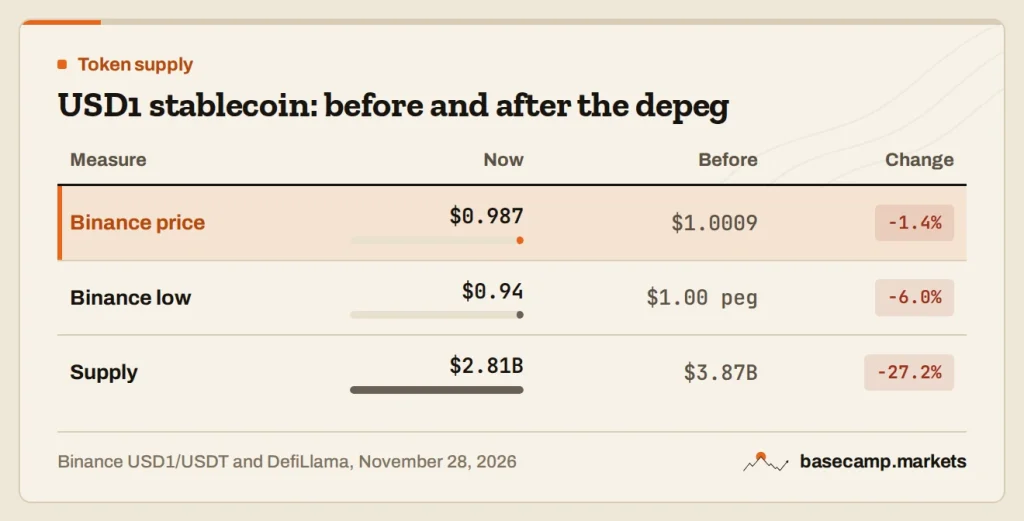
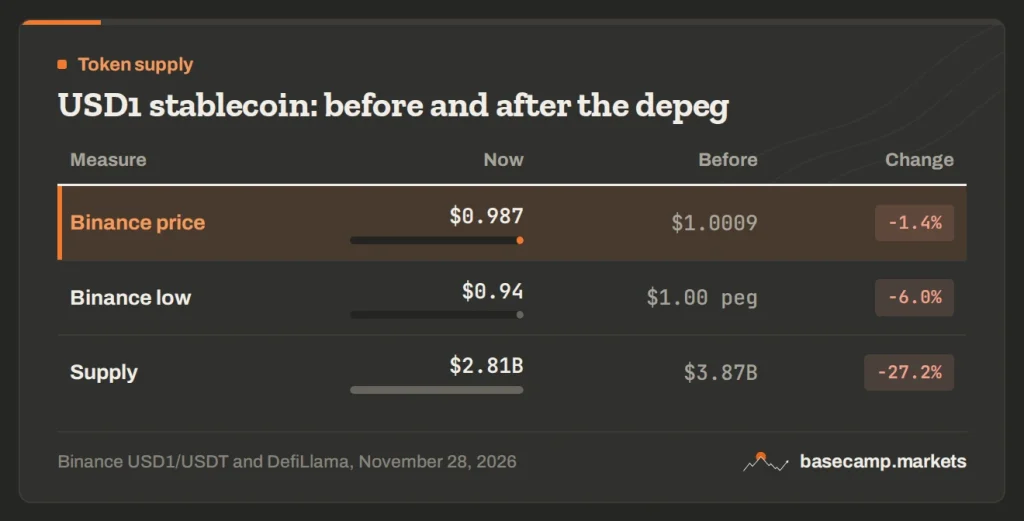
The “before” column is the price 24 hours ago, the peg itself and the supply a month ago. At $0.987, anyone who can redeem through BitGo buys a dollar for about 98.7 cents, and that trade is what normally closes a gap like this. The levels that tell you whether it’s working:
- $1.00: the peg. A move back above $0.997 would put USD1 near where it traded all night before the drop.
- $0.96: the 06:00 UTC close, where USD1 sat right before the wick. A return there would mean the bounce has faded.
- $0.94: Saturday’s low. A break under it would turn a weekend wobble into something closer to a run.
TRAIL MAP: Elizabeth Warren Senate Banking Plans Target Trump Crypto
USD1 has lost more than $1 billion of supply in a month, and the next week’s supply count will say more about trust in it than any single wick.

Teddy has been trading crypto since 2016. The focus is altcoins and EMA setups: finding coins sitting on key levels, waiting for support to hold or a range to be reclaimed, and trading the move from there. Bitcoin sets the tone, but the opportunities are usually in the alts.
More from Teddy