
The short version
- Crypto transfers are final. There’s no bank to call and no “undo.”
- The sender and the receiver must use the same network. USDT on Tron and USDT on Ethereum are not interchangeable.
- Check the whole address, add the memo or tag if one is required, and keep a little of the network’s coin for fees.
- Send a small test first. Every time it’s a new address or a big amount.
Sending crypto feels like sending a bank transfer, right up to the moment something goes wrong. Then you find out there’s no helpline, no chargeback and no one who can reverse it.
Most lost coins aren’t stolen. They’re sent to the wrong network, the wrong address, or without a memo. All three are easy to avoid once you know what to check, and that’s what this guide covers.
Why crypto transfers can’t be undone
When you send crypto, your wallet signs a transaction and broadcasts it to the network. Once it lands in a block and gets a few confirmations, it’s permanent. No company sits in the middle with the power to reverse it.
That’s the point of crypto, and it cuts both ways. Nobody can freeze your payment, and nobody can fix your typo. So the checking happens before you press Send, not after.
The anatomy of a transfer
Every crypto transfer has four parts:
- The asset: what you send (BTC, ETH, USDT…).
- The network: which blockchain carries it (Bitcoin, Ethereum, Solana, Tron, Base…).
- The address: where it goes.
- The fee: what you pay the network to process it, often called gas.
Some transfers have a fifth part, a memo or tag. We’ll get to that.
Step 1: Match the network
This is the mistake that catches the most people. Many coins exist on several blockchains at once. USDT, for example, lives on Ethereum, Tron, Solana, BNB Chain, Arbitrum and more. Each version is a different token on a different network.
When you withdraw from an exchange, it asks which network to use. When you deposit, the receiving side shows which networks it accepts. Both must match. Send USDT over Tron to an address that only accepts USDT on Ethereum, and at best you’ll wait weeks for a manual recovery with a fee. At worst, it’s gone.
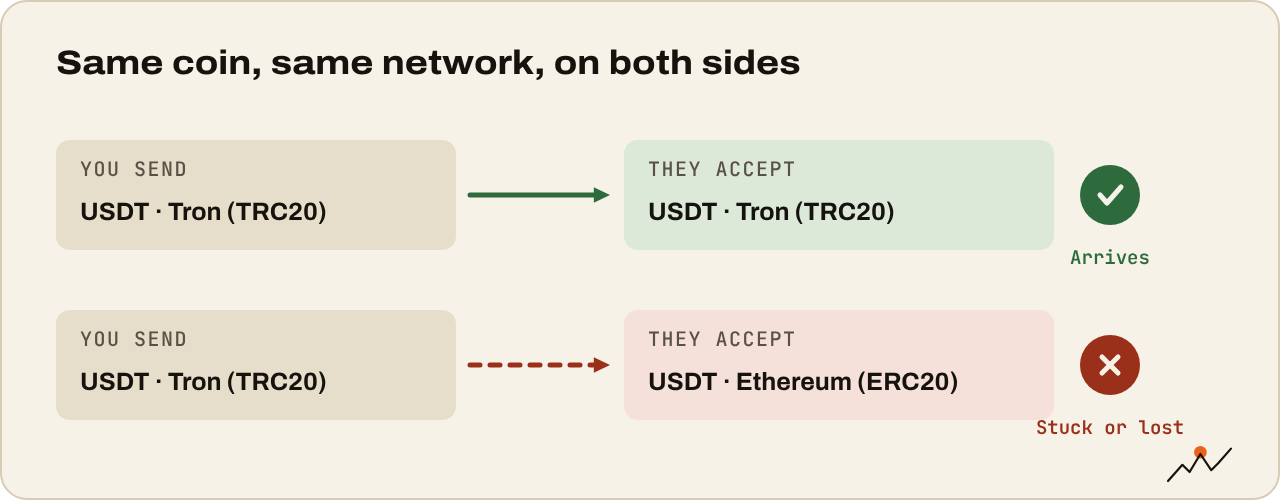
How to get it right:
- On the receiving side, open the deposit screen, pick the coin, then pick the network. Copy the address for that network.
- On the sending side, pick the same coin and exactly the same network.
- If the networks offered don’t overlap, don’t send. Swap or pick another route.
Watch out. Similar names aren’t the same network. “BNB Smart Chain (BEP20)” is not “Ethereum (ERC20),” and “Base” is not “Ethereum” even though both use addresses starting with 0x. The same-looking address can exist on many networks; the network decides where the coins go.
Step 2: Check the address properly
Crypto addresses are long strings like bc1q… (Bitcoin) or 0x… (Ethereum and similar networks). Nobody types them by hand, so you copy and paste. That opens two traps:
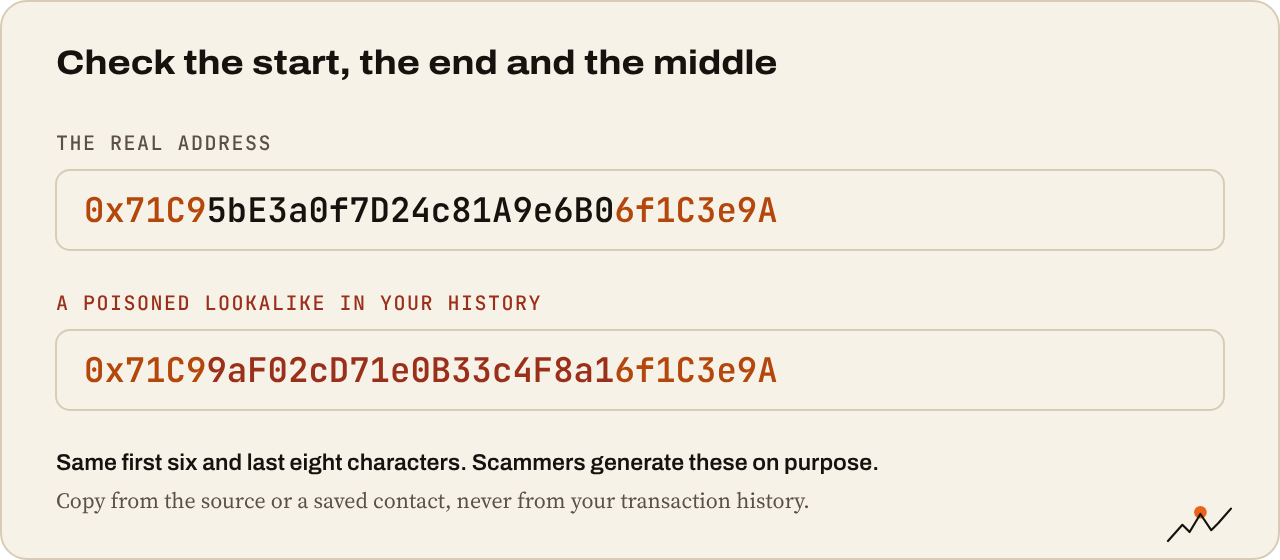
- Clipboard malware swaps the address you copied for the attacker’s.
- Address poisoning: scammers send tiny transactions from lookalike addresses, so a fake one sits in your history waiting to be copied by mistake.
The fix is a routine:
- Copy the address from the source (the receiver’s deposit screen or a saved contact), never from your transaction history.
- After pasting, check the first six and last six characters, then a few in the middle.
- For addresses you use often, save them as contacts or in your exchange’s withdrawal allowlist.
- For big amounts, confirm the address through a second channel, like a call with the person you’re paying.
Step 3: Add the memo or tag if needed
Some networks (XRP, Stellar, Cosmos, TON, Hedera and others) use one shared deposit address for everyone on an exchange, plus a memo or tag that says which account the coins belong to. If the exchange shows a memo, tag or “destination tag” on its deposit screen, you must include it.
Forget it and your coins arrive at the exchange with no name on them. Support can usually find them, but it takes days and sometimes a fee.
Step 4: Have enough for the fee
Every network charges a fee in its own coin. To send USDT on Ethereum, you need some ETH in the same wallet to pay the gas. To send USDT on Tron, you need TRX. On Solana, you need SOL.
From an exchange this is handled for you: the fee is taken from the amount. From your own wallet, keep a little of the network’s coin around, or you’ll be stuck with tokens you can’t move.
Fees change with how busy the network is. Bitcoin fees can go from well under a dollar in quiet times to much more during a rush. Ethereum fees dropped to cents or less in 2026 after upgrades raised capacity. Many Layer 2 networks cost a fraction of a cent. Our gas calculator turns a fee in gwei into dollars:
Base Camp tool
Gas fee calculator
What an Ethereum transaction costs, from the gas price in gwei.
For learning only, not financial advice.
Step 5: Send a test first
Before sending a large amount, or anything to a new address, send a small test, wait until it arrives, then send the rest.
Yes, it costs a second fee. Think of it as the cheapest insurance in crypto. A $1 fee to make sure $5,000 arrives is a bargain.
Track it on a block explorer
Every transaction gets an ID, called a transaction hash. Paste it into a block explorer to watch it in real time:
- Bitcoin: mempool.space
- Ethereum: etherscan.io
- Solana: solscan.io
- Tron: tronscan.org
You’ll see whether it’s pending, how many confirmations it has, and the exact address it went to. Exchanges often wait for a set number of confirmations before crediting a deposit, so “sent” and “arrived” can be minutes apart.
Your pre-send checklist
- Same coin and same network on both sides
- Address copied from the source, not from my history
- First six, last six and some middle characters checked
- Memo or tag added if the receiver shows one
- Enough of the network’s coin in my wallet for the fee
- Small test sent and confirmed for new addresses or big amounts
If something went wrong
- Wrong network, but to an exchange: contact the exchange’s support through its app with the transaction hash. Some can recover it, usually for a fee.
- Missing memo or tag: contact the receiving exchange with the hash and your account details.
- Wrong address: if it’s a random address, the coins are almost certainly lost. If it belongs to a known person or company, ask them.
- Anyone offering to “recover” funds for an upfront fee is running a scam. See The 10 most common crypto scams.
Where to go next
You’ve finished Stay safe. Now for the fun part: reading the market. The First charts series starts with What is a crypto chart, anyway?

On the climb since 2017. Trades futures and reads onchain data. Automates the boring parts.
More from VikingXBT →