
The short version
- Election night 2026 starts at 23:00 UTC (6 p.m. ET), and Kalshi gives Democrats a 94% chance of winning the House and 76% for the Senate, up from 65% a week ago.
- It matters for crypto because the Senate decides who writes the next crypto bill, and its key races close between 00:30 UTC (Ohio, North Carolina) and 02:00 UTC (Texas, Iowa).
- Next: Ohio at 00:30 UTC, where Fairshake spent $55 million against Sherrod Brown. Follow Base Camp on X through the night for the results that matter to crypto.
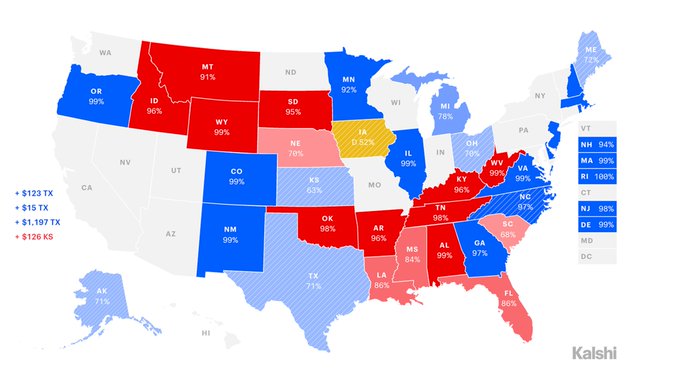
Election night 2026 starts at 23:00 UTC on Tuesday, when the first polls close in Indiana and Kentucky, and it won’t really end until Alaska finishes counting. In between sit the handful of Senate races that decide who writes the next crypto bill. Kalshi traders give Democrats a 94% chance of winning the House and 76% for the Senate at the time of writing, up from 65% a week ago.
The House looks settled before a single vote is counted. The Senate doesn’t, so that’s where the midterms crypto fight happens tonight. Here is when each race closes, in UTC and Eastern Time, and what to watch as the numbers come in.
Kalshi flagged the Senate move on Monday night, less than a day before the vote:

BREAKING: 75% chance Democrats control the Senate less than 1 day before election
Election Night 2026: When Do Polls Close?
The first polls close at 23:00 UTC (6 p.m. ET) and the last at 06:00 UTC on Wednesday (1 a.m. ET), according to 270toWin’s state list. The races that matter most for crypto close between 00:30 and 02:00 UTC, so the picture usually takes shape before Asia’s lunch break.
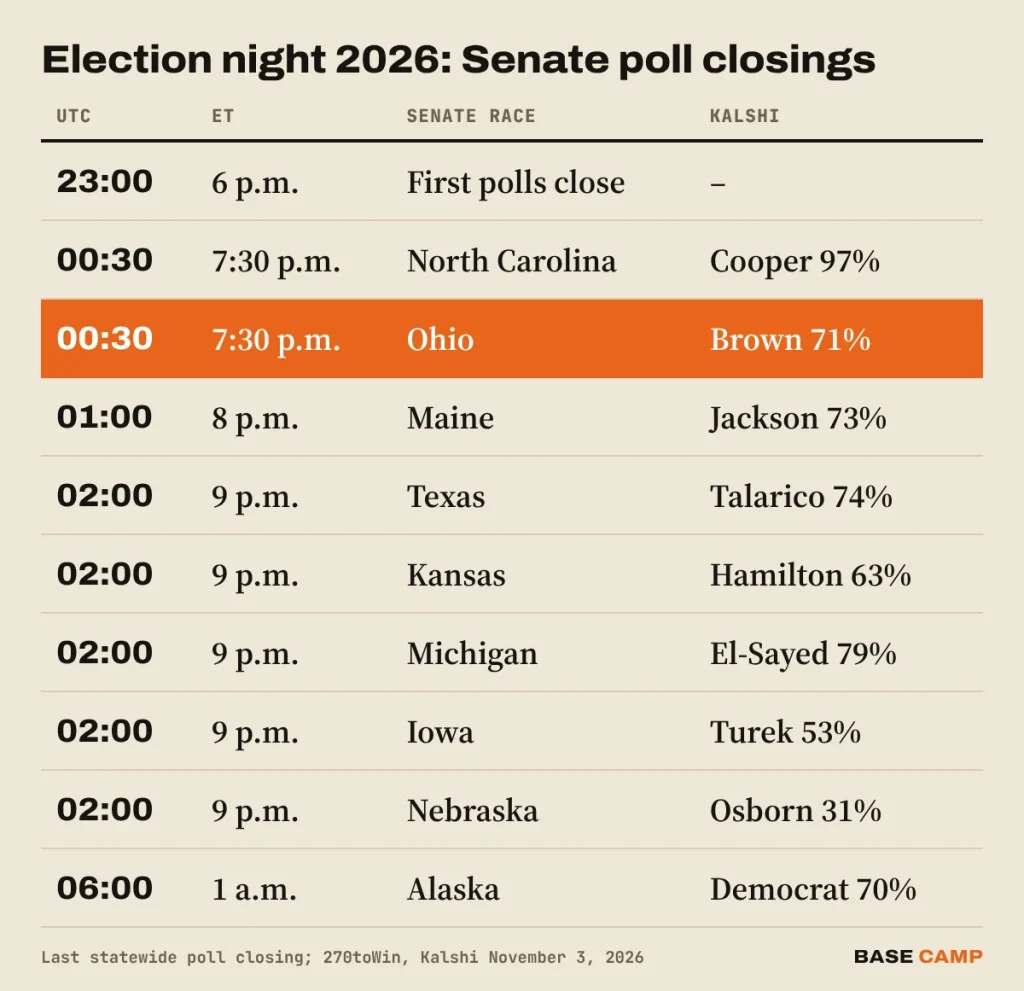
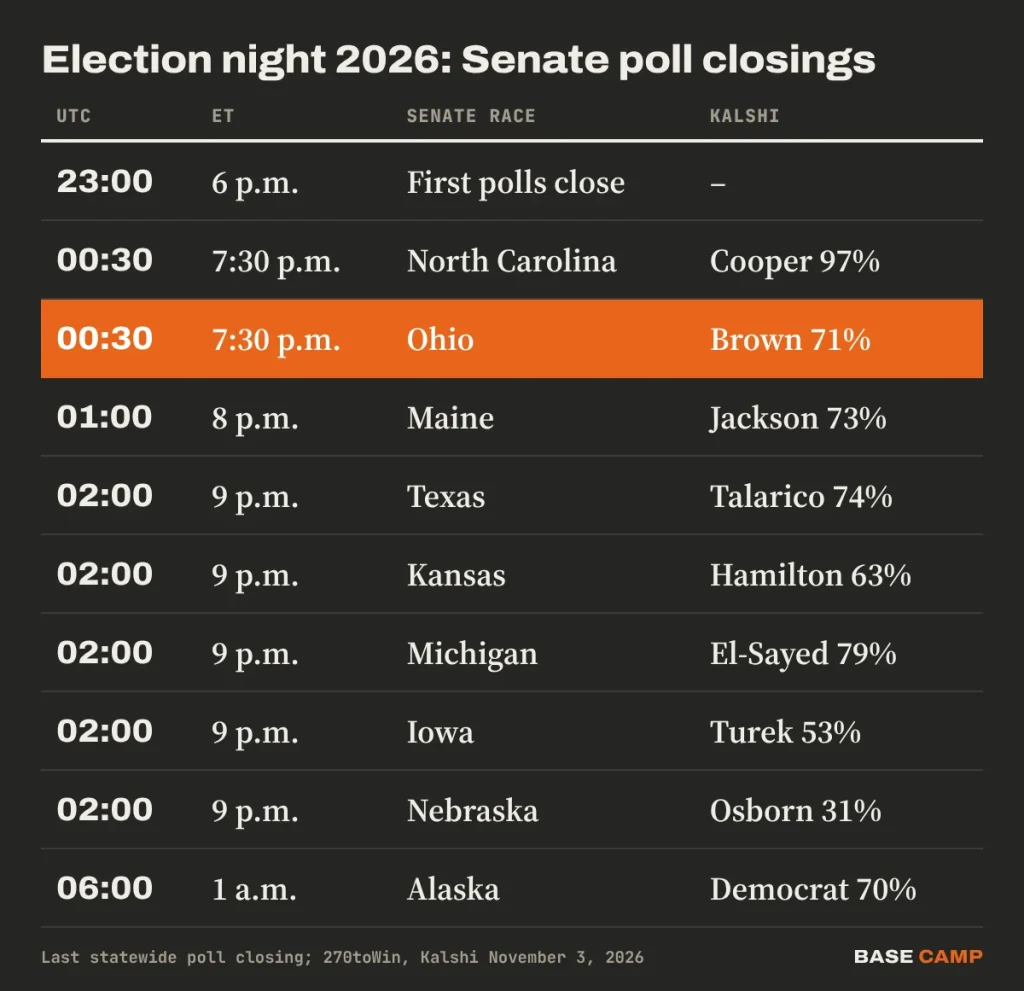
Every candidate in the table except Osborn, an independent, is a Democrat. Texas, Kansas and Michigan span two time zones, so most of each state closes at 01:00 UTC (8 p.m. ET), an hour before the last corner, and most of Alaska at 05:00 UTC. That answers when do polls close. The midterm election results come later: networks rarely call a close race before the last polls in the state shut, and a tight Senate count can run for hours after that.
Sponsored · Affiliate link
Save 20% on fees trading on WEEX
Base Camp may earn a commission if you sign up. It never affects what we write.
The Senate Path, Race by Race
Republicans hold the Senate 53–47, so Democrats need a net gain of four seats. At 50–50, Vice President JD Vance breaks the tie for Republicans.
The early hour carries the most weight. North Carolina is the easiest pickup on the map for Democrats, with Roy Cooper at 97% for the seat Thom Tillis is leaving. Ohio is crypto’s own race. Fairshake, the industry’s biggest super PAC with $169 million spent since January 2025, told CNBC it has spent $55 million against Sherrod Brown, the former Senate Banking chair. Kalshi still gives Brown 71% against Jon Husted. If Brown wins, the most expensive bet crypto made this cycle will have failed, and he could land back on the committee that writes crypto law.
At 01:00 UTC the map widens. Maine has Troy Jackson at 73% against Susan Collins. Texas is one of the busiest races on Kalshi, with about 79 million contracts traded. Ken Paxton wants America to be “the crypto capital of the world,” and James Talarico leads him at 74%. Kansas is the late surprise: Democrat Adam Hamilton sits at 63% against Senator Roger Marshall, in a state that hasn’t sent a Democrat to the Senate since 1932.
Democrats also have to hold what they have. Michigan is their most exposed seat, and Abdul El-Sayed’s odds hit a record 79% overnight against Mike Rogers.
SIDE TRAIL: Midterms and Crypto: What’s at Stake on Tuesday
If North Carolina, Ohio, Maine and Texas all flip, Democrats have their four seats before Iowa (Josh Turek 53%, the closest race on the board) and Nebraska (independent Dan Osborn 31%) even report. Alaska counts last and can take days, because a race where nobody passes 50% goes to ranked-choice rounds. Kalshi gives the Democrat 70% there.
What Would Surprise the Market?
A Republican Senate. Kalshi prices it at 24%, and most of that is a split Congress: Democrats take the House while Republicans keep the Senate, at 20%. A Republican sweep of both chambers trades at 7%.
That split result is the one that would change the crypto picture most. A Republican Senate keeps Tim Scott at the Banking Committee and gives a CLARITY-style bill a friendlier start in the next Congress. A Democratic sweep, which Kalshi puts at 75%, hands both crypto committees to Democrats, likely Maxine Waters in the House and Elizabeth Warren in the Senate.
Watch Ohio and Texas in the first hours. If either goes Republican, the 76% Senate number will move fast, and prediction markets will show it before any network call. Kalshi and Polymarket have turned election night into a market of its own: the two Senate and House control markets on Polymarket alone have traded about $60 million.
Bitcoin on Election Night: What Happened Before?
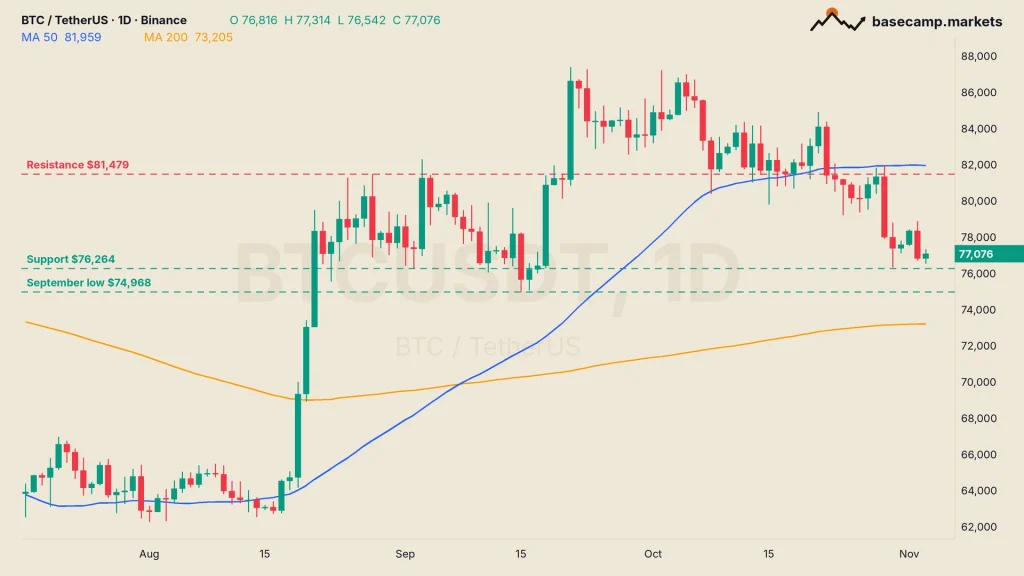
Bitcoin trades all night while the stock market is closed, so it is the first big market to react. How much it reacts depends on whether the result was already priced in.
The last midterm night was quiet. On November 8, 2022, BTC traded at $18,460 when the first polls closed and $18,304 at 07:00 UTC the next morning, less than 1% lower. The crash came later that Wednesday, from FTX. The 2024 presidential night was the opposite: Bitcoin went from $69,594 at 23:00 UTC to $75,000 by 03:00 UTC, up 7.8% and a new all-time high, as the results came in for the candidate who had courted crypto voters.
Tonight looks more like 2022. The House is a 94% favorite and the Senate a 76% one, so only an upset should move the price much.
The months after the vote have a cleaner record, at least for stocks. The S&P 500 rose from the end of October to the end of June after all 21 midterms since 1942, by 16.5% on average and never less than 2.2%. Bitcoin has only three of those windows, and it didn’t go three for three: it fell 22% after 2014, then rose 71% after 2018 and 49% after 2022.
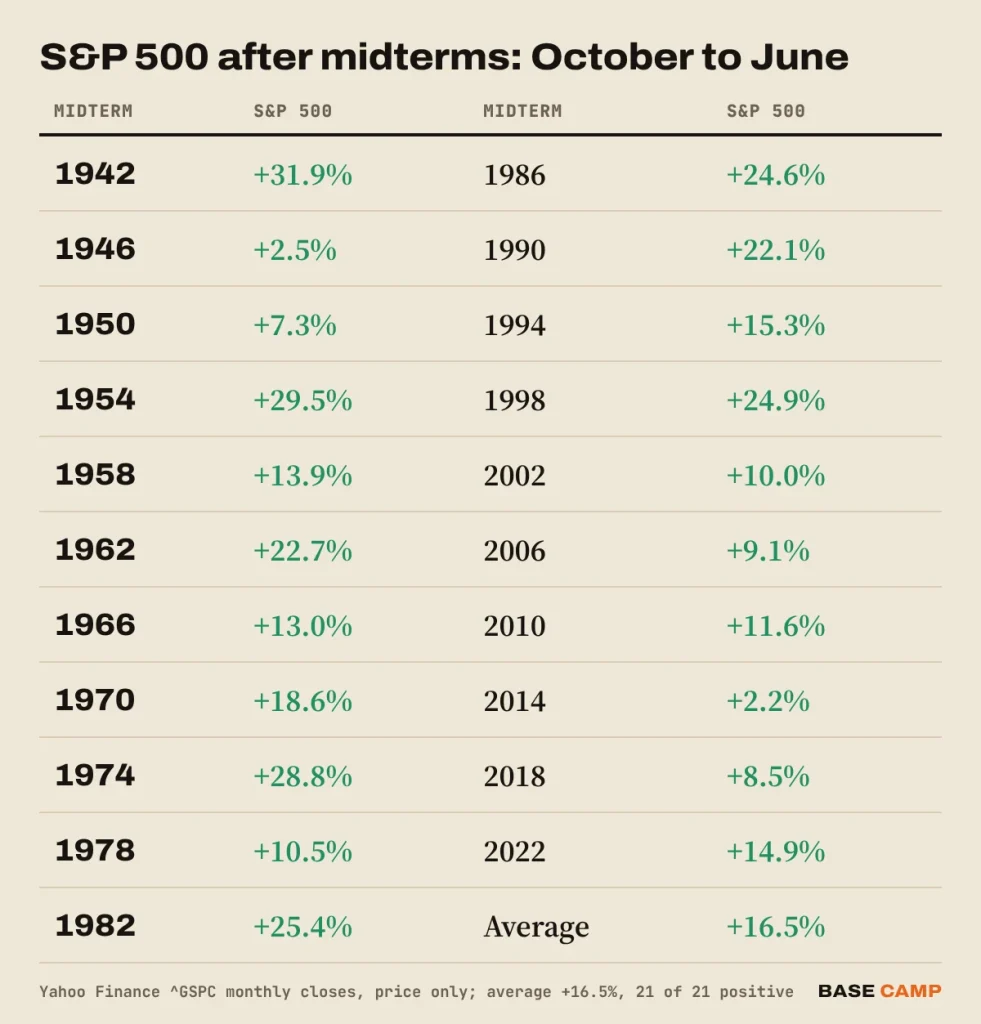
Twenty-one out of 21 is a pattern with some weight; three is not. We went through Bitcoin’s full record after past midterms this week:

Bitcoin was higher one year after all 3 previous midterms, but the road wasn’t smooth
• 2014: +23.6% after one year
• 2018: +44.9%
• 2022: +92.1%
Could 2026 follow the same pattern?
basecamp.markets/bitcoin-after-…
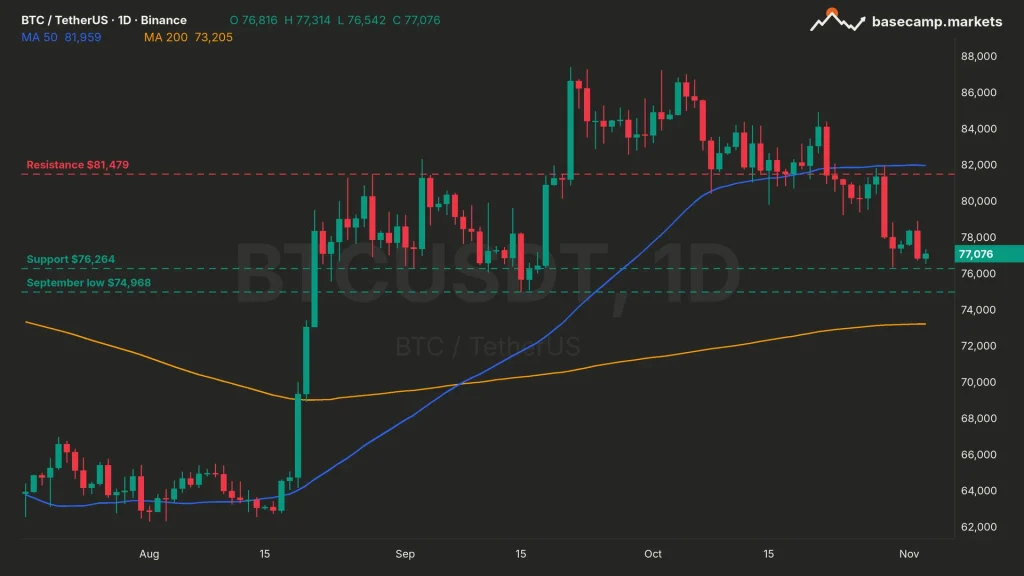
Bitcoin trades at $76,920 at the time of writing, 39% under its $126,080 all-time high. Monday’s close at $76,816 was the lowest daily close since September 17. BTC sits under the 50-day moving average at $81,959 and above the 200-day at $73,205.
The level to watch overnight is $76,264, the support that held at the end of October. A daily close below it opens the September low at $74,968. On the way up, BTC has to clear $81,479 to get back toward its 50-day line.
TRAIL MAP: Bitcoin After Midterms: What Happened in 2014, 2018 and 2022
The first real answer comes at 00:30 UTC from Ohio, and the Senate number will tell you how far the night can still move.

VikingXBT has been trading crypto since 2017. The focus is futures, onchain data and automation. Onchain flows get checked before a chart is trusted, and anything repetitive gets automated. VikingXBT built Base Camp's own onchain scanner, which flags bundlers, snipers, dev holdings and wallet clusters in one view, and backtests strategies before trading them.
More from VikingXBT