The short version
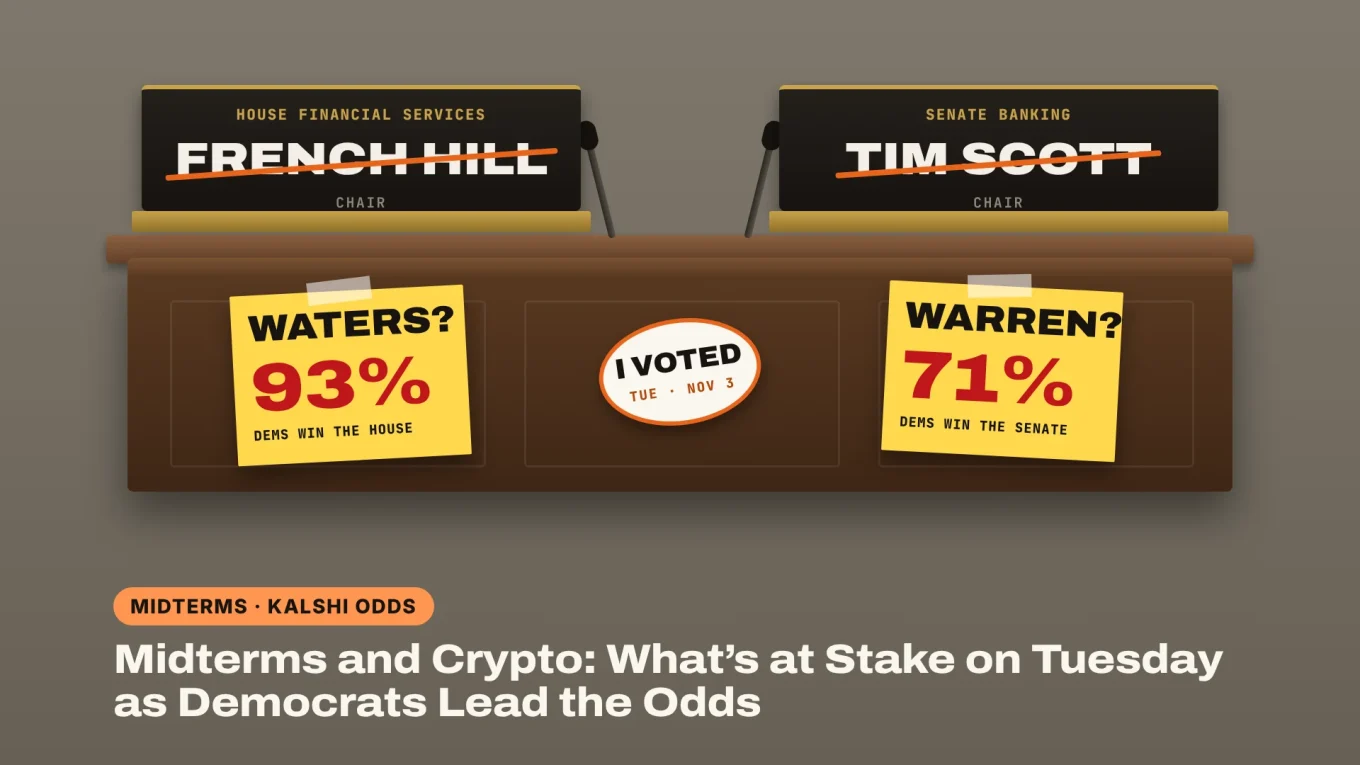
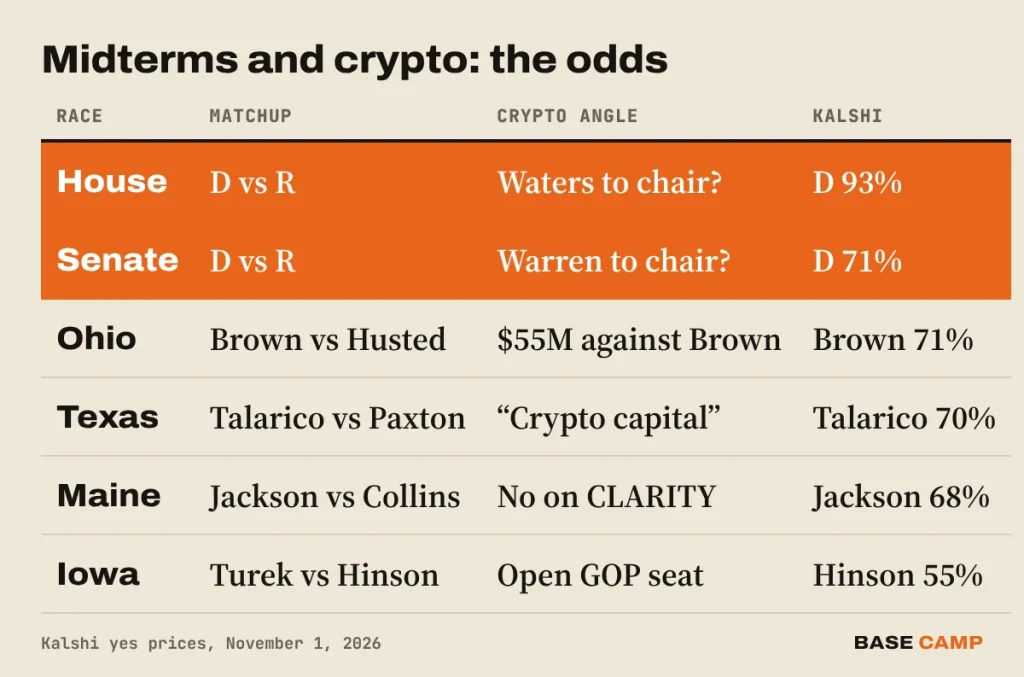
- Midterms and crypto collide on Tuesday, November 3: Kalshi gives Democrats a 93% chance of winning the House and 71% for the Senate, up from 62% a month ago.
- It matters because the winners pick the chairs who write crypto law, likely Maxine Waters and Elizabeth Warren, and the CLARITY Act dies on January 3 unless signed, with Kalshi at 6%.
- Next: Tuesday’s results in Ohio, where Fairshake spent $55 million against Sherrod Brown, and Texas. We’ll post the crypto races on Base Camp on X as the results come in.
Midterms and crypto haven’t been this tangled since 2024, and this time the industry is on the back foot. Americans vote on Tuesday, November 3, and the result decides who writes the next crypto bill. Kalshi traders give Democrats a 93% chance of winning the House and 71% for the Senate at the time of writing, up from 62% for the Senate a month ago.
The industry has bet the other way. Crypto groups have put more than $200 million into this cycle, Public Citizen counts, the largest group of single-issue super PACs the US has seen. So what changes if the odds are right?
Stand With Crypto, the voter group Coinbase started in 2023, spent the last weekend getting its people to the polls:

November 3rd is Election Day. Check your registration, find your state's deadline, and see where your candidates stand on crypto in one place: standwithcrypto.org/vote
Midterms and Crypto: What’s at Stake?
The committee chairs. Whoever wins each chamber picks who runs the two committees that write crypto law, and both would likely flip with the odds where they are.
In the House, Financial Services would pass from French Hill, who pushed the CLARITY Act through, to its top Democrat. Kalshi’s small market on the chair puts Maxine Waters at 74%. In the Senate, Banking would go from Tim Scott to Elizabeth Warren, the industry’s loudest critic. Warren voted against the CLARITY Act in September because its ethics rules wouldn’t stop officials, the president included, from profiting from crypto. She says she still wants a crypto bill, just not that one.
Republicans hold the Senate 53–47, so Democrats need four more seats; Vice President JD Vance breaks a 50–50 tie. Kalshi prices a Democratic sweep of both chambers at 70%.
Sponsored · Affiliate link
Save 20% on fees trading on WEEX
Base Camp may earn a commission if you sign up. It never affects what we write.
The Races Crypto Spent On: Ohio and Texas
Two Senate seats show the fight best.
Ohio is where the money went. Fairshake, the industry’s main super PAC with $169 million spent since January 2025, told CNBC it has spent $55 million against Sherrod Brown, the former Banking chair who wants his seat back from Republican Jon Husted. The same network spent about $40 million to beat Brown in 2024. It hasn’t worked this time, at least not yet: Kalshi gives Brown 71%, up from 59% in late September.
Texas may decide the Senate. Republican Ken Paxton’s campaign site says “America must be the crypto capital of the world,” and he backs the CLARITY Act. Democrat James Talarico wants to “bring digital assets within a clear regulatory structure,” the El Paso Times reported. Neither is anti-crypto, but only one would vote with a Republican majority. Kalshi has Talarico at 70%, in a state Democrats haven’t won statewide since 1994.
The House fight is wider, and most of the midterm elections crypto money went there quietly. Fairshake and its sister PACs back 33 House candidates from both parties, 19 Republicans and 14 Democrats, including Hill and Bryan Steil, who runs the House digital assets subcommittee.
What Happens to the CLARITY Act After the Midterms?
It most likely dies on January 3, when this Congress ends. The Senate vote to start debate failed 49–50 on September 15, and the chamber is out until November 6. That leaves about five working weeks in the lame-duck session, and Kalshi gives a market structure law before January 1 only 6%.
After that, the bill starts over in a new Congress. If Democrats take both chambers, the next version gets written by Waters and Warren, with tougher ethics rules on officials who earn money from crypto, the point that sank this one. Kalshi gives a market structure law before 2028 just 28%.
SIDE TRAIL: CLARITY Act’s Last Chance: The Senate Returns After the Midterms With Odds Under 4%
Regulators won’t wait, and that softens the blow. The SEC’s proposed crypto rules closed for comments on October 20 and the CFTC’s are under White House review, and neither needs Congress. A Democratic Congress can hold hearings and slow them down, but it can’t vote them away while President Trump holds the veto.
When Will We Know the Results?
Polls close in Ohio at 7:30 p.m. ET Tuesday, which is 00:30 UTC on Wednesday. Most of Texas closes at 7 p.m. local time, 01:00 UTC, and the El Paso corner an hour later. A clear House result usually comes overnight, by the time Europe wakes up on Wednesday. If the House is called early for Democrats, as Kalshi expects, the Senate becomes the only story that matters for crypto that night.
The Senate can take longer. Alaska and Maine count with ranked-choice voting, so a close race there can run for days. Kalshi settles its markets on the media calls.
Midterms 2026 and Bitcoin: Will the Vote Move the Price?
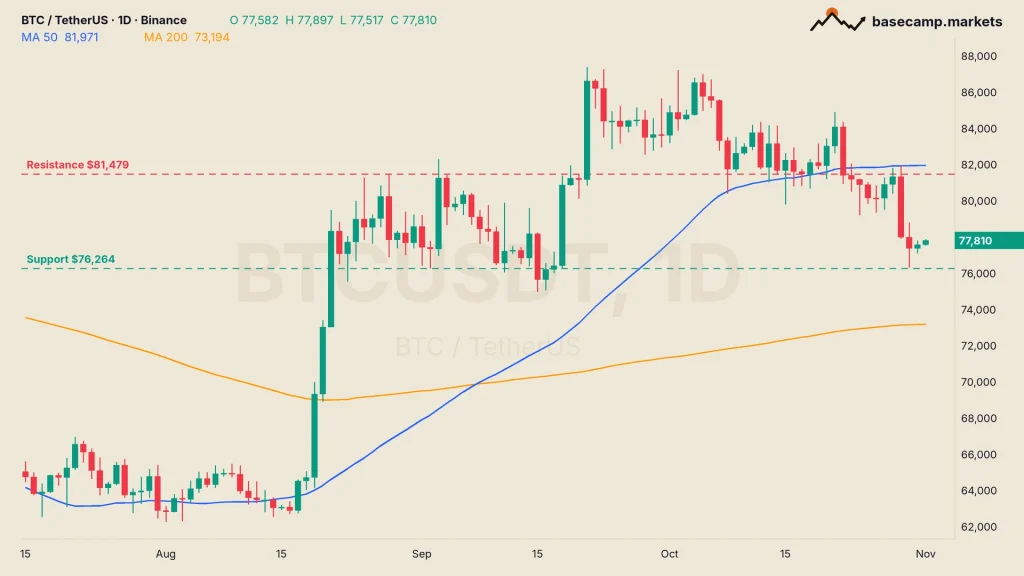
Probably not much on the night, if history holds. Bitcoin trades at $77,654 at the time of writing, 38% below its $126,080 all-time high, with the Fear & Greed Index at 34. It sits under the 50-day moving average at $81,971 and above the 200-day at $73,194.
The last two midterms were rough, but not because of the vote. Bitcoin fell from $6,519 on election day 2018 to $3,509 a month later in that year’s bear market, and in 2022 it dropped from $18,547 to $15,781 within two weeks as FTX collapsed. A result the odds already price in is unlikely to move it far. A surprise Republican Senate is the one result that would keep the CLARITY text alive in its current form.
The level to watch is the $76,264 support; a daily close below it opens $74,968. On the way up, BTC needs to clear $81,479 to get back to its 50-day line.
TRAIL MAP: Bitcoin Cycles and the Halving: What Four Cycles of Data Actually Show
Tuesday won’t change the price much. It will decide who writes the rulebook, and the odds favor the side the industry spent against.

Satoshi Flipper has more than 20 years of trading experience, starting in stocks before moving into crypto in 2017, and holds an MBA from the Kellogg School of Management. The edge is reading the economic data: rate decisions, inflation, jobs numbers, earnings and the US markets that move Bitcoin.
More from Satoshi Flipper