
The short version
- Decide how much of your account you’re willing to lose on a trade (1% is the classic number) before you look at entries.
- Position size = amount at risk ÷ distance to your stop-loss. The stop sets the size, not the other way round.
- Leverage changes how much margin you post, not how much you can lose. Your stop and size decide that.
- Losses compound against you: lose 50% and you need +100% to get back. Small risk per trade keeps you out of that hole.
Ask ten traders who blew up their accounts what went wrong, and you’ll hear about bad entries, fake breakouts and market makers hunting stops. Very few will say the real reason: they bet too much on one trade.
Risk management is the boring part of trading. It’s also the only part that’s fully in your control. You can’t decide whether a trade wins. You can decide exactly how much it costs you when it doesn’t, and that decision is what keeps you trading long enough to get good.
Why risk comes before entries
Even great traders lose often. A strategy that wins 45% of the time can be very profitable, which means more than half its trades are losers. Strings of five, eight or ten losses in a row are normal over a few hundred trades.
So the real question isn’t “will this trade work?” It’s “can I survive the bad streak that’s coming at some point?” Look at what a losing streak does at different risk levels:
| Risk per trade | After 5 losses in a row | After 10 losses in a row |
|---|---|---|
| 1% | −4.9% | −9.6% |
| 2% | −9.6% | −18.3% |
| 5% | −22.6% | −40.1% |
| 10% | −41.0% | −65.1% |
At 1%, ten straight losses is a bad month. At 10%, it’s most of your account.
The math of drawdowns
Losses and gains aren’t symmetrical. A drawdown needs a bigger gain to recover:
| Drawdown | Gain needed to get back to even |
|---|---|
| −10% | +11.1% |
| −20% | +25% |
| −33% | +50% |
| −50% | +100% |
| −75% | +300% |
| −90% | +900% |
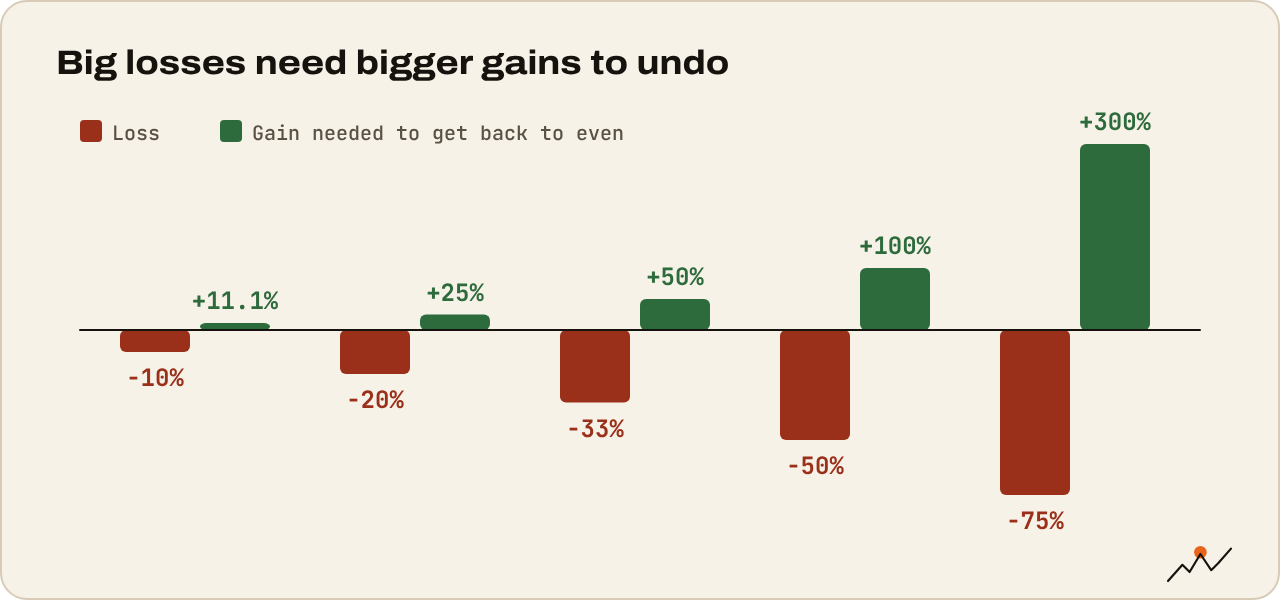
That’s why big losses are so dangerous. A trader who loses half their account doesn’t need to be as good as before. They need to be twice as good. Keeping losses small keeps you in the part of the table where recovery is realistic.
The 1% rule
The 1% rule says: never risk more than 1% of your trading account on a single trade. On a $10,000 account, that’s $100.
Some notes, because this rule is often misunderstood:
- It’s 1% risk, not 1% position. You can buy $4,000 of Bitcoin and still only risk $100, if your stop-loss is close enough. More below.
- 1% is a ceiling, not a target. Many professionals risk 0.25% to 0.5%. Some experienced traders go to 2% on their best setups. Above that, a normal losing streak starts doing real damage.
- It applies to your trading account, the money you’ve set aside for trading, not your long-term holdings.
How to calculate position size
Here’s the formula that matters most in this guide:
Position size = amount at risk ÷ stop distance (%)
Step by step, for a $10,000 account risking 1%:
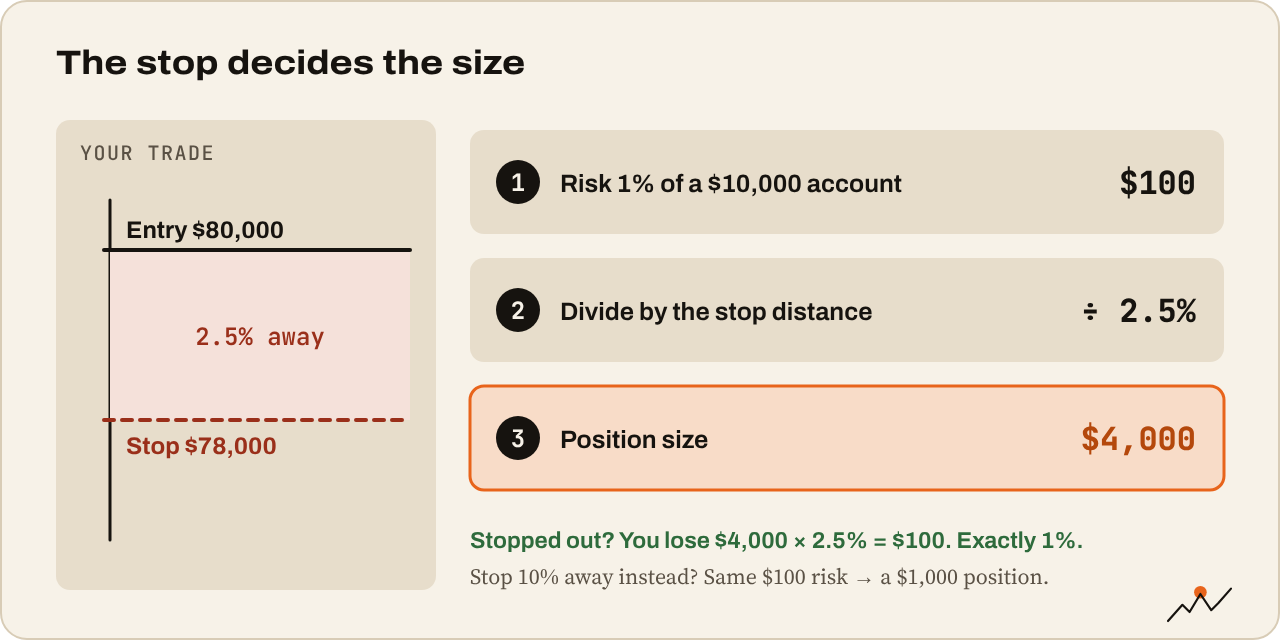
- Amount at risk: 1% of $10,000 = $100.
- Entry and stop: you want to buy Bitcoin at $80,000, and your trade idea is wrong if price falls below $78,000. That’s your stop-loss.
- Stop distance: ($80,000 − $78,000) ÷ $80,000 = 2.5%.
- Position size: $100 ÷ 2.5% = $4,000, or 0.05 BTC.
If Bitcoin drops to $78,000 and your stop fills, you lose $4,000 × 2.5% = $100. Exactly 1%.
Now see what happens with a wider stop. Same account, same entry, but the stop is at $72,000 (10% away). Position size: $100 ÷ 10% = $1,000. A wider stop means a smaller position, and the same $100 risk.
That’s the key idea: the stop decides the size. You don’t pick a size and then squeeze the stop to fit. You put the stop where the trade idea is proven wrong, then size the position so that being wrong costs 1%.
Our position size calculator does the math for you:
Base Camp tool
Position size calculator
How much to buy so that hitting your stop-loss only costs the risk you chose.
For learning only, not financial advice.
Where to put the stop
A stop-loss isn’t a random percentage. It goes where your reason for the trade no longer holds:
- Buying a bounce from support? The stop goes below the support zone, with some room for wicks.
- Buying a breakout? The stop goes back inside the range it broke out of.
- Trading a trend? The stop goes below the last higher low.
If the logical stop is so far away that the position becomes tiny, that’s fine. It just means this trade isn’t worth much at this location. Skip it or wait for a better entry.
Watch out. Don’t move your stop further away once you’re in a trade to “give it room.” That’s raising your risk after the fact, usually at the worst moment. Moving it closer to lock in profit is fine.
Leverage doesn’t change your risk
Here’s where many people get confused. With leverage, you can open that $4,000 Bitcoin position with $400 of margin at 10x. Does that mean you’re risking more?
Not if you use a stop. Your loss at the stop is still $4,000 × 2.5% = $100. Leverage only changed how much money sits on the exchange as margin. Position size and stop distance set the risk.
Leverage becomes dangerous when people size by margin instead of by risk (“I’ll put $1,000 in at 20x”) or trade without a stop, where the exchange’s liquidation price becomes the stop. We go deeper into that in Futures and leverage explained.
The risks a stop doesn’t cover
- Slippage and gaps. In a fast crash, your stop can fill below your price. Budget a little extra, especially on small coins.
- Fees. On a tight stop, fees and slippage can be a big part of the loss. Count them.
- Correlated trades. Five long positions on five altcoins aren’t five 1% risks. When Bitcoin dumps, they all fall together. Treat them as one bigger bet.
- Total open risk. Many traders cap the total risk across all open trades at 3% to 5% of the account.
- A daily or weekly loss limit. Stop trading for the day after losing, say, 3%. Tired, angry trading is how drawdowns get deep.
Your risk rules, written down
- Maximum risk per trade: ___% of my trading account
- Maximum total open risk: ___%
- I stop trading for the day after losing ___%
- Every trade has a stop-loss before I enter
- I size every position with the formula, not by feel
- I never widen a stop once I’m in
Tip. CryptoCred calls risk management the lesson to learn before any other, and his Risk Management video is worth the hour. For a seven-minute version, try Trader Mayne’s Trade Less, Profit More.
Where to go next
You know how much to risk. Next, how much to aim for, and why a 40% win rate can beat a 70% one: Risk/reward and why your win rate matters less than you think.

On the climb since 2017. Trades futures and reads onchain data. Automates the boring parts.
More from VikingXBT →