The short version
- Ethereum store of value: Vitalik Buterin argued on Sunday that ETH’s value should rest on being a store of value, keeping the EIP-1559 burn but not counting on it.
- He wrote that the 2021–23 burn of millions of ETH a year “was never a true floor,” because most of it came from crypto spending on itself.
- The burn is now about 90 ETH a day, roughly 3% of new issuance, and supply has grown 1.4% since the Merge to 122.2 million ETH.
“The value of ETH comes from elsewhere.”
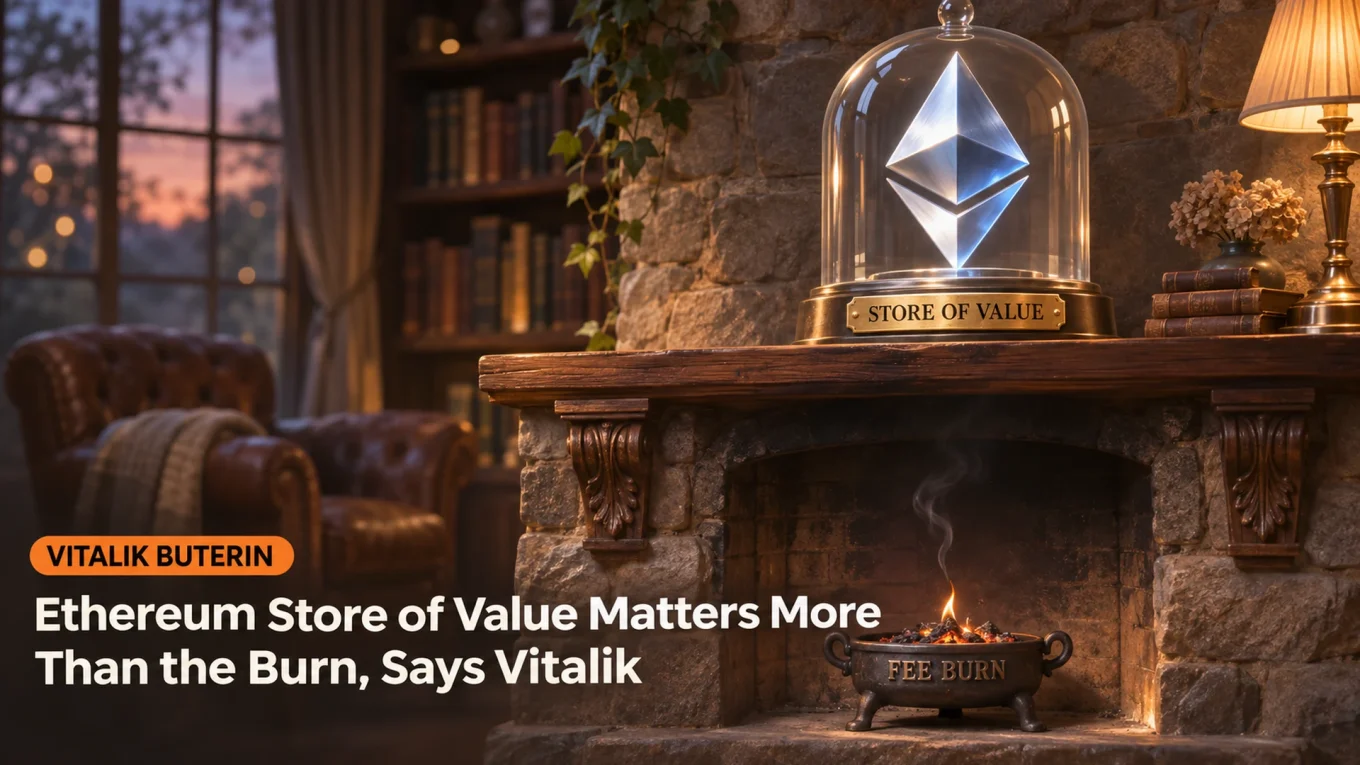
That’s Vitalik Buterin on the fee burn. In a long X thread on Sunday, the Ethereum co-founder made the Ethereum store of value case: ETH should be judged on how well it holds value, not on how many fees it burns.
The numbers make his point for him. Ethereum burned 2,705 ETH over the last 30 days, about 3% of what the network issued in that time. ETH trades at $2,105 at the time of writing, down 5.7% in 24 hours while Bitcoin lost 2.1%. So what is he actually saying, and what is left of the burn?
He opened the thread with the three reasons and one line on EIP-1559:

Expanding on why I believe "ETH as store of value (SoV)" makes much more sense to focus on than "ETH as fee-burning token".
Three primary reasons:
1. ETH as fee-burning token never was as strong as it seemed
2. Optimizing for ETH as fee-burning token would demand Ethereum and
The Ethereum Store of Value Case: Why the Burn Was Never a Floor
He isn’t scrapping it. EIP-1559, the 2021 upgrade that burns the base fee of every transaction, is “fine and good, we should keep them,” he wrote. But nobody should “feel sad if fee burn is < 10% of breakeven indefinitely.” Breakeven is the point where the burn cancels out new issuance.
The old pitch went like this. Value the token like a business paying out forever: market cap equals fees burned divided by a discount rate. Burn $1 billion a year at a 4% rate and you get a $25 billion floor. In 2021–23, Ethereum burned millions of ETH a year.
“But here’s the problem: this was never a true floor,” Buterin wrote in the second post. Most of that burn came from crypto spending on itself: NFT mints, lending, the “infamous $180m-fees-burned-in-one-day digital monkey sale.” If ETH had fallen 10x, those fees would have fallen with it.
His second reason is about size. To justify a market cap of about $270 billion through burning, Ethereum would have to act like a major corporation, somewhere around L’Oréal. Corporations spend on research. At L’Oréal’s ~0.58% of market cap a year, that means “in-protocol funding to the tune of ~700k ETH per year,” he wrote, cutting validator revenue by two-thirds. Add a high-fee chain that prices out users and governance he calls “highly interventionist,” and you lose the decentralization people hold ETH for.
His sums check out. 0.58% of $270 billion is about $1.57 billion, or roughly 700,000 ETH at the $2,240 ETH traded at when he posted. That is about 64% of the 1.09 million ETH a year the network now issues to stakers.
Sponsored · Affiliate link
Save 20% on fees trading on WEEX
Base Camp may earn a commission if you sign up. It never affects what we write.
What Is the ETH Burn Rate Now?
The ETH burn rate is about 90 ETH a day over the last 30 days, against roughly 6,450 a day before the Merge.
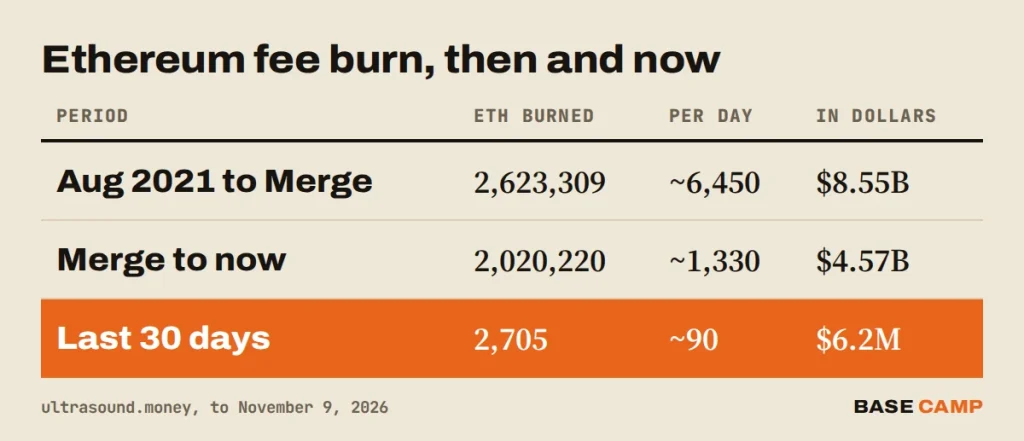
The supply tells the same story. There are 122,202,203 ETH today, ultrasound.money shows, up 1,681,062 ETH, or 1.4%, since the Merge in September 2022. At the last 30 days’ pace, net supply grows about 0.86% a year.
In other words, “ultrasound money,” the idea that ETH supply shrinks over time, stopped describing the chain a while ago. Buterin’s Ethereum store of value case says ETH doesn’t need it back.
SIDE TRAIL: Ethereum Funding Rates Hit Zero, but the Leverage Didn’t Leave
Solana co-founder Anatoly Yakovenko agreed with the core of it:

Vitalik is absolutely right that you can’t focus on fees as the product. That’s absolutely meaningless. You need to pick a product, the thing that brings value to people, and do that really well.
Not everyone is ready to drop deflation. DeFi analyst Ignas backed the store-of-value direction but wrote he hopes it “doesn’t come from a belief that Ethereum L1 will never generate enough fees to make ETH deflationary.”
ETH Price on the Weekly Chart
Five red weeks in a row. ETH closed the week at $2,127.46 on Binance, after Sunday night’s flash crash to $2,060, and sits under its 200-day moving average at $2,155.
On the weekly chart, last week’s high at $2,450 is the first level above. The swing low at $1,853.62 is the support below.
TRAIL MAP: Market Cap, Supply and Why “Cheap” Coins Aren’t Cheap
At the last 30 days’ pace, Ethereum would need 33 years of burning to cancel one year of new ETH.

TheCryptoMonk has been trading since 2017 and reads the market from the top down. The focus is macro and the high timeframes: where stocks, rates and liquidity are heading, and what the weekly and monthly charts say about Bitcoin. Short-term noise matters less than the bigger trend.
More from TheCryptoMonk