The short version
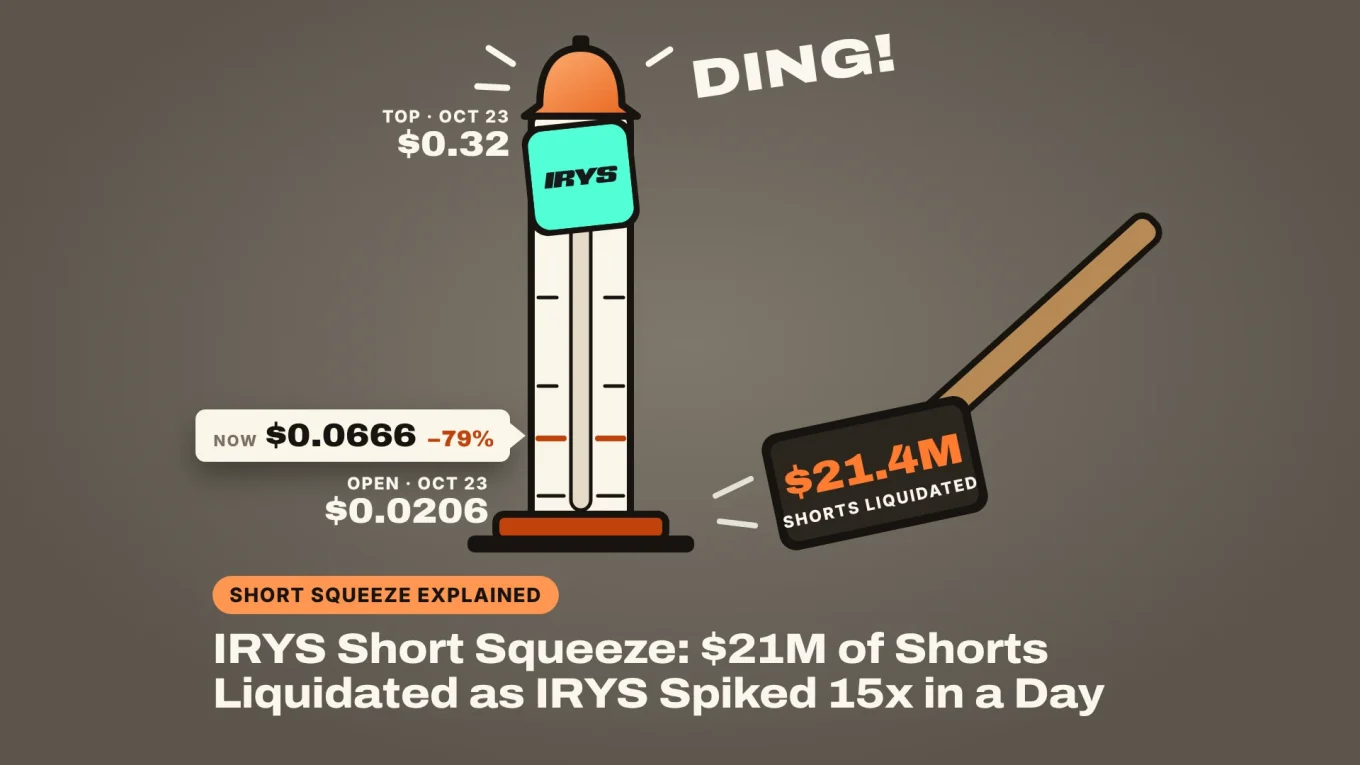
- The IRYS short squeeze sent the token from $0.0206 to a $0.32 wick on October 23 as about $21.4 million of shorts were liquidated, and it now trades at $0.0666.
- It followed the textbook pattern: IRYS trading on Upbit jumped to about $617 million in a day, OKX funding sat at -0.29% per four hours and open interest rose sixfold before 64% of it vanished in one hour.
- The crew is watching $0.0603 as support and $0.111 as the level to reclaim, with about 1.18 billion IRYS unlocking for investors and insiders on November 25.
The IRYS short squeeze is the cleanest lesson in leverage the market has handed out this month. IRYS, the token of the Irys datachain, opened October 23 at $0.0206 on OKX and wicked to $0.32 a little after 19:00 UTC, about 15 times higher, before most of it vanished within the hour. At the time of writing it trades at $0.0666, still more than five times its price a week ago.
Traders betting on a drop paid for most of the ride. CoinMarketCap’s derivatives data showed about $21.4 million of short positions liquidated in 24 hours, against $2.8 million of longs. So how does a $40 million token with no fresh news do that, and how do you spot the next one before it hits your account?
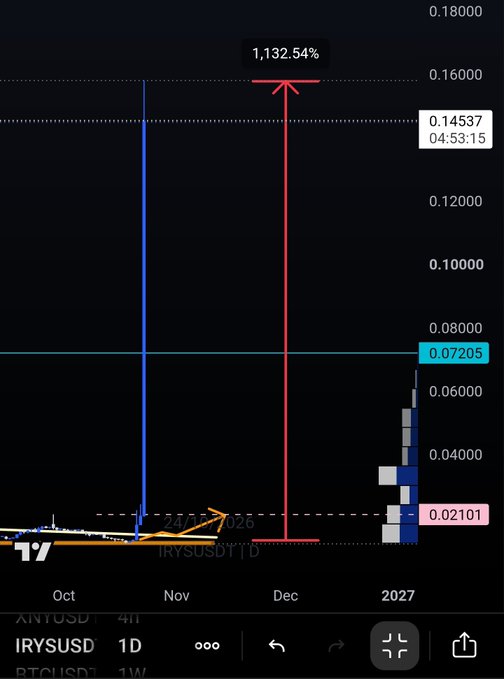
This is what the IRYS chart looked like at 19:08 UTC, minutes before the top:

$IRYS +1,132% PROFIT ✔️🔥
Called it publicly just 3 days ago.
Now sitting at a 12X. 🚀
Delivered 🤑
What Is a Short Squeeze?
A short squeeze is a fast rally fuelled by traders who bet on a drop being forced to buy back. A short seller profits when the price falls. On a futures exchange, that bet sits on borrowed margin, so when the price rises far enough the exchange closes the position for the trader. Closing a short means buying.
That is the whole trick. Every forced buy pushes the price higher, which pushes the next short past its liquidation price, which forces another buy. In a thin market the chain feeds itself until the shorts run out. Then nobody is left who has to buy, and the price falls back as fast as it rose.
DISCOVER: Futures and Leverage Explained: Perps, Margin and How Liquidation Really Works
How the IRYS Short Squeeze Played Out
It started in Korea. Upbit, South Korea’s biggest exchange, traded about $230,000 of IRYS on October 20. The next day it did about $64 million. On October 23 it did about $617 million. Upbit now shows IRYS with caution flags for price swings, soaring volume and soaring deposits.
Futures traders saw a tiny token running on retail volume and leaned against it. The funding rate on OKX’s IRYS perpetual, the fee one side pays the other to keep futures close to spot, turned negative on October 21 and kept falling. By the 16:00 UTC payment on October 23 shorts were paying longs 0.29% every four hours, a sign that far more traders wanted to be short than long.
Here is the part that made the squeeze possible. Open interest, the value of all open futures positions, climbed from $3.2 million to $19.6 million on OKX between midnight and 15:00 UTC while the price doubled. Rising open interest into a rally means fresh positions were opening, and negative funding says many of them were shorts.
Then the dam broke. Between 15:00 and 17:00 UTC IRYS went from $0.044 to $0.137 on OKX, and the 19:00 candle printed the $0.32 wick before closing at $0.111. The same 19:00 to 20:00 hour wiped out 64% of OKX open interest, from $19.8 million to $7.2 million. By the top, the trade had flipped: funding hit the 1% cap, longs paying shorts, as late buyers chased. The next hour IRYS touched $0.0603.
EXPLORE: Funding Rates and Open Interest: Reading the Leverage in the Market
How to Spot a Short Squeeze Before It Catches You
You can’t time the top of one, but the setup leaves fingerprints. IRYS showed all of them a day early:
- A thin market: IRYS was worth about $40 million on the morning of October 23, with 2 billion of its 10 billion tokens in circulation according to CoinGecko. In a market that small, a few million dollars of forced buying moves the price a long way.
- Negative funding during a rally: shorts paying to stay short while the price climbs means the crowd is on one side of the boat.
- Open interest rising with price: new positions opening into strength are fuel. When open interest drops 60% in an hour, the fuel is spent.
- Spot volume from one venue: a single exchange doing thousands of times its normal volume, here Upbit, is buying that futures traders can’t see in their own order book.
There is a quieter fifth one for this token. Tokenomics.com lists about 1.18 billion IRYS, roughly 12% of the total supply, unlocking on November 25 for private investors and insiders, when the one-year lock in Irys’s own tokenomics ends. That is more than half of today’s circulating supply arriving in a month.
Sponsored · Affiliate link
Save 20% on fees trading on WEEX
Base Camp may earn a commission if you sign up. It never affects what we write.
IRYS Price Analysis: What Happens After a Squeeze?
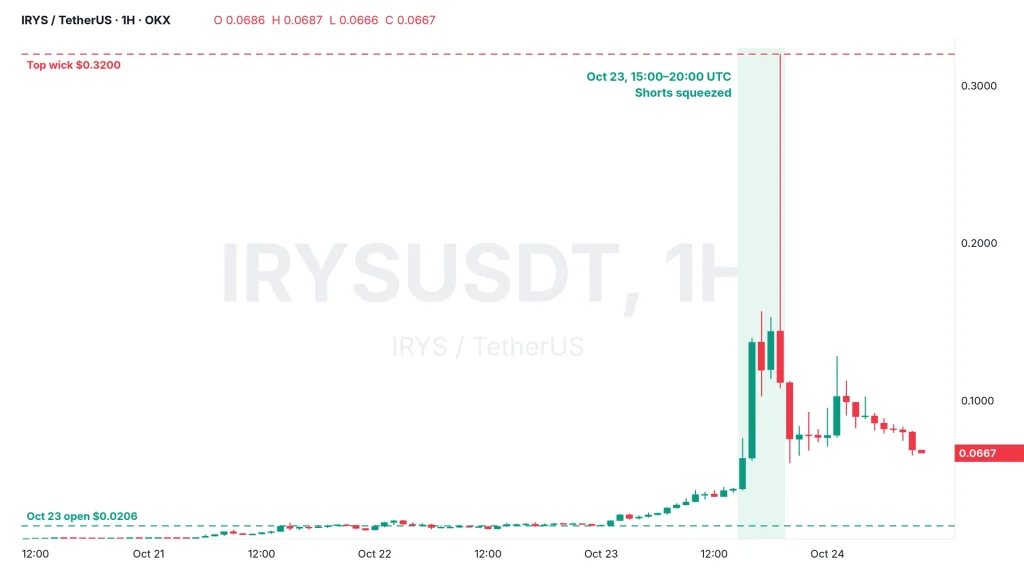
After a squeeze the price usually hunts for the level where real spot buyers stand, because the forced buyers are gone. IRYS has given back 79% of the wick already and is drifting lower on falling volume. Funding is back to a neutral 0.0025% per period on OKX and open interest has stayed near $7 million, so the shorts that fuelled the move have not come back.
The levels the crew is watching:
- Bull case: a reclaim of $0.111, where the peak hour closed, would show buyers absorbing supply; above it sits the $0.128 bounce high from early October 24.
- Base case: a range between $0.0603, the post-peak low, and $0.111 while the volume cools.
- Bear case: a break of $0.0603 opens $0.044, where the vertical leg started on October 23.
In other words, the squeeze is over and what is left is a much more expensive token with an unlock on the calendar. The IRYS short squeeze paid the traders who were already long. For everyone else the lesson is cheaper: check funding and open interest before shorting a small cap that Korea is buying.

On the climb since 2017. Trades futures and reads onchain data. Automates the boring parts.
More from VikingXBT →