The short version
- The Glamsterdam upgrade test on the Hoodi testnet, set for October 26, was called off on October 22 after ChainSecurity showed a new gas rule (EIP-8037) could affect 13 live contracts.
- No funds are at risk and ETH holders need to do nothing, but Hoodi was the last rehearsal before mainnet, where December 1, 8 or 9 were the candidate dates.
- The crew is watching for a new Hoodi date and the gas fix, and whether ETH holds $2,318, its October low and 200-day average.
The Glamsterdam upgrade was four days from its last dress rehearsal. Now it has no date at all. Ethereum’s core developers pulled the October 26 activation on the Hoodi testnet after security firm ChainSecurity showed that one of the new gas rules can make some existing contracts behave in ways their authors never planned for.
ChainSecurity says it has already found 13 live contracts that could be affected. No exploit has been reported, and the coins in your wallet are not at risk. But Hoodi was the last test before mainnet, and developers had pencilled in early December for the real thing. So what broke, and does a delayed upgrade matter for ETH?
ChainSecurity shared the decision shortly after the developer call:

⚠️ It has just been decided to delay the Glamsterdam hard fork on the Hoodi testnet because of security impacts we identified in this blog post: chainsecurity.com/blog/glamsterd…
We already found 13 real-world examples and are in responsible disclosure with the affected projects.
Please
What Is the Glamsterdam Upgrade?
It’s Ethereum’s next big hard fork, built to let the main chain handle a lot more activity. Glamsterdam pairs “Amsterdam” on the execution side with “Gloas” on the consensus side, and the Ethereum Foundation lists 18 changes in it.
Two of them carry the upgrade. Enshrined proposer-builder separation (ePBS) moves the deal between validators and the professional block builders into the protocol itself, so it no longer runs through trusted middleware. Block-level access lists tell nodes up front which accounts and storage a block touches, so they can check transactions in parallel instead of one by one.
The third piece is the one causing trouble: new gas prices. EIP-8037 makes it much more expensive to create new data on Ethereum, and meters that cost separately. EIP-8038 raises the price of reading and changing existing data. The aim is to stop the chain’s state from bloating as the block gas limit climbs. Mainnet runs at 60 million gas per block today, and Hoodi was set to jump to 200 million at the fork.
The Glamsterdam upgrade went live on the Sepolia testnet on October 6 without trouble. Hoodi, the bigger testnet where validators and staking providers rehearse, was meant to be the final check.
Sponsored · Affiliate link
Save 20% on fees trading on WEEX
Base Camp may earn a commission if you sign up. It never affects what we write.
Why Was the Glamsterdam Test on Hoodi Delayed?
Because of a quirk in the new gas rules. Developers decided on the October 22 All Core Devs call (ACDE #248) to wait so they could study how EIP-8037 interacts with contracts already on mainnet.
The warning came from ChainSecurity’s report, “When Spent Gas Comes Back”, published on October 13. Security researcher pcaversaccio raised it before the call and summed it up in one line: “The fundamental ‘broken’ thing is that `gasleft()` can increase.”
Here’s the simple version. Many smart contracts call another contract and, if that call fails, write the failure down: a claim marked as used, a retry blocked. To stop an attacker from forcing a failure by sending too little gas on purpose, they rely on one assumption. After a call runs out of gas, so little is left that the contract can’t finish writing the failure, and the whole thing reverts so the user can try again.
Glamsterdam breaks that assumption in a few ways. Gas paid for new data can flow back to the contract after a failed call, and the new reservoir for state gas can pay for the expensive part of a write. The failure handler can now finish when it used to run dry. In ChainSecurity’s words, a retryable operation can turn into a permanent failure, and a user can lose a valid claim for good.
The new prices also bite the other way. Under EIP-8038, writing to a fresh storage slot can cost up to 110,020 gas instead of 22,100 when the reservoir is empty. A contract that hardcoded a gas budget years ago may simply no longer send enough.
ChainSecurity says it is working with the 13 affected projects privately, so their names aren’t public. The Ethereum Foundation’s delay notice also scrapped the 200 million gas limit test on Hoodi and set no new activation epoch.
Does the Glamsterdam Delay Matter for ETH Holders?
Not directly. The Foundation says plainly that “no action is required from Ethereum mainnet users or ETH holders.” Your ETH, your staking and your wallet work exactly as before. Only teams running Hoodi nodes and validators have to update their software.
The timing is what moved. The ACDE agenda listed December 1, December 8 and December 9 as candidate mainnet dates, with the plan to pick one at the next call “if Hoodi goes smoothly.” It didn’t happen. A new Hoodi date has to come first, then usually a few weeks on the testnet before mainnet. Devcon in Mumbai runs from November 3 to 6 and takes a big part of the developer crowd with it, so a December mainnet now looks tight.
For the price, the market shrugged. ETH fell 3.4% on October 22, but Bitcoin fell 3.2% the same day, and the ETH/BTC ratio has barely moved since. Traders are treating this as a routine slip, not a crisis. Ethereum has delayed forks before, and catching a problem on a testnet is the whole point of having one.
If you build on Ethereum, the Foundation’s repricing impact checker shows whether a contract is on the list of ones the new gas prices affect.
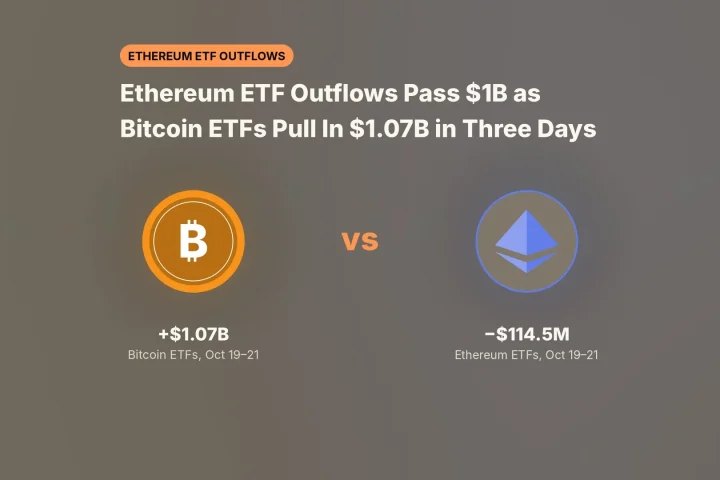
DISCOVER: Ethereum ETF Outflows Pass $1 Billion in October as Bitcoin ETFs Pull In $1.07B in Three Days
Ethereum Price Analysis: Can ETH Hold $2,318?
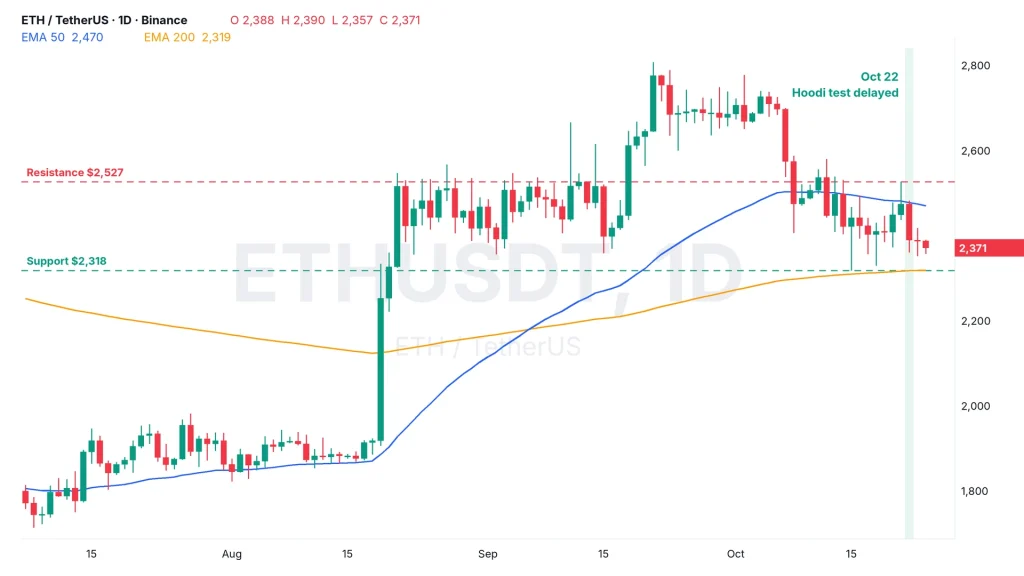
It’s close to the test. The ETH price trades at $2,371 at the time of writing, down 1.3% over 24 hours, below its 50-day EMA at $2,470 and only 2% above its 200-day EMA at $2,319.
- The first ceiling: $2,470. The 50-day EMA, which ETH lost on October 22 and hasn’t reclaimed.
- The bigger ceiling: $2,527. The October 21 high, where the last bounce ran out.
- The floor to defend: $2,318. The October 15 low, right on top of the 200-day EMA.
- The deeper support: $1,854. The swing low from August, before the late-summer rally.
In the bull case, ETH holds the 200-day, reclaims $2,470 and retests $2,527, helped by a fresh Hoodi date. In the base case, it chops between $2,318 and $2,470 while developers rework the gas rules. In the bear case, a daily close under $2,318 breaks both the October low and the 200-day, and there is little support until the summer range.
EXPLORE: Moving Averages, RSI and Volume
The fix is the next thing to watch. Developers can patch EIP-8037, trim it, or keep it and ask the 13 projects to update. Whatever they choose sets the new Hoodi date, and only a smooth Hoodi fork puts a mainnet date for the Glamsterdam upgrade back on the table.

On the climb since 2017. Trades futures and reads onchain data. Automates the boring parts.
More from VikingXBT →