The short version
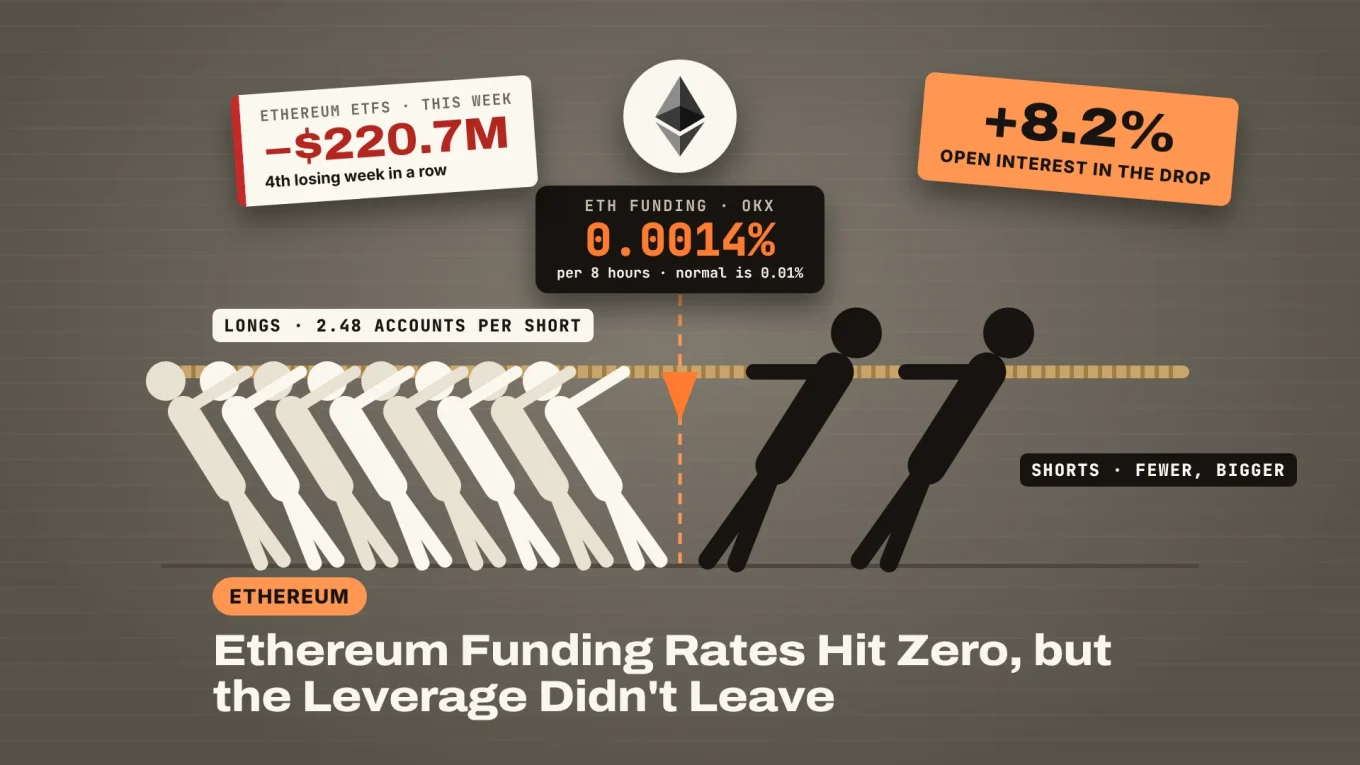
- Ethereum funding rates fell to zero this weekend: OKX’s ETH perpetual paid 0.0014% per eight hours at midnight UTC, a seventh of normal, and Hyperliquid’s turned negative as ETH hit $2,282.
- The leverage didn’t leave: OKX open interest rose 8.2% through Saturday’s drop to 625,744 ETH, while Ethereum ETFs lost $220.7 million this week, so the selling came from spot.
- The crew is watching $2,282: a daily close under Saturday’s low runs the dip buyers’ stops toward $2,222, and a close above the 50-day EMA at $2,466 squeezes the new shorts.
Ethereum funding rates fell to zero this weekend, and the easy read is that the leverage has left the building. It hasn’t. ETH dropped to $2,282 on Binance on Saturday, its lowest price since August 20, and the perpetual futures market went flat with it: on OKX, the last funding payment was 0.0014% per eight hours, the lowest since October 16.
ETH trades at $2,360 at the time of writing, down 11.9% in 30 days. Ethereum ETFs lost $220.7 million this week, their fourth losing week in a row. So if the futures traders aren’t the ones selling, who is, and is the leverage really gone?
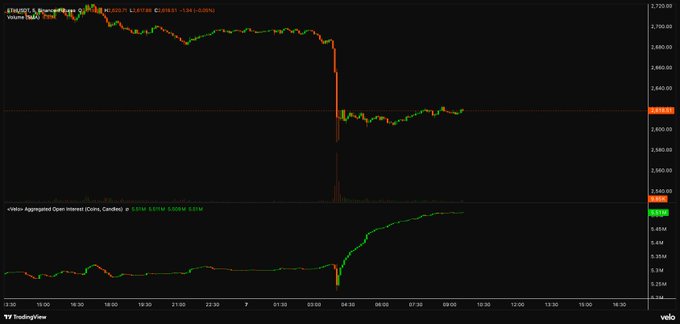
Daan Crypto Trades described the same mix on October 7, the last time Ethereum funding went negative:

$ETH Crazy amount of Open interest piling in after the move.
Funding turned negative but spot selling also pretty rampant at the same time. Mixture of longs longing the dip and shorts piling onto the downside momentum.
Price unchanged for the past few hours so one side is bound
Ethereum Funding Rates at Zero: What Does It Mean?
It means longs and shorts are paying each other almost nothing to hold their bets. A funding rate is the fee that keeps a perpetual future close to the spot price. When longs are crowded, the perp trades above spot and longs pay shorts. When shorts are crowded, it flips.
OKX’s ETH-USDT perpetual settled at 0.0014% per eight hours at midnight UTC, about 1.5% a year. The next payment was tracking 0.0010%. A calm market with no premium pays about 0.01% per eight hours on OKX, close to 11% a year, so Ethereum funding is running at a seventh of normal.
Hyperliquid, the onchain perp exchange, went below zero. Ethereum funding there was negative in 6 of the 24 hourly payments between 23:00 UTC on Friday and 22:00 UTC on Saturday, with the deepest at 01:00 UTC, as ETH slid toward its low. It has been back at the standard 0.00125% an hour since 20:00 UTC on Saturday.
The perp also trades below spot. OKX’s premium sat at minus 0.04% and Hyperliquid’s at minus 0.03%, so futures traders are pricing ETH a touch cheaper than the spot market.
Sponsored · Affiliate link
Save 20% on fees trading on WEEX
Base Camp may earn a commission if you sign up. It never affects what we write.
Is the Leverage Gone From Ethereum?
No. Ethereum open interest, the value of all futures bets still open, rose while funding fell. OKX’s ETH-USDT perpetual held 578,491 ETH in open contracts at 22:00 UTC on Friday and 625,744 ETH at 16:00 UTC on Saturday, up 8.2% through the drop. It holds 612,451 ETH now, worth $1.45 billion, about where it sat in early October.
Hyperliquid holds another 1.11 million ETH, worth $2.62 billion. That is a lot of ETH leverage for a market that was supposed to have flushed it out.
Funding near zero with open interest going up means new positions opened on both sides and the two sides are roughly matched in size. And the head count leans long. OKX’s long/short account ratio, the number of accounts net long for each account net short, hit 2.87 on Saturday evening and reads 2.48 now. It was 1.58 four days earlier.
Many small accounts bought the dip with leverage, and fewer but bigger accounts took the other side. When funding is flat but most accounts are long, the longs are the bigger crowd by head count. They are the ones with stops under Saturday’s low.
DISCOVER: Funding Rates and Open Interest: Reading the Leverage in the Market
Who Is Selling Ethereum, Then?
Spot holders, led by the ETFs. US spot Ethereum ETFs lost $220.7 million this week, per Farside, and BlackRock’s ETHA lost $233.2 million on its own. Ethereum ETF outflows now add up to $1.22 billion over four weeks, and $1.18 billion of it came in October.
That is the difference with a leverage-driven drop. When longs get liquidated, funding usually stays positive into the fall and open interest collapses. Here funding drifted to zero and open interest grew, which points to selling in the spot market, with futures traders reacting to it rather than causing it.
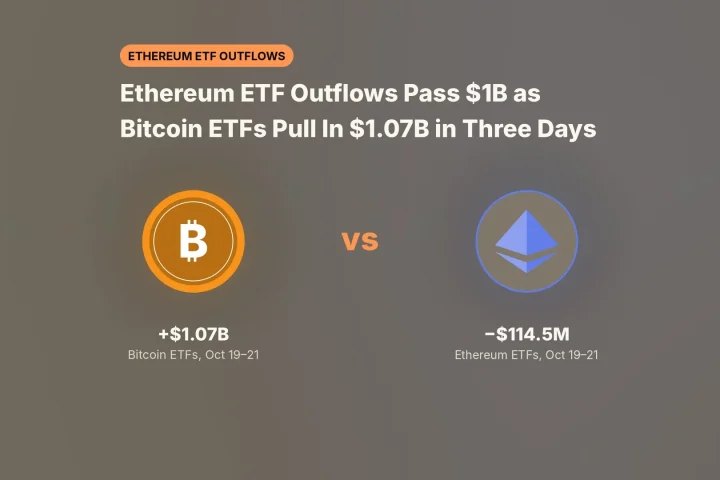
EXPLORE: Ethereum ETF Outflows Pass $1B as Bitcoin ETFs Buy
What Happened the Last Time Funding Went to Zero?
ETH bounced, then fell again. The last stretch of zero and negative funding on OKX ran from October 8 to 13, with 11 of 18 payments below zero. It started after open interest peaked at 693,433 ETH on October 6 and longs were flushed as ETH fell from $2,697 to $2,406.
With shorts paying, ETH climbed to $2,580 by October 12. Three days later it was down at $2,318. Zero funding took the pressure off for a few days, but it did not mark the bottom, because the spot selling never stopped.
Ethereum Price Analysis: Can ETH Hold $2,282?
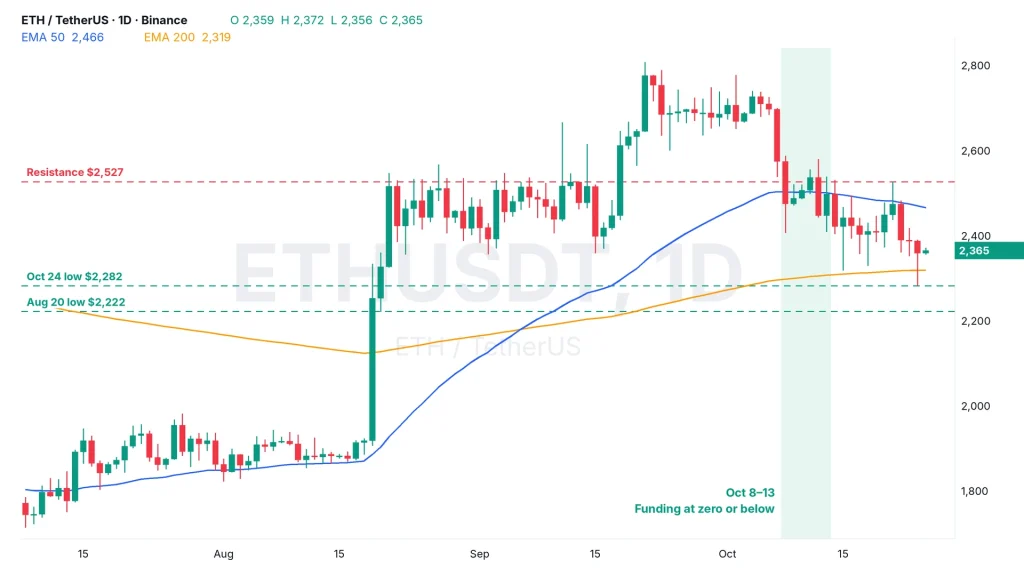
It is the level to watch. The Ethereum price sits at $2,360, above the 200-day EMA at $2,319 and below the 50-day EMA at $2,466. ETH has closed under the 50-day EMA every day since October 12, and Saturday’s wick to $2,282 put it under the 200-day line for a few hours.
The levels the crew is watching:
- Bull case: a daily close above $2,466, the 50-day EMA, would squeeze the shorts that opened on Saturday and put the October 21 high at $2,527 in play.
- Base case: a range between $2,282 and $2,466 into Wednesday’s Fed decision, with funding hovering around zero.
- Bear case: a daily close under $2,282 runs the stops of Saturday’s dip buyers. Next is $2,222, the August 20 low, where ETH retested its jump from $1,906 the day before.
Ethereum funding rates at zero say the futures market is balanced, not empty. With the ETFs still selling, the leverage that stayed is waiting for spot buyers to show up.

On the climb since 2017. Trades futures and reads onchain data. Automates the boring parts.
More from VikingXBT →