The short version
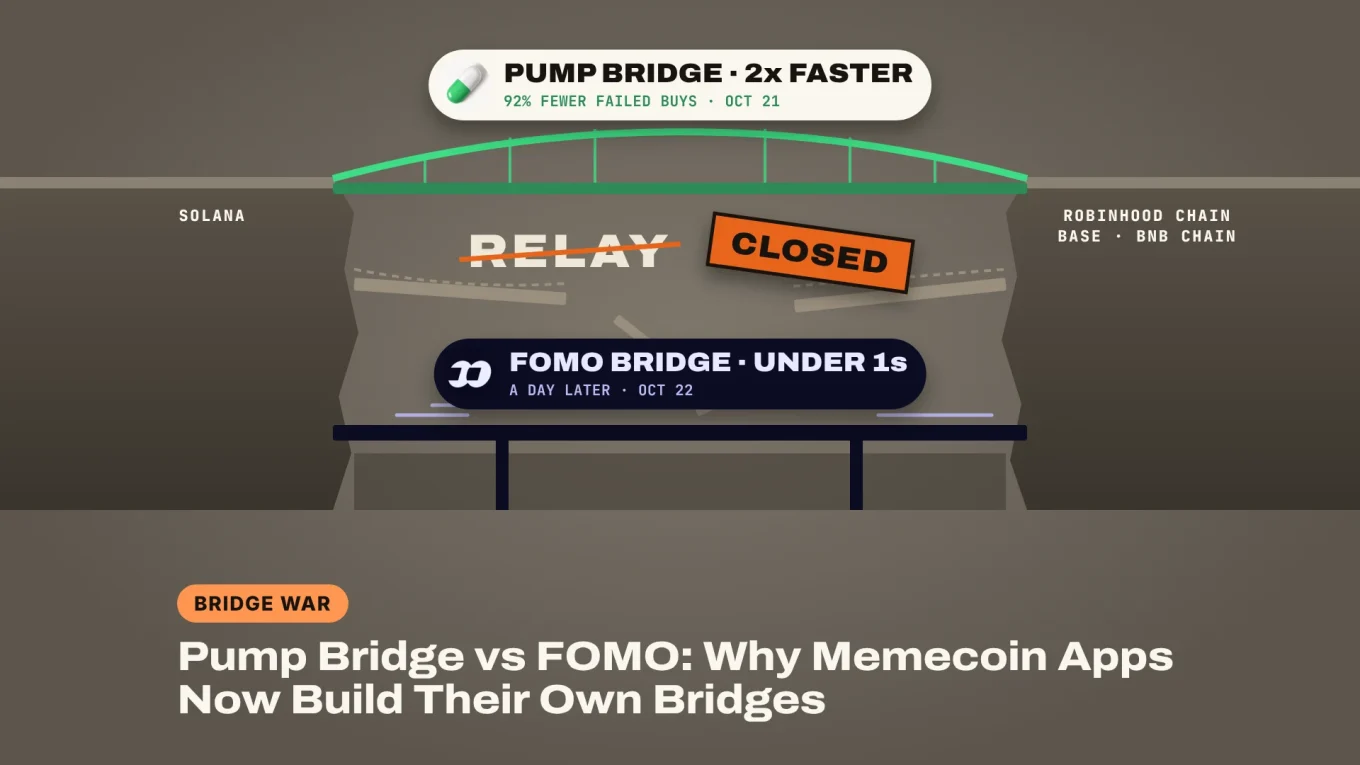
- Pump Bridge went live on October 21: Pump.fun dropped Relay and says its own bridge buys in 1.95 seconds instead of 3.88, with failed buys down 92% from 11.2% to 0.9%.
- Rival FOMO answered about 27 hours later with its own bridge promising crosschain trades in under a second, and Relay’s own dashboard shows FOMO’s new route at 0.25 seconds against 0.34 for Pump Bridge.
- The crew is watching the fills, not the speed: even on Pump Bridge, a typical small buy still landed 3% below the price on screen.
Pump Bridge went live on October 21, and it came with a jab at the competition. Pump.fun said its crosschain trades had been “slow, broken and overpriced for months” on Relay, the bridge it shared with rival app FOMO. Its own bridge, it says, buys twice as fast with 92% fewer failed buys.
FOMO answered about 27 hours later with a bridge of its own and a bigger promise: crosschain trades that land in under a second. Two memecoin apps, two new bridges, one shared supplier dropped in the same week. Why would a trading app bother building a bridge at all?
Pump.fun’s launch post took aim at both apps’ old setup:

Your crosschain trades have been slow, broken and overpriced for months.
Relay, used by Fomo & Pumpfun, has led traders to worse fills, missed trades and poor experiences. We refused to let this go on.
Introducing Pump Bridge: 2x FASTER, 12x FEWER buy errors & the BEST fills 👇
What Is Pump Bridge?
Pump Bridge is the Pump.fun bridge for crosschain trading: its in-house route for buying tokens on other chains straight from Solana. A bridge moves value from one blockchain to another. When you tap buy on a Robinhood Chain or Base memecoin in the Pump.fun app, the bridge is the part that gets your money there before the price runs away.
It replaced Relay as the default route in the Pump.fun mobile app. Pump.fun tested the two side by side from September 28 to October 7, switching users between them at random, across 416,669 trades on Robinhood Chain, BNB Chain, Base, Arc and Ink. Its numbers:
- Speed: a typical buy took 1.95 seconds on Pump Bridge against 3.88 seconds on Relay.
- Failed buys: 0.9% of buys errored, down from 11.2%. For someone making 10 buys a day, that’s one failure every 11 days instead of more than one a day.
- Fills: on USDC buys under $500, the median buy landed 3.0% below the shown price, against 3.6% on Relay.
There’s no extra bridging fee for now; the normal 0.45% trading fee still applies. Pump.fun co-founder Alon followed up with a long post titled “How your social trading app has been robbing you”. No prize for guessing which app he meant.
Sponsored · Affiliate link
Save 20% on fees trading on WEEX
Base Camp may earn a commission if you sign up. It never affects what we write.
How Did FOMO Answer?
With its own bridge and trading router. The FOMO bridge rolled out to everyone after FOMO announced on October 22 at 21:44 UTC that crosschain trades now land in under one second. It had tested quietly for a week with a small share of users. CEO Paul Erlanger said FOMO has “the fastest cross chain transactions of any trading app and it’s not even close.”
Co-founder Seyong made the case that speed only counts under load. “Speed is easy when there’s no traffic,” he wrote, adding that FOMO had more than 50% of all trading wallets at Robinhood Chain’s peak.
Pump Bridge vs FOMO: Which One Is Faster?
On the one public dashboard, both new bridges beat Relay, and FOMO’s is quicker. The data comes from a Dune dashboard published by Relay itself, which measures only the bridge leg of each trade over the 30 days to October 23. Relay says it isn’t checked against its own records, and it isn’t a neutral party.
On buys from Solana to Robinhood Chain, the median trip took 0.25 seconds on FOMO’s new route and 0.34 seconds on Pump Bridge. On Relay it took 0.57 seconds for FOMO and 1.11 seconds for Pump.fun.
Look at those last two numbers again. The same bridge ran twice as fast inside FOMO as inside Pump.fun. In other words, a good part of Pump.fun’s old problem was how it had wired Relay in, not only Relay.
FOMO also moves far more trades. It sent about 2.17 million buys down that route in 30 days, against about 181,000 for Pump.fun, roughly 12 times as many. Not every result goes one way, though. On sells back from Robinhood Chain to Solana, Pump Bridge’s median was 0.55 seconds, slower than the 0.43 seconds Pump.fun got from Relay.
Why Do Memecoin Apps Build Their Own Bridges?
Because on a fresh memecoin, a second is money. Prices on new tokens still on a bonding curve can jump in the seconds a buy is in flight, so a slow or failed bridge means a worse fill or a missed trade. When every app lists the same coins, speed and fill quality are what traders compare.
Owning the bridge also gives each app control. It no longer depends on another company’s queue in a busy hour, it can drop the bridging fee to win users, and it keeps the routing data to itself. Robinhood Chain made this urgent. Its memecoin rush turned crosschain buying from a side feature into the main event, and both apps wanted that flow on their own pipes.
The trade-off sits with the user. A bridge is one of the riskiest pieces of code in crypto, and neither app has said much yet about who supplies the money on the other chain or how a stuck transfer gets refunded. Faster is good. Faster with an unknown failure plan is the part to keep an eye on.
DISCOVER: Bitcoin vs Altcoins vs Stablecoins vs Memecoins: What You’re Actually Buying
What Pump Bridge vs FOMO Means for Traders
Faster buys and fewer failures, for now on both apps. The bigger cost hasn’t moved much, though. Even on Pump Bridge, a typical small buy still landed 3% below the price on screen, and that slippage costs more than the speed gap between the two apps.
All the headline numbers come from the companies or from Relay, so the useful check is your own. Note the price you tap and the price you get on a few small buys in each app. Pump.fun says it’s publishing its raw test data, which will let others run the numbers. Until then, the bridge war is mostly a fight over the last half-second, and the trader pays the 3%.