The short version
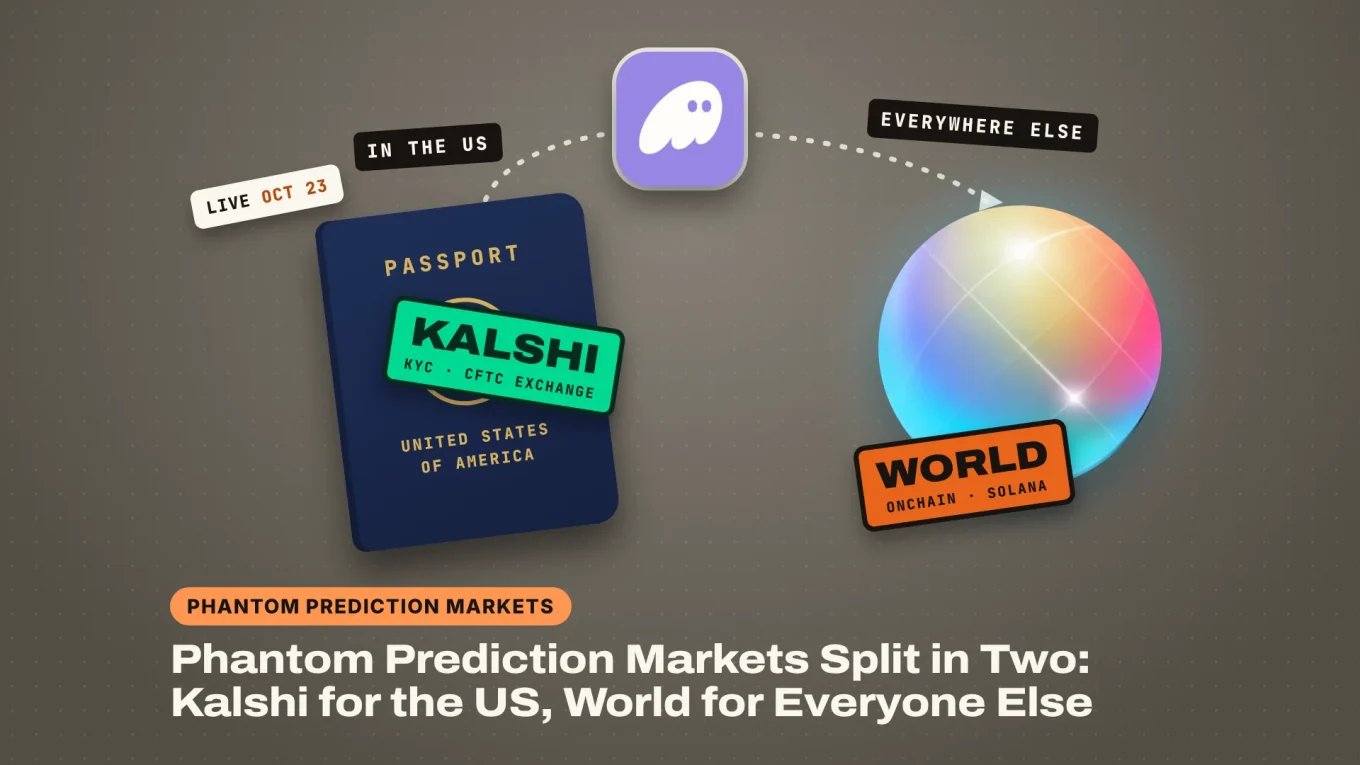
- Phantom prediction markets now run on two platforms: since October 23, US users trade Kalshi markets after Kalshi’s ID checks, while everyone else trades on World, an onchain market on Solana.
- The split follows the law: US event contracts need a CFTC-registered exchange like Kalshi, which holds the funds, while World is non-custodial and pays winners automatically in Phantom’s CASH stablecoin.
- The crew is watching how fast the US rollout reaches everyone, whether more states join Michigan, Nevada and Washington in blocking categories, and how World’s lower fees on lopsided odds hold up.
Phantom prediction markets now come in two versions, and which one you get depends on where you live. On October 23, Phantom began rolling out Kalshi markets to its US users. Everyone else in the wallet keeps trading on World, an onchain prediction market on Solana that has run Phantom’s Predict tab since June 1.
Same tab, same Yes and No buttons. Underneath, the two could hardly be more different: one is a CFTC-regulated exchange that checks your ID and holds your money, the other settles on Solana and pays winners in Phantom’s CASH stablecoin without anyone holding funds. So why does one wallet need both?
World introduced itself on July 1, after a month of powering Phantom’s markets without a public name:

millions wondered "what is world xyz?" 🌎
world is the @solana prediction market
world is live in @phantom with @chainlink as oracle infra
world is how the world trades what happens next
world is just getting started
Why Do Phantom Prediction Markets Run on Two Platforms?
Because US law and the rest of the world want different things. In the US, event contracts have to trade on an exchange registered with the CFTC, and Kalshi is one. Outside the US, Phantom can plug into an onchain protocol with no account to open.
Phantom got its US door opened in March. The CFTC staff gave it no-action relief (Staff Letter 26-09), which lets the wallet offer access to regulated markets without registering as an introducing broker, Phantom general counsel Kevin Jacobs wrote on October 23. Kalshi is that regulated market. Phantom’s help pages now split the product cleanly: in the US, markets are offered through Kalshi; outside it, they are powered by World Prediction Markets on Solana.
Sponsored · Affiliate link
Save 20% on fees trading on WEEX
Base Camp may earn a commission if you sign up. It never affects what we write.
How the Kalshi Side Works for US Users
The Phantom Kalshi setup works like a brokerage account dressed as a wallet. Before the first trade, US users create or link a Kalshi account inside Phantom and pass Kalshi’s KYC checks, which can ask for a Social Security number, a US government ID and, in some cases, a live selfie.
The money leaves the wallet. When you confirm a trade, the funds move from your CASH balance or any Solana token to Kalshi, which holds the trading account, executes the order and decides the outcome. When you cash out or win, Stripe sends the money back to your Cash account, usually within seconds to minutes. Linking an existing Kalshi account doesn’t merge balances, and amounts under $1 can stay stuck at Kalshi because they sit below its withdrawal minimum.
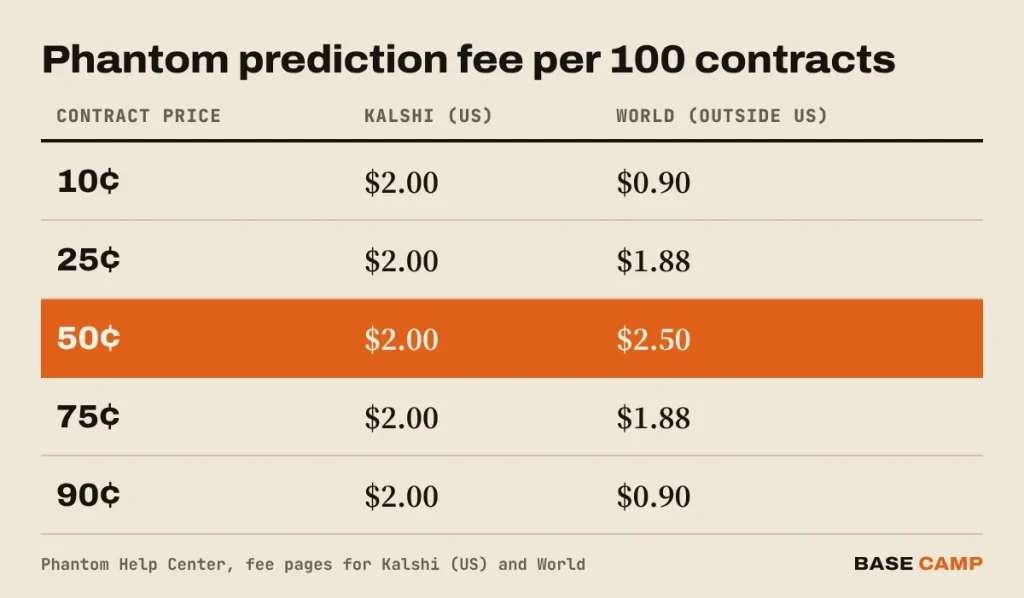
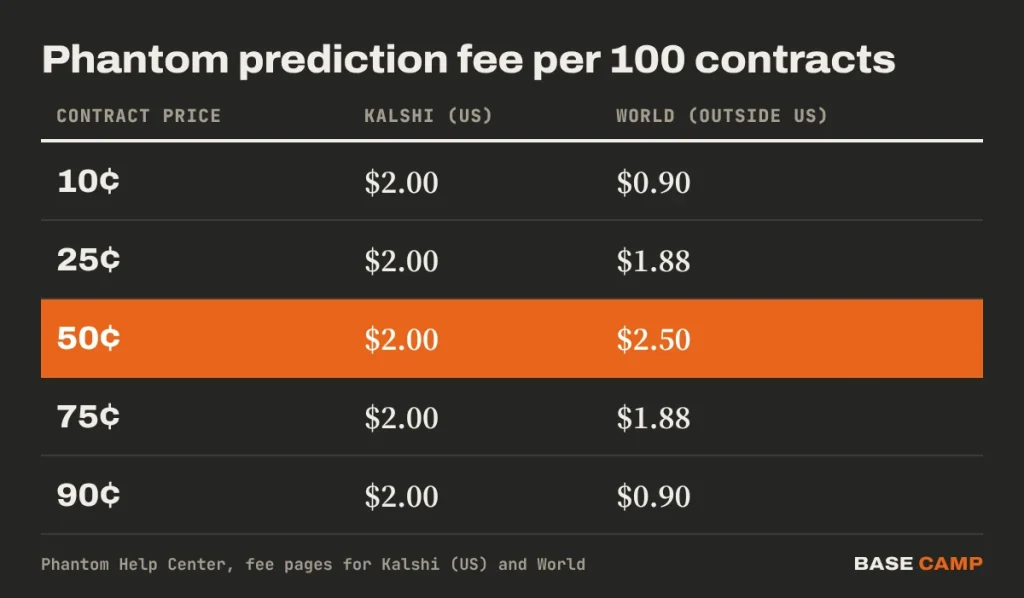
The fee is flat: $0.02 per contract, of which $0.01 goes to Phantom and $0.01 is Kalshi’s exchange fee. A 10-contract trade costs $0.20 in prediction fees, plus a small network fee to move the funds.
Not every market is open in every state. Phantom says it blocks sports markets in Michigan; sports, elections, politics and entertainment in Nevada; and all of those plus culture, science and tech, mentions and geopolitics in Washington, while those states fight Kalshi in court. Access is rolling out over the next few weeks, so not every US user sees the tab yet.
How World Works for Everyone Else
World is the opposite build. It is a non-custodial protocol that routes orders to liquidity providers on Solana, according to Phantom’s prediction market disclosures, and Phantom says it doesn’t take custody of the funds or the positions. Your position is a regular Solana token, an “outcome token”, that sits in your wallet until the market settles.
Markets resolve through an oracle rather than a company’s database. Chainlink became World’s main oracle provider at launch, promising “immediate resolutions & instant payouts”. Winning positions pay out automatically as CASH to the Phantom account that was active when the market resolved; losers settle at $0.
SIDE TRAIL: Prediction Markets Under Pressure: Pentagon Bans Insider Bets, Polymarket Reportedly Fires Its CMO
The fee works differently too. Phantom charges 0.1 × p × (1 − p) per contract, where p is the contract price. That is $0.025 per contract at a 50-cent price and drops toward zero near $0 or $1. So the cheaper side depends on the odds: World costs less on long shots and near-certainties, the Kalshi route costs less on coin flips between roughly 28 and 72 cents.
The team behind World hasn’t put names to the project, and no World token has been announced. It has since opened its own app at world.xyz, but the Phantom wallet is still its biggest door.
Wait, Didn’t Phantom Already Use Kalshi?
It did, in a different way. Phantom launched its prediction markets on December 12, 2025 “powered by Kalshi”, but not through a Kalshi account. DFlow wrapped Kalshi’s markets into tokenized event contracts that wallet users bought with Solana tokens or CASH, and it was never open to US users.
That setup ended for new trades on June 1. Positions opened before then still run on Kalshi via DFlow, and redeeming a win means swapping the expired outcome token back for the stablecoin you paid with, at a quote that can differ from the contract price. Positions opened since June 1 run on World and pay out on their own.
So Kalshi left Phantom’s international tab in June and came back in October, this time as a regulated exchange for Americans only.
What the Crew Is Watching
Three things. First, how fast the US rollout reaches everyone, and whether the Michigan, Nevada and Washington blocks spread to more states as the court cases move. Jacobs said Phantom is “confident and comfortable” because the CFTC’s jurisdiction is clear, but the states don’t agree yet.
Second, whether Phantom prediction markets outside the US keep their pull now that Americans get a regulated version in the same app; World’s automatic payouts and lower fees on lopsided markets are its selling points. And third, what Phantom does with all that CASH, since winnings on both sides land in its stablecoin.
TRAIL MAP: Bitcoin October Low: Bettors Give a Dip Below $77,500 a 45% Chance
For the basics, our glossary explains how a prediction market prices the odds.

In crypto since 2017, trading stocks for over 20 years. MBA. Follows the economic data and US markets closely.
More from Satoshi Flipper →