The short version
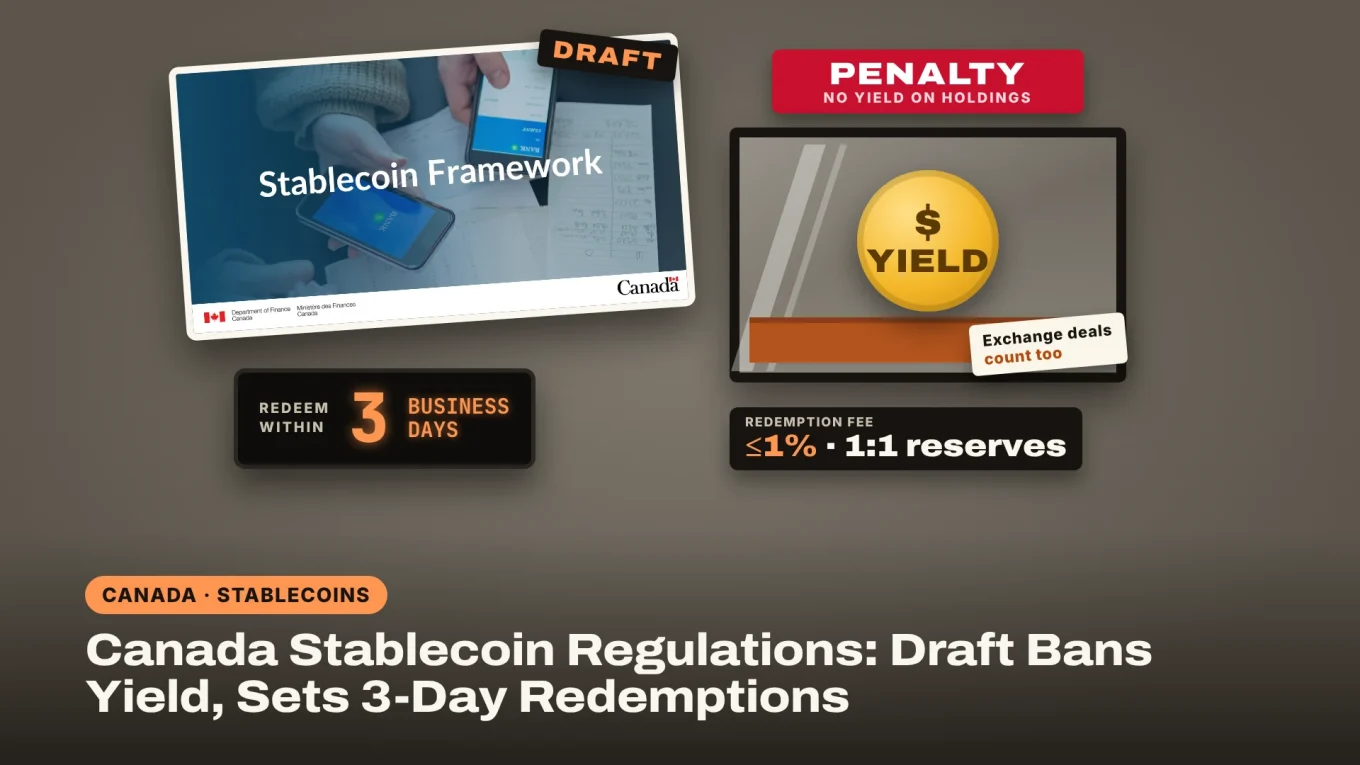
- Canada stablecoin regulations are out in draft: issuers need 1:1 reserves, must redeem within three business days with no minimum, and can charge at most 1%.
- The yield ban covers deals where an issuer shares income with an exchange or app, while rewards for using a stablecoin stay allowed.
- The crew is watching the comment window to December 23 and whether Circle and exchanges fight the income-sharing clause before the fall 2027 start.
Canada stablecoin regulations are finally on paper. Ottawa has published the draft rules that switch on the Canada Stablecoin Act, passed in March, and they ban paying holders to sit on a stablecoin while forcing issuers to pay out within three business days. The country’s own Canadian-dollar coins add up to about $3.5 million.
Finance Canada posted the draft on October 23, and the full text ran in the Canada Gazette the next day. Comments are open for 60 days, until December 23, and the rules are meant to start in fall 2027.
Finance Canada announced it on X:

Today, proposed regulations to bring the Stablecoin Act into force were pre-published for a 60-day comment period, supporting competition and innovation in the Canadian financial sector.
What Do the Canada Stablecoin Regulations Require?
Full backing and fast redemptions, with no interest. Any issuer that offers a fiat-backed stablecoin to people in Canada, including a foreign one like Circle, has to register with the Bank of Canada and follow these rules.
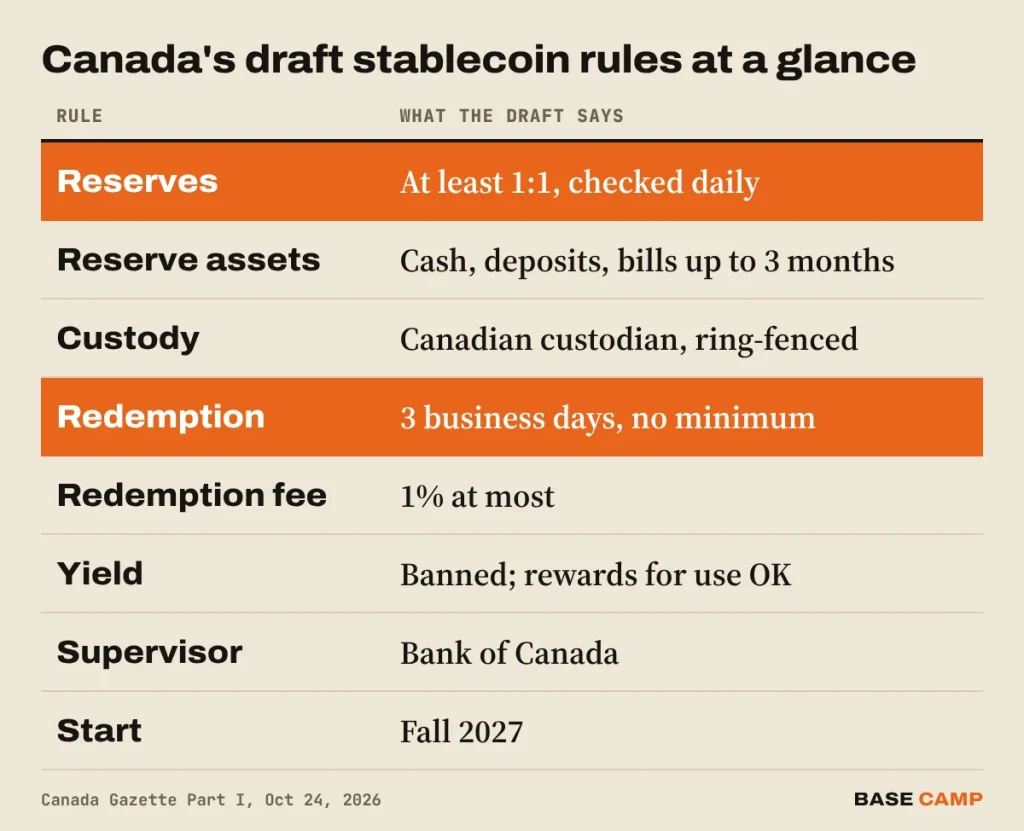
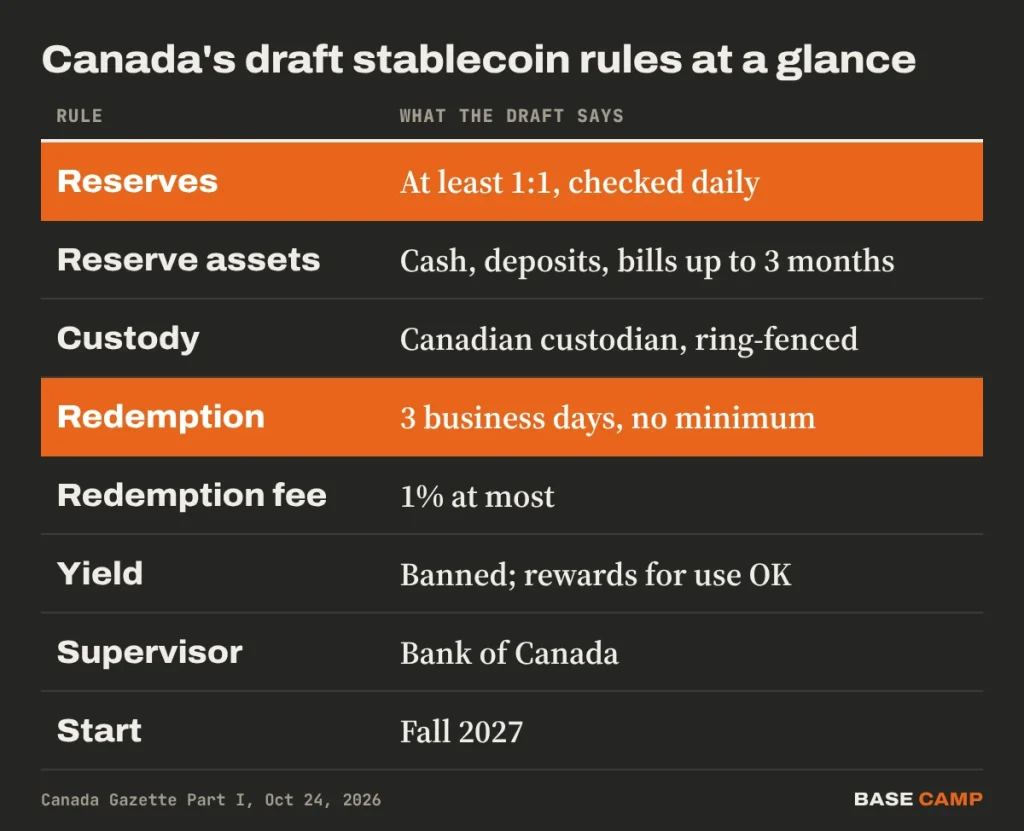
Reserves must be held in the coin’s own currency at a Canadian-incorporated custodian, in an account creditors can’t touch if the issuer goes bust. An issuer can only cap daily redemptions when the markets for its reserve assets run short of cash, and it has to spell out in advance when that could happen.
Supervision by the Bank of Canada should cost about $1.8 million a year, billed to issuers. The biggest, with roughly $710 million or more in coins out, pay a base fee of about $530,000 plus most of the rest. The smallest pay about $18,000.
Sponsored · Affiliate link
Save 20% on fees trading on WEEX
Base Camp may earn a commission if you sign up. It never affects what we write.
The Stablecoin Yield Ban Reaches Past the Issuer
This is the part to read twice. Section 14 bans “interest or yield tied to the holding of a stablecoin”, and it also catches indirect payments. If an issuer has a deal with an exchange or app that lets the partner earn yield on the coin, “including through income sharing”, or nudges it to pass yield on to holders, it counts as the issuer paying yield.
That goes at the model behind many US “rewards on your USDC” offers, where the issuer shares reserve income with the platform that pays users. Canada leaves one door open: a reward tied “only to the use and not the holding” of a stablecoin, like cashback on a payment, is still allowed.
In seven roundtables in January and three in June, fintechs and financial institutions both called yield “an important issue”, according to the notice. Ottawa kept the ban anyway.
SIDE TRAIL: Stablecoin Supply Falls to $301.6B as USDC Drops $4.15B
Who Is Affected?
Not many issuers yet. Ottawa expects the rules to cover five, and names three: QCAD from Stablecorp, CADC from Loon Technology and USDC from Circle.
Canada’s own coins are tiny. DefiLlama data shows QCAD at about $1.26 million in circulation, CADC at $1.2 million and Tetra’s CADD at $1 million. USDC alone has $71.3 billion out, inside a $303 billion stablecoin market.
That gap is what Ottawa is betting on. The notice says the goal is “to promote competition and innovation in the financial sector”, and the rules were written to line up with the US, UK and EU so Canadian coins could one day be recognized abroad. It also admits it can’t predict whether the US will treat Canada’s regime as comparable.
What Happens Next
The Canada stablecoin regulations can still change. After December 23 Finance Canada reviews the comments and publishes final rules in Part II of the Gazette. Existing issuers then get 30 days to apply for registration once the Act takes effect.
TRAIL MAP: Bitcoin vs Altcoins vs Stablecoins vs Memecoins: What You’re Actually Buying
Until then nothing changes for anyone holding USDC in Canada. What to watch: whether exchanges and Circle push back on the income-sharing clause before the comment window shuts.

On the climb since 2017. Trades futures and reads onchain data. Automates the boring parts.
More from VikingXBT →