The short version
- Bitcoin bridges could work without operators or challengers if Praxis, a new witness encryption preprint from Babylon’s David Tse and two co-authors, holds up.
- The paper claims a 7.88 GiB encrypted file at 100-bit security, against hundreds of terabytes in a preprint first posted in February, but it has not been peer reviewed.
- BABY is up about 14% over 24 hours to $0.00889, with no proof that the paper is the reason.
7.88 GiB. That is how big one encrypted file gets in a new paper that has Bitcoin builders talking. A design first posted in February put the same kind of job at hundreds of terabytes.
The preprint is called Praxis. It comes from David Tse, a Stanford professor and Babylon co-founder, with Nikhil Vanjani and Psi Vesely. If it holds up, Bitcoin bridges could one day check proofs with no operators and no challengers.
Traders noticed too. Babylon’s token, BABY, is up about 14% over 24 hours on Binance while Bitcoin is down 1.7% to $60,735 at the time of writing. So what did the team actually publish?
Tse announced it on Monday at 13:31 UTC (5:31 a.m. in California):

The first practical solution to witness encryption for general NP:
eprint.iacr.org/2026/2971
At 100 bits security: ciphertext size: <8 GB, encryption and decryption time: seconds. Formally lean verified from standard security assumptions (bi-linear generic group and random oracle
What Is Witness Encryption?
It is a lock that opens for a proof instead of a key. You encrypt a message to a statement, and whoever can prove the statement true can decrypt it.
Now imagine a Bitcoin key inside that lock, with the statement “these coins were burned on the other chain.” A valid zero-knowledge proof would open it and free the BTC. Nobody has to sign off. That is the dream for Bitcoin bridges, anyway.
Cryptographers have chased witness encryption for over a decade without a usable version. The paper’s abstract gives these costs at 100-bit security:
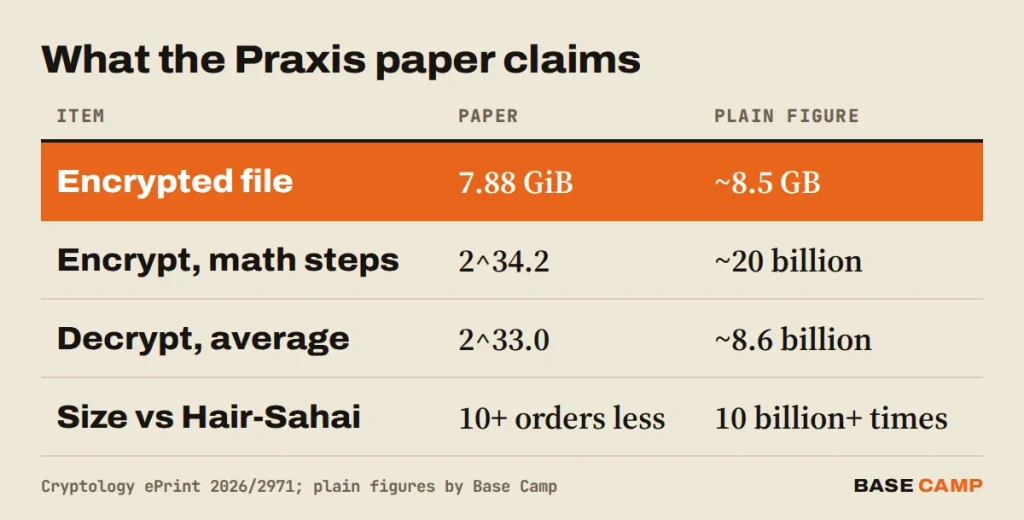
Tse’s post says both steps take “seconds.” The abstract gives no timings and names no hardware, so that claim is Tse’s for now.
Sponsored · Affiliate link
Save 20% on fees trading on WEEX
Base Camp may earn a commission if you sign up. It never affects what we write.
How Do Bitcoin Bridges Work Today?
With someone on watch. A bridge moves coins between chains, and Bitcoin can’t easily check what happened on the other side by itself.
- BitVM2: its paper needs one honest party during setup and one rational operator to keep things moving. Any user can challenge.
- BitVM3: a challenger catches an operator’s false claim, for about $9 in total on-chain cost. A worst-case BitVM2 dispute runs about $16,000.
- Babylon’s vaults: they avoid bridging, but the docs still list “Universal Challengers” who watch for invalid proofs, on top of the depositor’s own right to challenge.
Praxis aims to make all that watching unnecessary. BitVM creator Robin Linus, who co-wrote both BitVM papers with Tse, spelled out what is at stake and on what condition:

If this witness encryption construction holds up against independent peer review, it will fundamentally improve Bitcoin bridges. Eliminating the need for operators and making deposits and withdrawals non-interactive.
SIDE TRAIL: Fusionist ACE Bridge Exploit: Unbacked Mint Sold for $2M, Then Traders Drained $3.7M of Real ACE
The Catch: No Peer Review Yet
ePrint received Praxis on November 21 and approved it on November 23, but that only clears it for posting. The page still says “Preprint.”
The authors give Lean 4 proofs, which a computer can check, for correctness and for extraction: in short, that breaking the lock takes a real proof. Those rest on idealized models and a lattice problem called Module-SIS, and the instantiation needs a Groth16 setup that was run honestly.
It isn’t the first attempt, either. That February preprint already called its design “implementable.” Praxis itself builds on Hair and Sahai’s September paper, which Tse describes as a feasibility result. The big word in the new claim is “practical.”
Babylon has plenty else on its plate. Co-founder Fisher Yu suggested on November 17 that the community consider sunsetting Babylon Bitcoin staking by year-end to focus on the vaults.
BABY Price: A Bounce Below the 50-Day Average
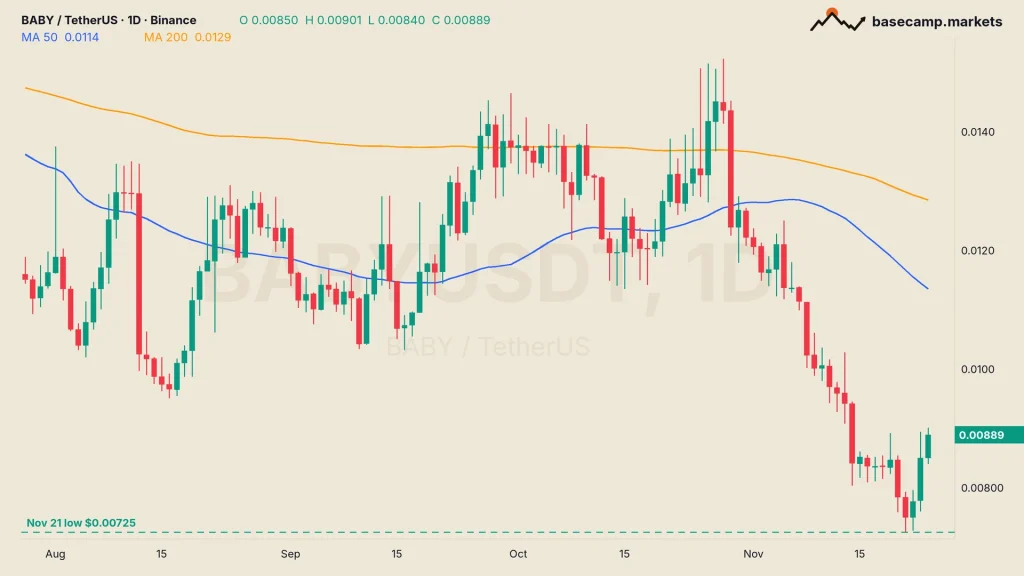
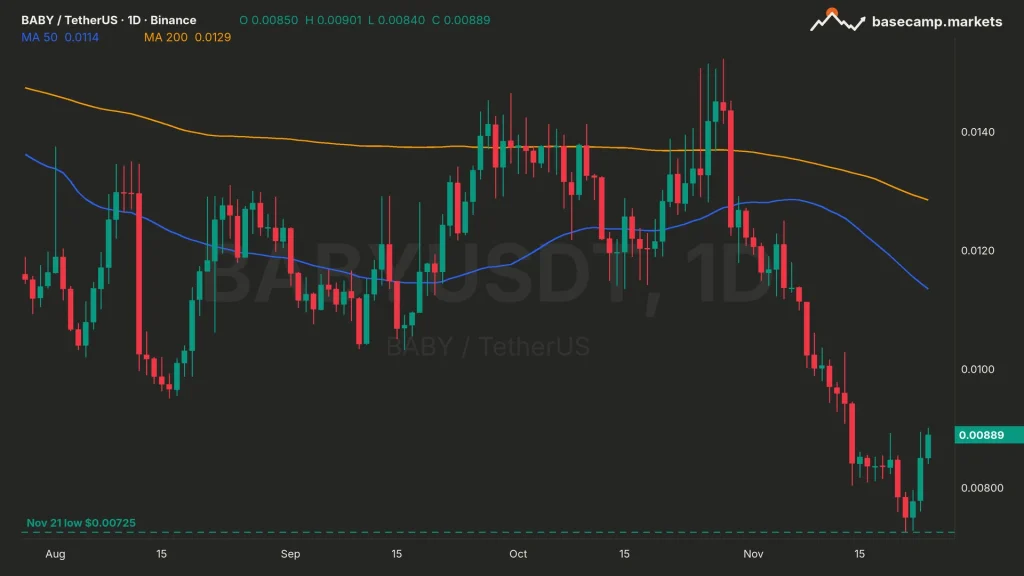
The BABY price is $0.00889, about 23% above Saturday’s $0.00725 low. It stood at $0.00772 at 12:00 UTC on Monday, before the post, and has since touched $0.00901. The timing fits, but nothing proves the paper moved it. The 50-day moving average is still well above at $0.0114.
TRAIL MAP: DeFi Basics: Swaps, Liquidity Pools and Impermanent Loss
Even inside Babylon, the cheer came with a request. “This could be the singularity of applied cryptography,” Yu wrote on X, before adding: “Look forward to peer reviews!”

Satoshi Flipper has more than 20 years of trading experience, starting in stocks before moving into crypto in 2017, and holds an MBA from the Kellogg School of Management. The edge is reading the economic data: rate decisions, inflation, jobs numbers, earnings and the US markets that move Bitcoin.
More from Satoshi Flipper