The short version
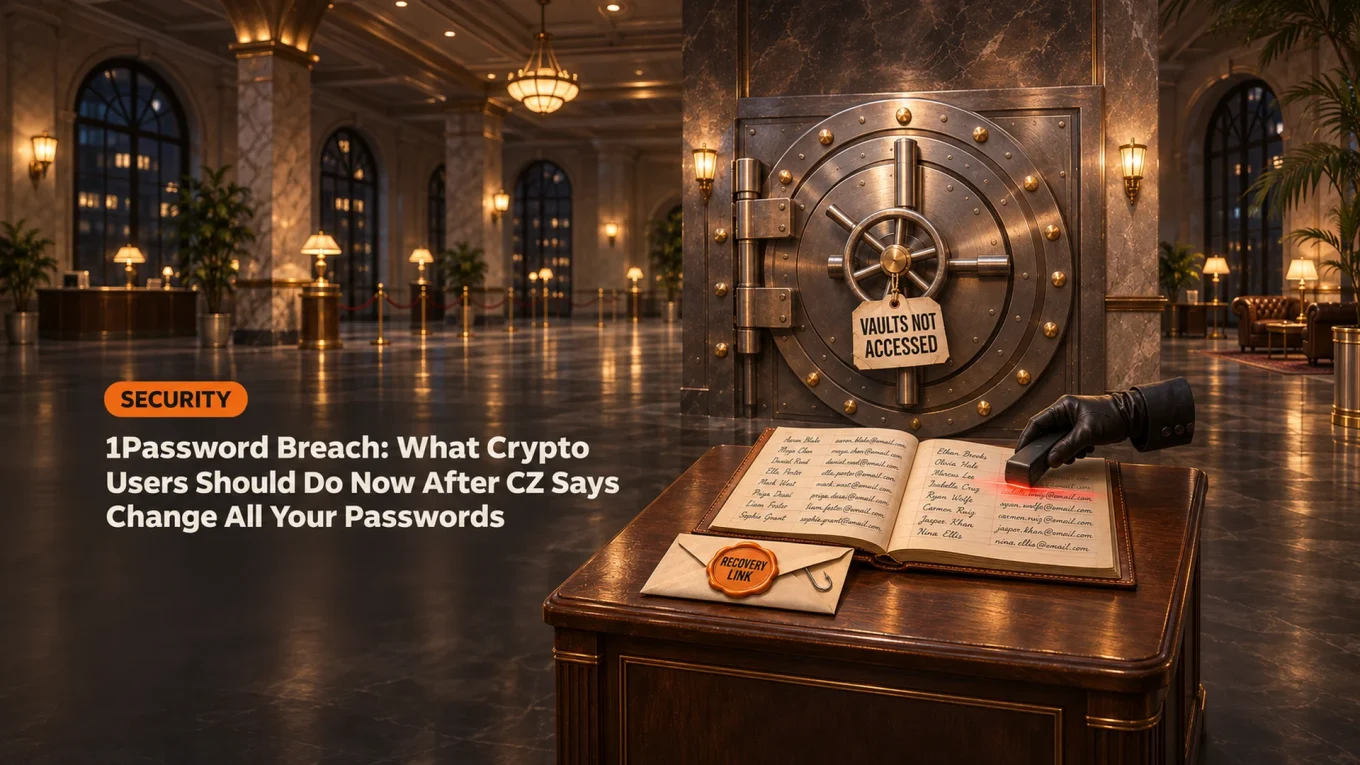
- 1Password breach: an attacker used one employee’s GitHub account to take names, emails and account records for a subset of users, but not vaults or master passwords.
- CZ told users to change all their passwords, while 1Password says no reset is needed and no account takeovers were found.
- The bigger risk for crypto users is phishing: fake recovery or invitation emails sent to a list of confirmed 1Password customers.
“It’s a pain in the neck, but necessary.” That was CZ’s verdict on the 1Password breach, posted early on Thursday to anyone who uses the password manager: change all of your passwords.
1Password itself says you don’t need to change anything. Both can’t be the whole story, so what actually leaked, and what should a crypto user do this morning?
CZ posted his advice as a quote of a breach alert, at 02:17 UTC:

If you use 1Password, recommend you to change ALL your passwords. It's a pain in the neck, but necessary.
What Did the 1Password Breach Expose?
Account records for a subset of users, not the vaults. 1Password says in its incident update that it started investigating on November 19, after signs that an attacker had taken over an employee’s corporate GitHub account.
The chain from there is short:
- GitHub account taken = access to private source code and the CI/CD system, the pipeline that builds and ships the company’s code.
- Malicious code pushed to backend services = customer account records downloaded.
- Those records = names, email addresses, account and user IDs, sign-up and last sign-in times, public keys and login protocol parameters.
For a small group of users who were in the middle of an invitation, setup or account recovery, the attacker also got the tokens inside those emailed links. 1Password says a token alone doesn’t open an account. It also needs an SSO sign-in or an emailed code, and the company has stretched that code from six digits to ten letters and numbers. Those users were told directly.
What wasn’t touched, per the company: vaults, the items in them, the keys that protect them and account recovery keys. 1Password doesn’t store your account password or Secret Key, so it couldn’t lose them. It says it found no account takeovers.
The company’s own post went out on Wednesday, November 25, at 17:28 UTC:

We’re sharing an update about a recent security incident involving some of 1Password’s backend systems. 𝗡𝗼 𝗰𝘂𝘀𝘁𝗼𝗺𝗲𝗿 𝘃𝗮𝘂𝗹𝘁 𝗰𝗼𝗻𝘁𝗲𝗻𝘁, 𝗶𝗻𝗰𝗹𝘂𝗱𝗶𝗻𝗴 𝘀𝗲𝗰𝗿𝗲𝘁𝘀, 𝗽𝗮𝘀𝘀𝘄𝗼𝗿𝗱𝘀 𝗮𝗻𝗱 𝗼𝘁𝗵𝗲𝗿 𝘃𝗮𝘂𝗹𝘁 𝗶𝘁𝗲𝗺𝘀, 𝗼𝗿 𝘁𝗵𝗲 𝗸𝗲𝘆𝘀 𝘁𝗵𝗮𝘁
Sponsored · Affiliate link
Save 20% on fees trading on WEEX
Base Camp may earn a commission if you sign up. It never affects what we write.
So Is CZ Right to Say Change Everything?
Not strictly needed, but not harmful either. Nothing in the 1Password data breach points to stolen passwords, so a full reset fixes a problem the company says you don’t have.
The real risk is 1Password phishing. A list of confirmed customers’ names and emails is a gift to a phishing crew. Expect fake “recovery” or “invitation” emails that look official. Changing 50 passwords does nothing against a fake login page you type the new ones into.
SIDE TRAIL: Two-Factor Authentication for Crypto Accounts
What Crypto Users Should Do Now
In order of what matters most:
- Ignore 1Password emails you didn’t ask for. Open the app or type the address yourself. The company says it will never ask for your account password or Secret Key.
- Change the passwords that unlock money first. If you follow CZ’s advice, start with your email (it resets everything else), then exchanges, then the rest.
- Check your exchange settings. Turn on the anti-phishing code and a withdrawal address allowlist where your exchange offers them.
- Move 2FA off SMS. An authenticator app or a hardware key is better. If your 2FA codes live in the same vault as the passwords, one breach opens both doors.
- Keep seed phrases out of any password manager. Paper or metal, offline, is the safe default for a seed phrase.
The 1Password breach didn’t expose vaults, so this is no reason to panic-move coins today. But if a seed phrase sits in any cloud vault, it is only as safe as that company’s next bad week. For bigger amounts, a new wallet with a fresh seed written on paper is the cleaner fix.
Why It Lands Harder in Crypto
A leaked bank login can often be reversed. A drained wallet can’t. That is why crypto users read every password manager headline twice, and why scam crews follow them closely.
The source code taken in the breach adds a second question for later. 1Password says it holds no user secrets, and it has started a rotation of every credential that may have been exposed. Outside security experts are checking the cleanup.
TRAIL MAP: 10 Common Crypto Scams and How to Spot Them
The vault held. The inbox is where this breach will be tested.

Teddy has been trading crypto since 2016. The focus is altcoins and EMA setups: finding coins sitting on key levels, waiting for support to hold or a range to be reclaimed, and trading the move from there. Bitcoin sets the tone, but the opportunities are usually in the alts.
More from Teddy