
The short version
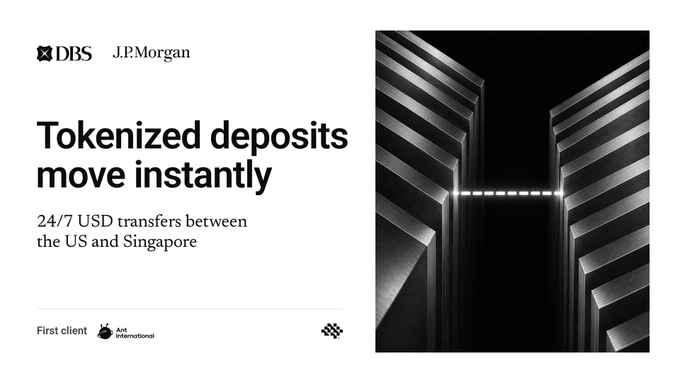
- Tokenized deposits now move between DBS in Singapore and Kinexys by J.P. Morgan in the US instantly, 24/7 and on weekends, the banks said on November 16.
- Ant International is the first client, shifting US dollars between its own companies in both markets for treasury and liquidity.
- These are bank deposits on permissioned blockchains, not stablecoins, and only one gap remains: a three-hour pause every Saturday, 20:00 to 23:00 UTC.
Saturday used to be a dead day for anyone moving corporate dollars between Asia and America. Two of the biggest banks on either side of the Pacific just took that excuse away.
DBS, Singapore’s largest bank, and Kinexys by J.P. Morgan, the US bank’s blockchain unit, launched a link on Monday that lets institutions move tokenized deposits in US dollars between Singapore and the US instantly, around the clock, weekends included. Ant International is the first client. So is this the banks’ answer to stablecoins? Pretty much, with one big difference.
Jay Jo, head of product at Tiger Research, flagged the launch within hours of the announcement:

How Do the 24/7 Transfers Work?
Each bank runs its own blockchain ledger for client deposits, and the new link lets dollars cross between the two in real time. On one side sits DBS Token Services. On the other, JPMorgan’s Blockchain Deposit Account network on Kinexys. Both are permissioned, meaning only vetted clients of the banks can use them.
Partior, a settlement network DBS and JPMorgan helped found, handles the orchestration between them. The link puts into practice the framework the two banks announced in November 2025, and it feeds Project BLOOM, a program led by the Monetary Authority of Singapore. DBS and Kinexys co-lead its token interoperability workgroup.
“Tokenised money is moving rapidly from experimentation to delivering live tangible value for clients,” said Rachel Chew, chief operating officer and co-head of digital assets in DBS’s global transaction services unit.
There is one gap, tucked into a footnote. Moving money between JPMorgan’s blockchain accounts and its ordinary deposit accounts pauses for three hours every Saturday, from 20:00 to 23:00 UTC (3:00 to 6:00 p.m. in New York). An upgrade is in the works.
Sponsored · Affiliate link
Save 20% on fees trading on WEEX
Base Camp may earn a commission if you sign up. It never affects what we write.
Why Does Ant International Want Weekend Dollars?
Because its business doesn’t stop on Friday night. Ant International runs payments across many time zones and will use the link to shift dollars between its own companies in the US and Singapore for treasury and liquidity.
It knows both banks well. Ant tested DBS Treasury Tokens for round-the-clock cash moves in 2024 and was one of the first companies in Asia on the Kinexys deposit network.
Payments analyst Simon Taylor thinks that is exactly why the link works: Ant banks at both ends, so neither bank has to hold the other’s token.

🚨 BREAKING: JPMorgan and DBS just linked their tokenized deposits.
Ant International is the first client, and I think Ant is why it works.
A tokenized deposit is a bank balance recorded on a blockchain. JPMorgan's blockchain unit, Kinexys, and DBS each ran their own and have
“We require treasury solutions with round-the-clock agility, speed and efficiency to meet our customers’ needs,” said Kelvin Li, general manager of platform tech at Ant International.
The banks are chasing a big pot. Outbound cross-border payments from Asia could hit $24 trillion by 2033, almost double the $13.5 trillion of 2025, according to Money20/20 and FXC Intelligence figures DBS quotes. A DBS survey found 88% of corporations already deploying or piloting tokenized money.
SIDE TRAIL: Visa Stablecoin Settlement Adds Monad: What It Means for MON
Tokenized Deposits vs Stablecoins: What’s the Difference?
A tokenized deposit is a bank deposit written on a blockchain. A stablecoin is a token sold against a pile of reserves, usually by a company that isn’t a bank.
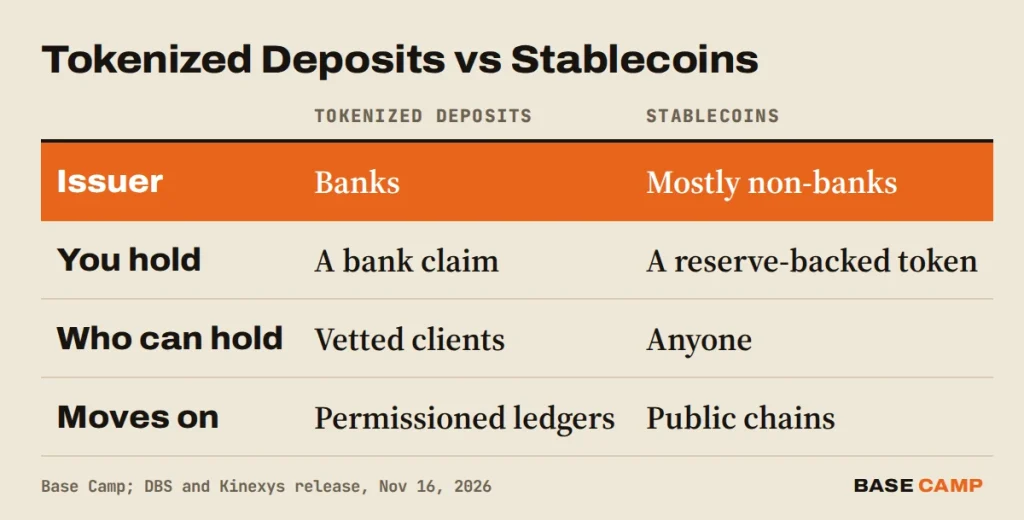
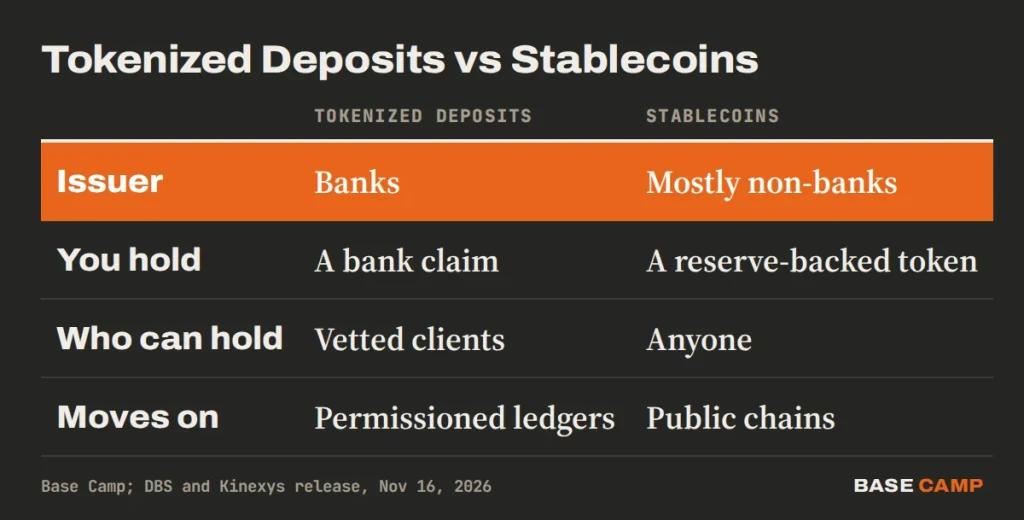
That matters for who carries the risk. A dollar at DBS or JPMorgan stays a dollar at DBS or JPMorgan, inside bank rules and capital requirements, even when it moves on a blockchain. A USDT or USDC balance is only as good as the issuer’s reserves, but it trades on public chains and anyone can hold it.
For context, stablecoins in circulation add up to about $287.5 billion, according to DefiLlama. The banks are betting that big corporate treasurers would rather get the same weekend speed without leaving the banking system.
Neither bank shared a volume or a dollar figure for the new link. For now, Ant International is the only client with its name on it.

Satoshi Flipper has more than 20 years of trading experience, starting in stocks before moving into crypto in 2017, and holds an MBA from the Kellogg School of Management. The edge is reading the economic data: rate decisions, inflation, jobs numbers, earnings and the US markets that move Bitcoin.
More from Satoshi Flipper