The short version
- Glamsterdam Hoodi upgrade: Ethereum developers set the last testnet fork for epoch 143616, December 15 at 19:12 UTC, on Thursday’s ACDC #192 call.
- They kept the EIP-8037 gas change exactly as written, a month after it cost Hoodi its October 26 date over 13 live contracts at risk.
- Next: the Hoodi fork on December 15, then a mainnet date. Follow Base Camp on X to see the date first.
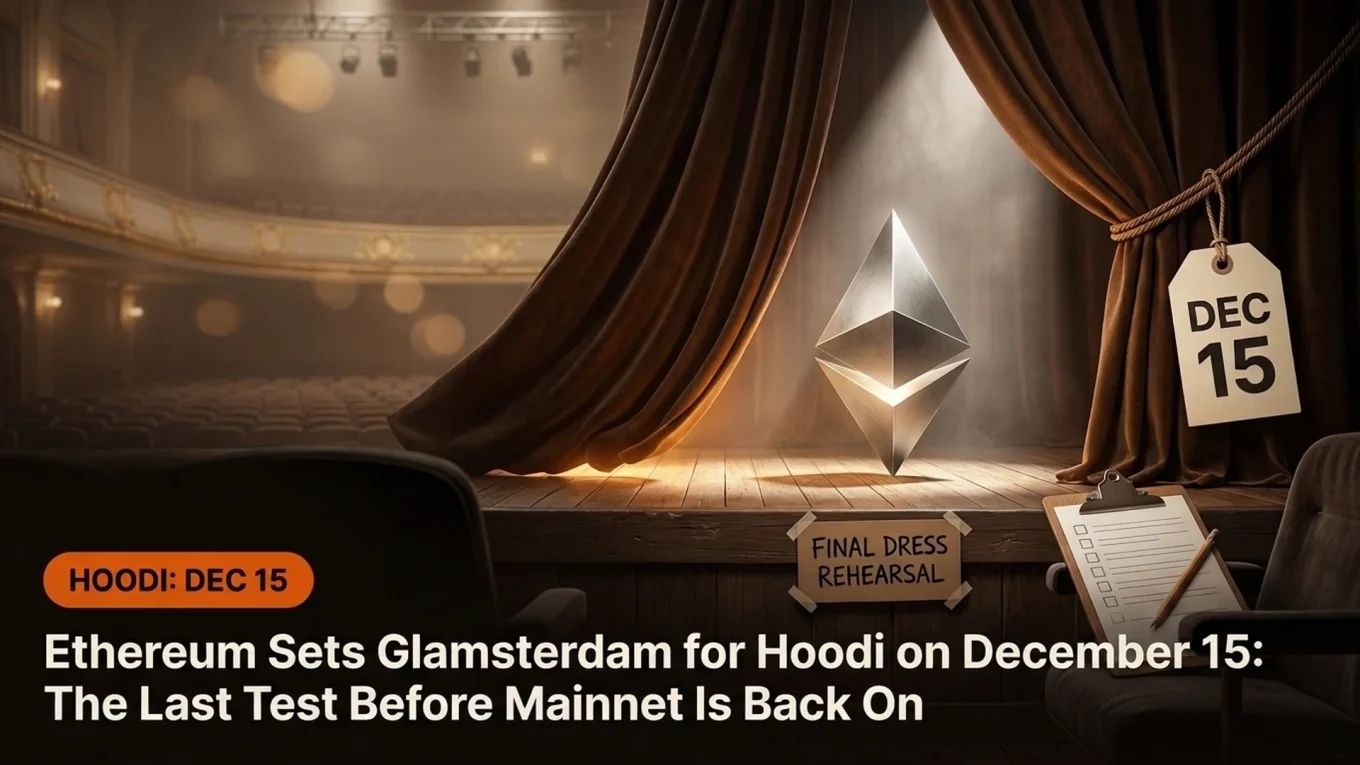
Glamsterdam has a date again. On Thursday’s consensus-layer developer call, ACDC #192, Ethereum’s core developers locked the Glamsterdam Hoodi upgrade for epoch 143616. That is December 15 at 19:12 UTC (2:12 p.m. Eastern).
Hoodi is the last public testnet before mainnet. A month ago it lost its October 26 slot over a gas change that can trip up live contracts. This time nobody fixed the gas change. Developers weighed the patches on the table, decided none was worth another delay, and kept the spec exactly as it is.
So the upgrade is moving again. What did they agree, and when does mainnet get its turn?
Lodestar, one of the consensus clients, posted the date minutes after the call:

Green light for Glamsterdam on Hoodi!
Core devs just locked in the Hoodi testnet upgrade for Dec 15, 2026 (19:12 UTC / Epoch 143,616)
What Did Developers Decide on ACDC #192?
Three things: ship the gas change as written, pick a payload check, and set the date. The call summary in the ethereum/pm repo lists all three as decisions.
The execution teams went first. Ansgar Dietrichs went client by client on EIP-8037, the rule that makes creating new state on Ethereum much more expensive. Reth and ethrex wanted to ship it unchanged. Geth and Nethermind called it a hard trade-off, Besu abstained, and nobody blocked it. The summary’s line: no spec change “clears the bar vs. delay cost.”
The consensus teams then chose PR 5770, a block-hash check on the payloads that builders hand to validators, over a bigger alternative. It keeps Sepolia, which forked on October 6, compatible. No redo there.
Then the date. Epoch 143616 lands on Tuesday, December 15, at 19:12 UTC. We checked the arithmetic: 143,616 epochs of 6.4 minutes after Hoodi’s March 2025 launch ends at exactly that minute. Chair Ben Edgington explained why it can’t slip much: “We probably don’t want to do an upgrade much later than the 15th or 16th, because we’re getting into the holiday season.”
Sponsored · Affiliate link
Save 20% on fees trading on WEEX
Base Camp may earn a commission if you sign up. It never affects what we write.
Why the Glamsterdam Hoodi Fork Slipped in October
Because of a quirk in EIP-8037. Security firm ChainSecurity showed that under the new rules, gas can come back to a contract after a failed call. Some contracts rely on running out of gas at that moment. When the test was pulled, we covered the 13 live contracts ChainSecurity flagged and how a claim a user could retry might turn into a permanent loss.
ChainSecurity announced that first delay on X the day it was decided:

⚠️ It has just been decided to delay the Glamsterdam hard fork on the Hoodi testnet because of security impacts we identified in this blog post: chainsecurity.com/blog/glamsterd…
We already found 13 real-world examples and are in responsible disclosure with the affected projects.
Please
That quirk is still there. What changed is how sure developers are about who it hits. “Everyone involved in the audits and impact analysis of 8037 specifically seems… confident that the understanding we have now for the impact of these changes is… comprehensive,” Dietrichs said on the call. Nobody expects the Glamsterdam Hoodi fork to turn up more affected projects.
Not everyone was happy about it. Felix from Geth put it plainly: “We just have to see what is the amount of breakage that will happen.” Reth’s Dragan Rakita pushed the other way: “In general, this delay of few months is too long.”
SIDE TRAIL: Bit Digital Sells 29,825 ETH at About $1,676 to Halve Its Galaxy Loan
When Does Glamsterdam Reach Mainnet?
There is no mainnet date yet. Dietrichs laid out the order on the call: “Hoodi before the end of this year, and then we schedule a mainnet date.”
That sounds vague. It isn’t, really. With both testnets on the same spec, Thursday’s vote also locks what goes to mainnet, “unless something completely unexpected happens.” Only the timing stays open. The Glamsterdam upgrade still brings enshrined proposer-builder separation and block-level access lists, the two changes built to let Ethereum carry much more activity.
ETH holders don’t have to do anything. Teams running Hoodi nodes and validators need new client releases before December 15. The consensus spec release was due within a day of the call, and staking operator stakefish expects client releases early next week.
Ethereum Price Analysis: Where Does the Weekly Chart Sit?
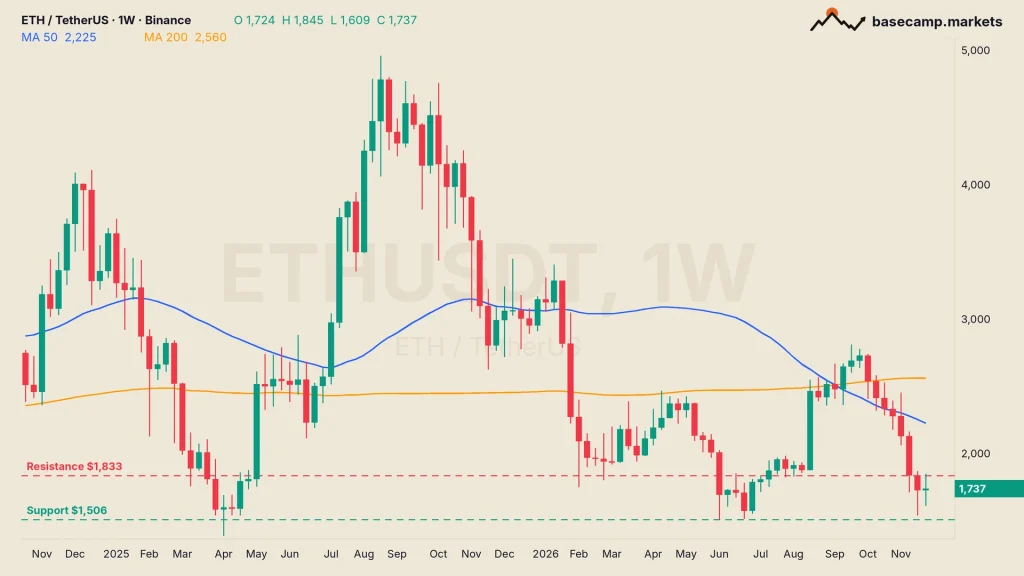
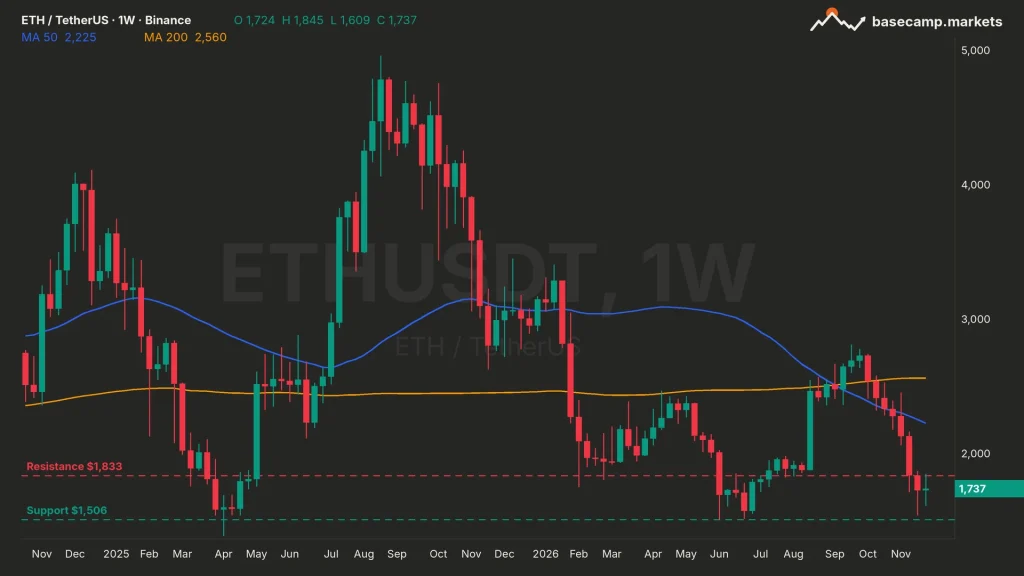
Below both weekly averages. ETH trades at $1,733.44 at the time of writing, up 2.63% over 24 hours and down 26.49% over 30 days. It sits under both its 50-week moving average (MA) at $2,225 and its 200-week MA at $2,560.
- The ceiling: $1,833.40. The nearest swing high. This week’s bounce poked above it to $1,845 and fell back.
- The floor: $1,505.68. The June 6 low, the level the weekly candles keep coming back to.
A testnet date rarely moves ETH by itself. For this Ethereum price analysis, the weekly close above $1,506 matters more than any fork calendar.
TRAIL MAP: Multi-Timeframe Analysis
One testnet already runs Glamsterdam. Hoodi is the last box to tick.

TheCryptoMonk has been trading since 2017 and reads the market from the top down. The focus is macro and the high timeframes: where stocks, rates and liquidity are heading, and what the weekly and monthly charts say about Bitcoin. Short-term noise matters less than the bigger trend.
More from TheCryptoMonk