
The short version
- MSCI Strategy decision: the final list comes shortly after 22:00 UTC on Wednesday, November 11 (5:00 p.m. in New York), and MSCI’s own draft already marks Strategy, Metaplanet, Yellow Cake, Skel and Upexi “Deleted”.
- Strategy expects the cut in its own 10-Q, and JPMorgan put the selling from MSCI-tracking funds at about $2.8 billion, with up to $8.8 billion if other index providers follow.
- Index funds sell at the close on November 30; the stock drops out, but nobody has to sell Bitcoin, and Strategy’s 849,327 BTC stay put.
- Next: MSCI’s final list shortly after 22:00 UTC on Wednesday, then the November 30 close. Make sure to follow Base Camp on X for more updates like this.
“We expect our class A common stock to be excluded.” That line sits in Strategy’s own quarterly report, filed on November 2, and it takes most of the suspense out of the MSCI Strategy decision due on Wednesday.
MSCI posts the final list for its November index review shortly after 22:00 UTC on November 11 (5:00 p.m. in New York). Its own draft of that list already marks Strategy (MSTR), Metaplanet and three other companies as “Deleted”. The cut takes effect at the close on November 30, when every fund that tracks an MSCI index has to sell.
So the real questions are how much money leaves, when, and whether any of it touches Bitcoin.
Strategy fought the rule from the start. This was its reply when it sent MSCI a formal letter on August 31:

Strategy responded today to MSCI’s proposed “non-operating company” exclusion. While not material to $MSTR, the proposal is misguided, flawed, and conflicts with established securities laws and accounting principles. Read our letter and share your support: strategy.com/msci
What Does MSCI Decide on Wednesday?
It confirms which companies fail its new test for “non-operating companies” and leave the MSCI Global Investable Market Indexes. That family sits under MSCI USA, MSCI World and MSCI ACWI, the benchmarks a large share of the world’s index funds and ETFs track.
MSCI adopted the rule on October 15. It replaces the stopgap MSCI used for companies holding 50% or more of their assets in crypto, including the freeze on their share counts. The new test isn’t about crypto at all. It works in two steps:
- The core screen: does the company have substantial operating assets? Operating assets above 50% of total assets is a pass.
- The exclusion screen: anyone who fails gets five financial ratios. These cover operating assets, operating spending, cash flow, fair-value swings and reliance on raising capital. Fail four of the five and you are out.
Current members only get removed if they fail in each of their two most recent annual filings. A company with about $63 billion in Bitcoin and $125 million a quarter in software sales fails that test easily, and Strategy knows it.
Sponsored · Affiliate link
Save 20% on fees trading on WEEX
Base Camp may earn a commission if you sign up. It never affects what we write.
Five Names on MSCI’s List Marked “Deleted”
MSCI published its list of potentially impacted securities with the October 15 decision, using filings as of September 30 and market values from October 9.
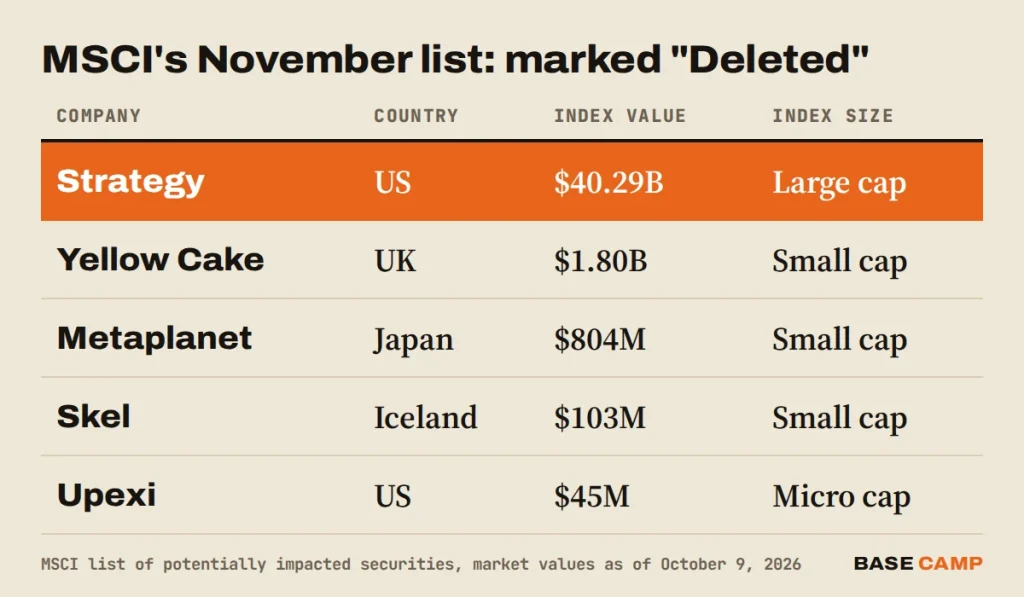
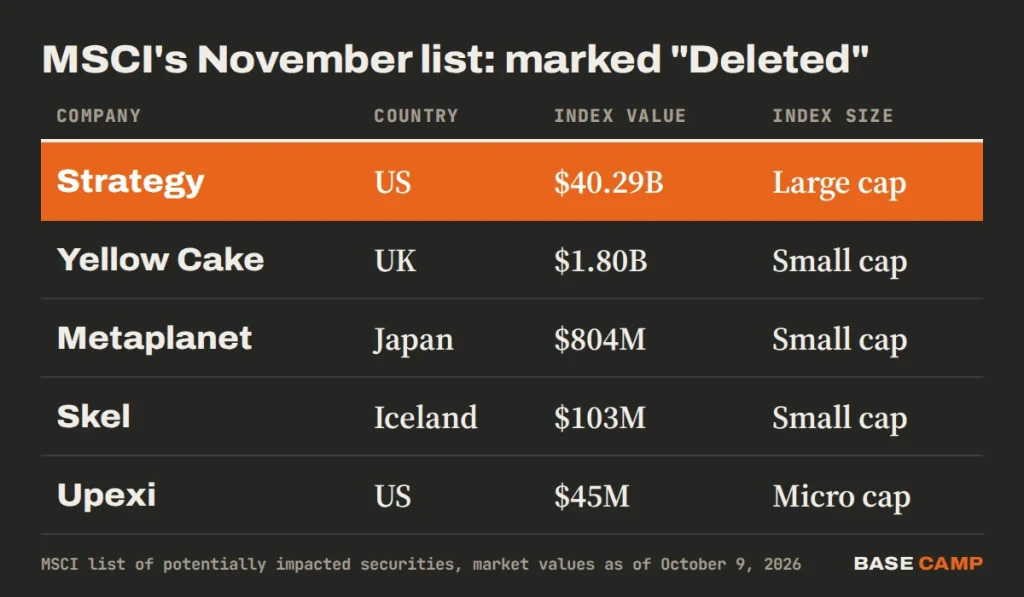
Strategy is the only large cap on it, and it makes up more than 90% of the list by value. Yellow Cake is a sign the rule really is asset-neutral: it holds uranium, not Bitcoin. Metaplanet, Japan’s biggest Bitcoin holder with about 44,000 BTC according to BitcoinTreasuries, and Solana treasury firm Upexi make up the rest of the crypto names.
Another 17 companies sit on a new watchlist. They failed on their latest filing but not on both, so they stay in for now. Beyond the Bitcoin treasury names in the table, the crypto treasuries on it are SharpLink, TON Strategy, Capital B, DeFi Development, Sui Group, Solana Company and Cypherpunk Technologies. A second failed annual filing would put them where Strategy is today.
How Much Passive Money Could Leave MSTR?
The best public estimate is JPMorgan’s: about $2.8 billion from MSCI-tracking funds alone. Analysts led by Nikolaos Panigirtzoglou put it at that figure last November, and said up to $8.8 billion could follow if other index providers copied MSCI.
That number is a year old, and it has probably shrunk. Index funds hold MSTR by weight, and the weight falls with the share price. MSCI valued Strategy’s index slice at $40.29 billion on October 9, when the stock closed at $154.34. MSTR finished Friday at $128.93, 16.5% lower.
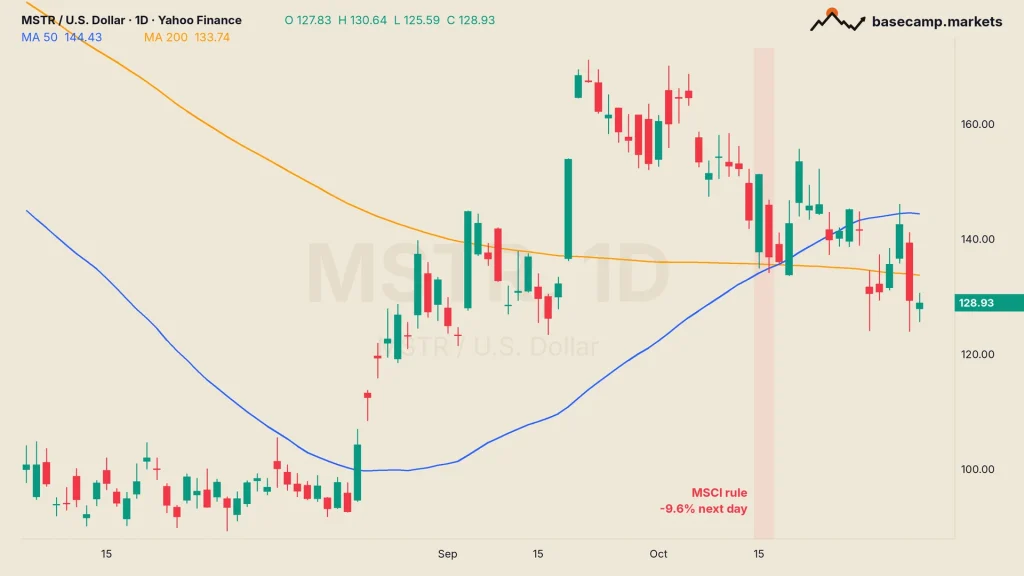
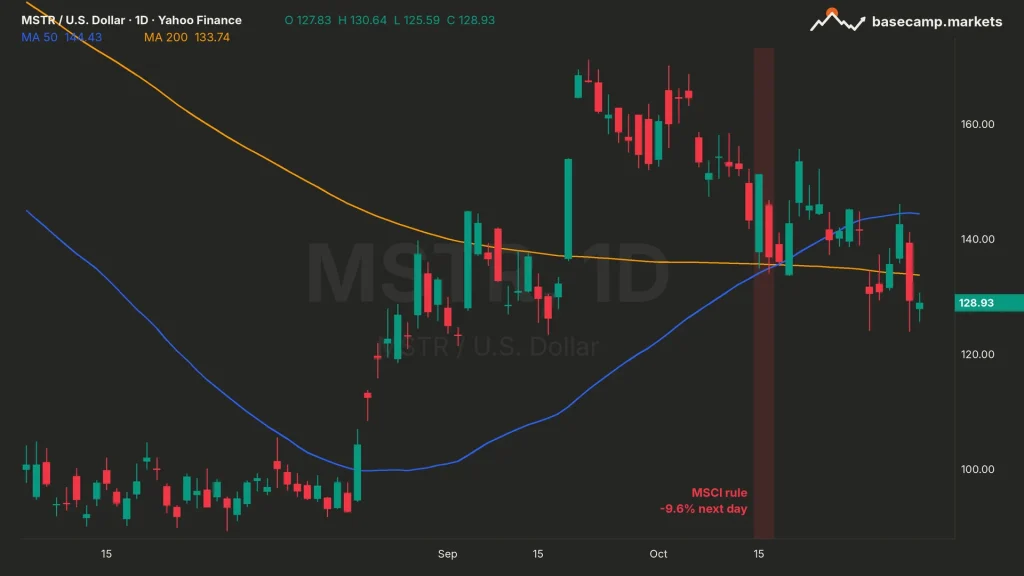
The stock has already done some of the adjusting. MSTR closed at $151.29 on October 15, before MSCI’s announcement went out after the bell. The next day it closed at $136.83, down 9.6%. Metaplanet went the other way in Tokyo and rose 4.5% on October 16, then gave it back: it trades about 12% below its pre-decision price now, near $1.50 a share.
The forced selling itself happens in one go. Index funds trade at the closing price on November 30 so they match the index exactly, which is why rebalance days often end with a burst of volume in the closing auction.
What Happens to MSTR if MSCI Confirms the Cut?
It leaves on November 30 and can’t come straight back. Under the rule MSCI adopted, a company outside the index can only be added if it passes the test in both of its last two annual filings. For Strategy that means two clean years, and its balance sheet isn’t built to change that fast.
Strategy’s public line, in that August post, is that the rule is “not material” to MSTR. The 10-Q is more careful. It warns that the exclusion could hurt MSTR’s price and liquidity, could push other index providers to do the same, and could weaken Strategy’s “ability to raise capital”.
The company had put it more bluntly on August 14, two weeks before the letter:

Digital assets are assets. Index providers should measure markets, not decide which assets companies are allowed to own. MSCI’s proposal puts it out of step with regulators, markets, and its own customers. Bitcoin doesn’t need MSCI. Neither does Strategy. $BTC $MSTR
That last part matters most for Bitcoin. Strategy pays for its coins mostly by selling new MSTR shares. In the week to November 1 it sold 1.18 million of them for $164 million and put only $65.5 million into 811 BTC, for a stack of 849,327 BTC. Fewer natural buyers for the stock means less fuel for that machine. Nobody has to sell a single Bitcoin because of an index change, though.
If the MSCI Strategy decision goes the other way and the name is missing from Wednesday’s list, it would surprise Strategy too, judging by its own filing. MSCI says it may also use the latest interim filing, which leaves a small door open.
SIDE TRAIL: Strategy Q3 Earnings: $19.1 Billion Profit, but 2026 Is Still in the Red
MSCI Strategy Decision: Dates to Watch
Bitcoin is at $74,200 at the time of writing, below Strategy’s average cost of $75,451 a coin. The index story lands on top of that.
- Wed, Nov 11, shortly after 22:00 UTC (5:00 p.m. New York): MSCI posts its November review, with the final non-operating list.
- Thu, Nov 12: first full trading day for MSTR in New York and Metaplanet in Tokyo with the list known.
- Mon, Nov 30, at the close: the deletions take effect; index funds sell at the closing price in each market.
- Tue, Dec 1: Strategy and Metaplanet trade outside MSCI’s indexes for the first time.
The bigger risk sits beyond MSCI. Strategy warned in its filing that other index providers could copy MSCI’s criteria, and JPMorgan’s $8.8 billion figure assumes exactly that.
TRAIL MAP: Bitcoin Treasury Companies Selling: Seven Firms Sold Every Coin, and We Checked the Filings

Satoshi Flipper has more than 20 years of trading experience, starting in stocks before moving into crypto in 2017, and holds an MBA from the Kellogg School of Management. The edge is reading the economic data: rate decisions, inflation, jobs numbers, earnings and the US markets that move Bitcoin.
More from Satoshi Flipper