
The short version
- Solana Labs launched Leap, a self-custodial mobile trading app for tokenized stocks, ETFs and crypto, in invite-only early access on November 5.
- Some Solana builders say the chain’s own company now competes with their apps, while others point out every Leap trade pays Jupiter and Helius.
- Leap charges no fee yet; a share of future fees is planned to buy and burn SOL, and its tokenized stocks are not available in the US.
Solana Labs launched Leap on Thursday, November 5: a mobile app for trading tokenized stocks, ETFs, commodities, currencies and crypto, open in invite-only early access. The company that helps build Solana’s tools now runs a trading app of its own. Within hours, some of the developers building on Solana were asking a fair question: what happens when the chain’s own company competes for your users?

Introducing Leap, the mobile trading app designed for high performance.
A Solana Labs Company.
Early access starts today. 🧵👇
What Is the Leap Trading App?
The Leap trading app is self-custodial and run by Leap Platforms, LLC, “a Solana Labs Company”. Every trade is an onchain swap on Solana: Jupiter routes the orders, Helius runs the infrastructure and Birdeye supplies market data. The team behind it is Dialect, which Solana Labs bought earlier this year.
Leap says retail traders deserve an app “engineered for discipline”. It opens on a home tab of daily curated stories, then shows profit and loss for every position around one number, your breakeven, with deposits, withdrawals and fees counted in.
What it costs, for now:
- No Leap fee on swaps at launch. You pay network and routing costs, shown before every trade, plus [slippage](/glossary/#slippage) on bigger orders and smaller tokens.
- When fees start, Leap plans to use a share to [buy and burn](/glossary/#burn) SOL and to pay referral rewards.
One catch for most of our readers: Leap’s own site says its tokenized stocks and ETFs are not available in the US, and the whole app is closed to UK users. Americans get the crypto side only.
Sponsored · Affiliate link
Save 10% on fees trading on FOMO
Base Camp may earn a commission if you sign up. It never affects what we write.
Why Are Solana Builders Upset About Solana Labs?
Because the company behind the chain now competes with the apps built on it. Solana Labs has the name, the money and the reach small teams lack, so its app starts ahead. One developer, CocoraEth, put it as a jab: if you don’t want your host chain competing against you, “just use Arbitrum”. Vibhu, who works on product at the Solana Foundation, turned the line around:

If you are building onchain and don't want your host chain to have any users, just use @arbitrum.
The worry runs like this. Labs builds a consumer app, so it competes for the same retail traders as independent teams. If Labs can enter any category, fewer teams want to raise money for apps it might copy. That is the “chilling effect” the Solana Daily account described the day after launch.
The other side has a chain of its own. Every Leap trade pays Jupiter’s routing and runs on Helius, so the infrastructure teams earn from it, and more users on Solana are more users for every app there. Solana co-founder Toly made the point with a joke: Samsung just added a USDC account on Solana to Samsung Wallet, and he wrote he “can’t believe Samsung was comfortable competing with” Solana Mobile, the phone Labs built.
Solana co-founder Raj Gokal didn’t oversell it. “Solana is intensely competitive, and we are likely to fail,” he wrote, adding that Labs wants a product built for “disciplined, long-term investing”.
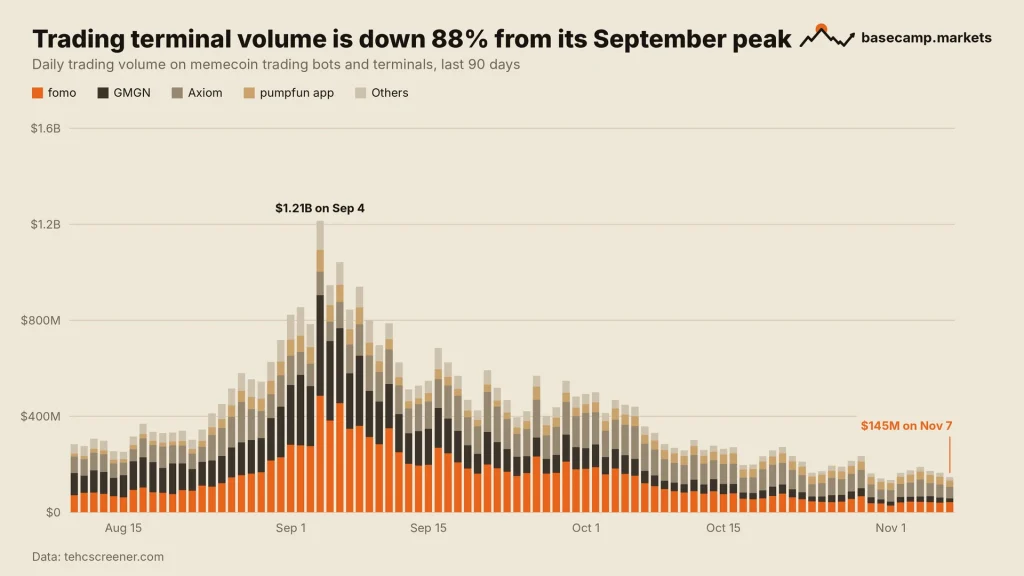
The pool Leap fishes in has also shrunk. Memecoin trading bots and terminals handled $145 million of trades on November 7, tehcscreener.com data shows, down 88% from $1.21 billion on September 4. Axiom ($48 million), FOMO ($42 million) and the Pump.fun app ($27 million) took the biggest slices. Leap is no memecoin terminal, but it chases the same traders on the same phones.
SIDE TRAIL: Tokenized Treasuries on Solana Hit $2.1B, Up 272% This Year
Does the Leap Fee Burn Matter for SOL?
Not yet, because the Solana Labs Leap app charges no fee to burn. The plan matters more as a signal: it ties Leap’s trading volume to SOL’s supply, so a busy app would mean a little less SOL around.
The fine print deserves a plain look, though. Leap’s Founders Club pays members 30% of Leap’s fees on trades by friends they refer (20% after 12 months), and the launch thread adds 5% from those friends’ referrals. A referral scheme that earns more the more your friends trade sits a little awkwardly next to an app built “for discipline”. It is the part worth reading before you share an invite link.
SOL trades at $88.92 at the time of writing, down 6.9% this week and sitting right on its 200-day moving average at about $89. The area to watch is that line: a daily close back above it keeps Solana’s price steady, while a break below opens the way to the July and August lows around $73 to $74.
TRAIL MAP: DeFi Basics: Swaps, Liquidity Pools and Impermanent Loss
Leap charges no fees yet, so the burn is still a promise. The first fee schedule will show how much of it really reaches SOL.

Teddy has been trading crypto since 2016. The focus is altcoins and EMA setups: finding coins sitting on key levels, waiting for support to hold or a range to be reclaimed, and trading the move from there. Bitcoin sets the tone, but the opportunities are usually in the alts.
More from Teddy