The short version
- MSTR MSCI removal takes effect at the close on Monday, November 30, and Strategy stock goes into it at a 52-week low of $77.32, 48.7% below its October 15 close.
- JPMorgan’s $2.8 billion selling estimate dates from a $177 share price; the same shares are worth about $1.2 billion now, and up to $1.6 billion on a newer figure.
- That is roughly one normal day of MSTR trading, and nobody has to sell any of Strategy’s 851,305 BTC.
- Next: the closing auction at 21:00 UTC (4:00 p.m. in New York) on Monday, after a Thanksgiving week with three sessions left from Wednesday.
“No meaningful impact on Strategy’s business.” That is what Michael Saylor and Phong Le told MSCI to expect in their August 31 letter, if the index provider went ahead and threw the company out. The MSTR MSCI removal lands on Monday, and the stock isn’t taking it quite so calmly.
Strategy (MSTR) touched $77.32 on Tuesday, November 24, a new 52-week low, and closed at $77.55, down 8.1% on the day. It hasn’t closed this low since February 2024. A year ago it traded above $170.
Every fund that copies an MSCI index has to be out by the close on November 30. From Wednesday that leaves three trading sessions, with Thanksgiving in the middle. So how many shares still have to go, and how much of the damage comes from MSCI at all?
Le’s own version of the answer came on television, the day after MSCI confirmed the cut:

I joined @contessabrewer and @SullyCNBC on @PowerLunch to discuss $MSTR, MSCI, Bitcoin market volatility, regulatory developments, cybersecurity, and the future of AI.
00:17 – MSCI exclusion would have immaterial impact on $MSTR; only 3% of shares tied to its indices
01:01 –
How Much MSTR Do Index Funds Have to Sell on Monday?
Probably $1.2 billion to $1.6 billion at today’s price, by our math, well under the $2.8 billion that gets quoted everywhere.
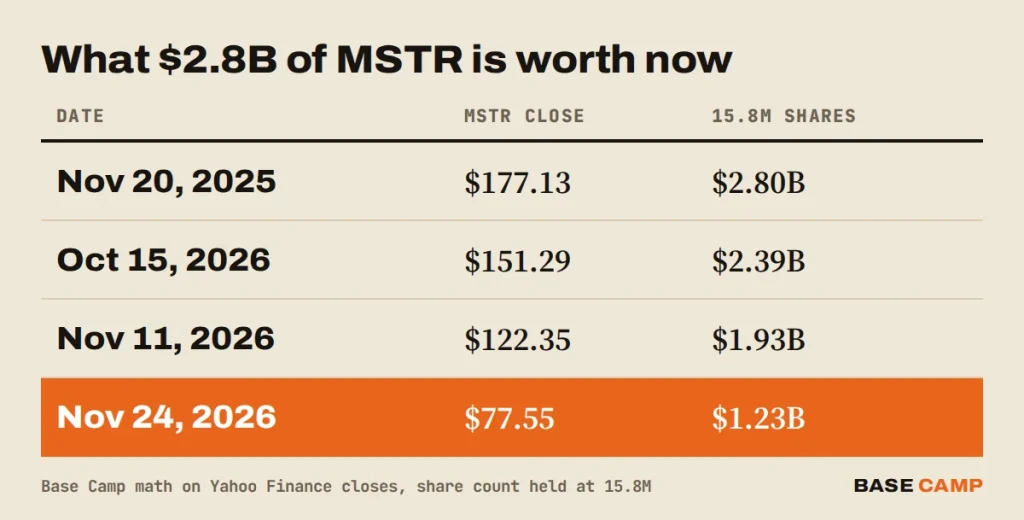
That $2.8 billion came from JPMorgan in November 2025. A stake measured in shares doesn’t care about the share price, but its dollar value does, and MSTR has more than halved since. On November 20, 2025, when the estimate made the rounds, the stock closed at $177.13. At that price $2.8 billion is about 15.8 million shares. Here is what the same block is worth as the price falls:
The upper end uses a newer number. VanEck’s Matthew Sigel put JPMorgan’s estimate at about $2.5 billion on November 12. Against the $122.35 close from the night before, that’s 20.4 million shares, or $1.58 billion at Tuesday’s close:

$MSTR to be removed from MSCI indices.
Metaplanet also.
JPM has estimated ~$2.5B in index selling at end of month in response.
$MSTR -6% this morning vs. Bitcoin ETFs -2%
These are rough. We don’t know the exact price JPMorgan used, and some funds may have sold already. But the share count is the part that matters for Monday, because it can be set against real trading. On Tuesday 23.6 million MSTR shares changed hands, and the average is about 20.4 million shares a day over the past 20 sessions.
In other words, the whole block is roughly one normal day of trading. The catch is that most of it wants the same price, at the same minute.
Sponsored · Affiliate link
Save 20% on fees trading on WEEX
Base Camp may earn a commission if you sign up. It never affects what we write.
Why Is MSTR Stock Falling Before the MSCI Deadline?
Mostly because Bitcoin is, and MSTR falls harder. The index exit is one link in a longer chain:
- October 15: MSCI adopts its rule against “non-operating” companies. MSTR closes at $151.29 that day, before the news.
- November 11: MSCI publishes its final impact list with the November review. MSTR closes at $122.35.
- November 12 to 20: seven red days in a row, down to $77.80, while Bitcoin slides under $60,000.
- November 23 and 24: a bounce to $84.40, then all of it handed back.
Since October 15 the stock has lost 48.7%. Bitcoin is down about 28% over the same stretch, at $59,276 at the time of writing. That gap is the part worth explaining, and a forced seller with a known date is one reasonable piece of it. Anyone can sell ahead of a fund that has no choice.
Leverage is another piece. Strategy’s debt and preferred stock don’t shrink when Bitcoin drops, so the common shares take the hit. We can’t split the 48.7% neatly between the two, and we’d be wary of anyone who says they can.
SIDE TRAIL: MSCI Strategy Exclusion Confirmed: What Happens to MSTR and Bitcoin Before Nov 30
MSTR Stock Has Little Left Underneath
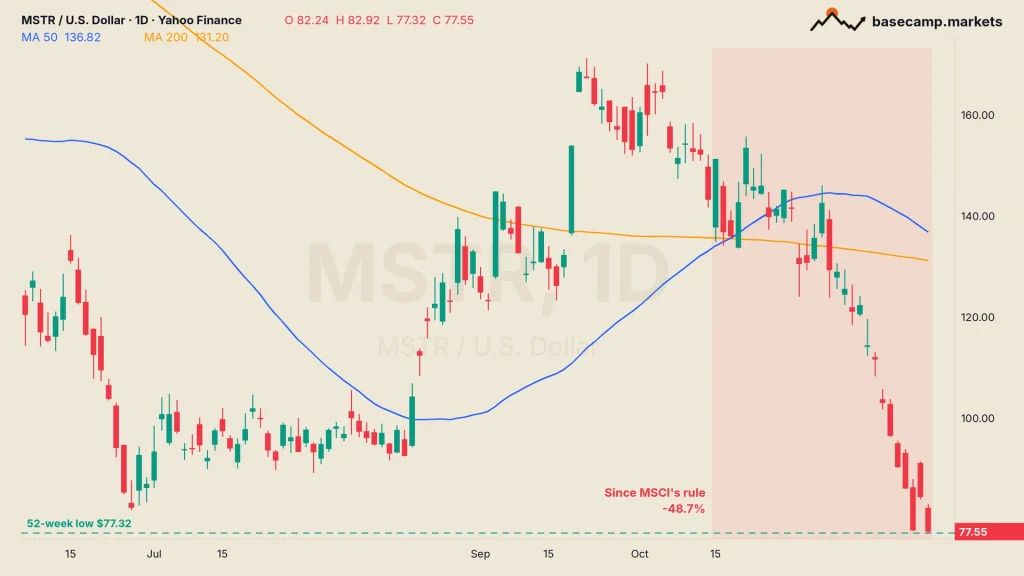
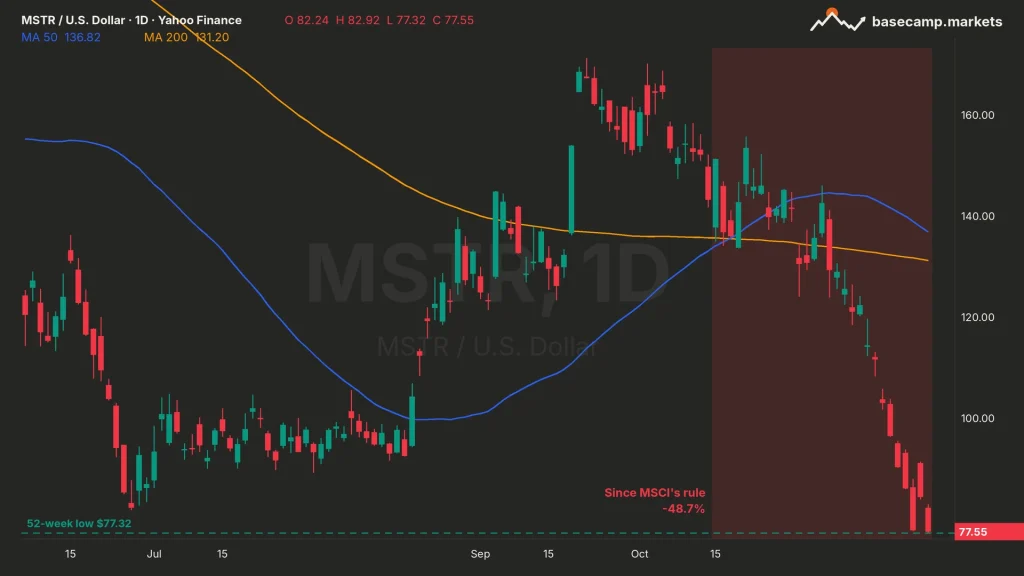
The area to watch is $77.32 to $77.80. Friday’s $77.80 close sparked Monday’s bounce, and Tuesday’s close is back inside that range. It was already being tested after hours on Tuesday, when the stock changed hands around $76.30.
If that area holds on a closing basis, Monday’s $84.40 close is the first level to win back, and $91.38, the top of Monday’s bounce, comes after it. If it doesn’t, the next closes to look at go back to February 2024: $76.99 on the 14th, $71.80 on the 15th and $68.74 on the 23rd.
The 50-day moving average is far above at $136.82, and the 200-day sits at $131.20. Neither matters much this week.
Does the MSCI Exit Force Strategy to Sell Bitcoin?
No. Funds sell MSTR shares to other investors, and the company’s coins don’t move. Strategy held 851,305 BTC at an average cost of $75,446 in Monday’s 8-K. At today’s price that stack is worth about $50.5 billion, some $13.8 billion less than it cost.
What a lower share price does change is the cost of raising money, which is where Bloomberg saw the pressure on the day the cut was confirmed:

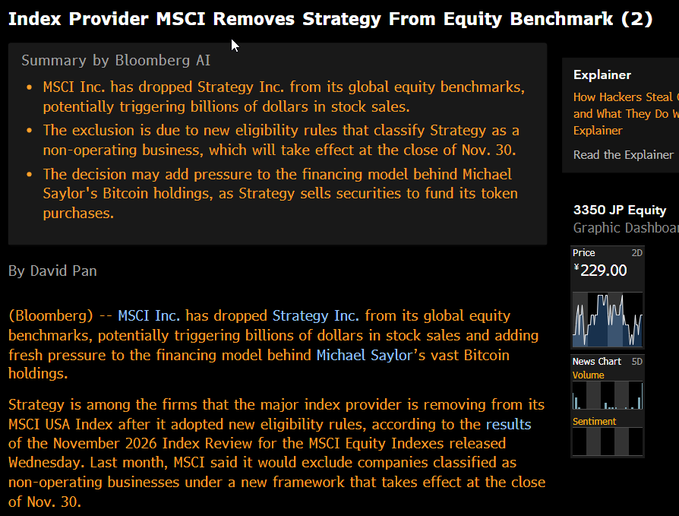
MSCI has dropped Strategy from its global equity benchmarks, potentially triggering billions of dollars in stock sales and adding fresh pressure to the financing model behind Michael Saylor’s vast Bitcoin holdings bloomberg.com/news/articles/…
The chain goes like this:
- MSTR falls, so Strategy has to issue more shares for the same cash.
- More shares dilute holders, which makes the stock harder to own.
- Less cash is left for Bitcoin once the preferred stock has been looked after.
Last week shows the size of it. Strategy sold 1,925,676 shares for $176.7 million, about $92 each. At $77.55 the same money takes about 2.28 million shares, 18% more. And only $29.6 million of the total went into Bitcoin, against $211.8 million spent on buying back STRC, its preferred stock.
That’s why the August letter and the 10-Q filed on November 2 read like two different companies wrote them. The letter sees nothing meaningful. The filing warns the exclusion could hurt MSTR’s price and liquidity, and the company’s “ability to raise capital”.
TRAIL MAP: Strategy STRC Buyback Takes $212M vs $30M for Bitcoin as $1B Moves Out of Its Dividend Reserve
What Happens After the MSTR MSCI Removal?
The sellers are done, at least the ones who had to. Deleted stocks sometimes bounce once that pressure clears, but nothing guarantees it, and MSTR will still trade off Bitcoin the next morning.
A quick return isn’t coming. Under MSCI’s rule, a company outside the index can’t be added if it fails the test in either of its last two annual filings.
Until then the calendar is thin. US markets are shut on Thursday for Thanksgiving, Friday ends early at 18:00 UTC (1:00 p.m. in New York), and the closing auction that matters is at 21:00 UTC (4:00 p.m. in New York) on Monday. Thin holiday trading can push prices around more than usual in both directions.
JPMorgan’s bigger figure, up to $8.8 billion if other index providers copied MSCI, has shrunk too: at Tuesday’s close and the same share count, it’s about $3.9 billion.

Teddy has been trading crypto since 2016. The focus is altcoins and EMA setups: finding coins sitting on key levels, waiting for support to hold or a range to be reclaimed, and trading the move from there. Bitcoin sets the tone, but the opportunities are usually in the alts.
More from Teddy