The short version
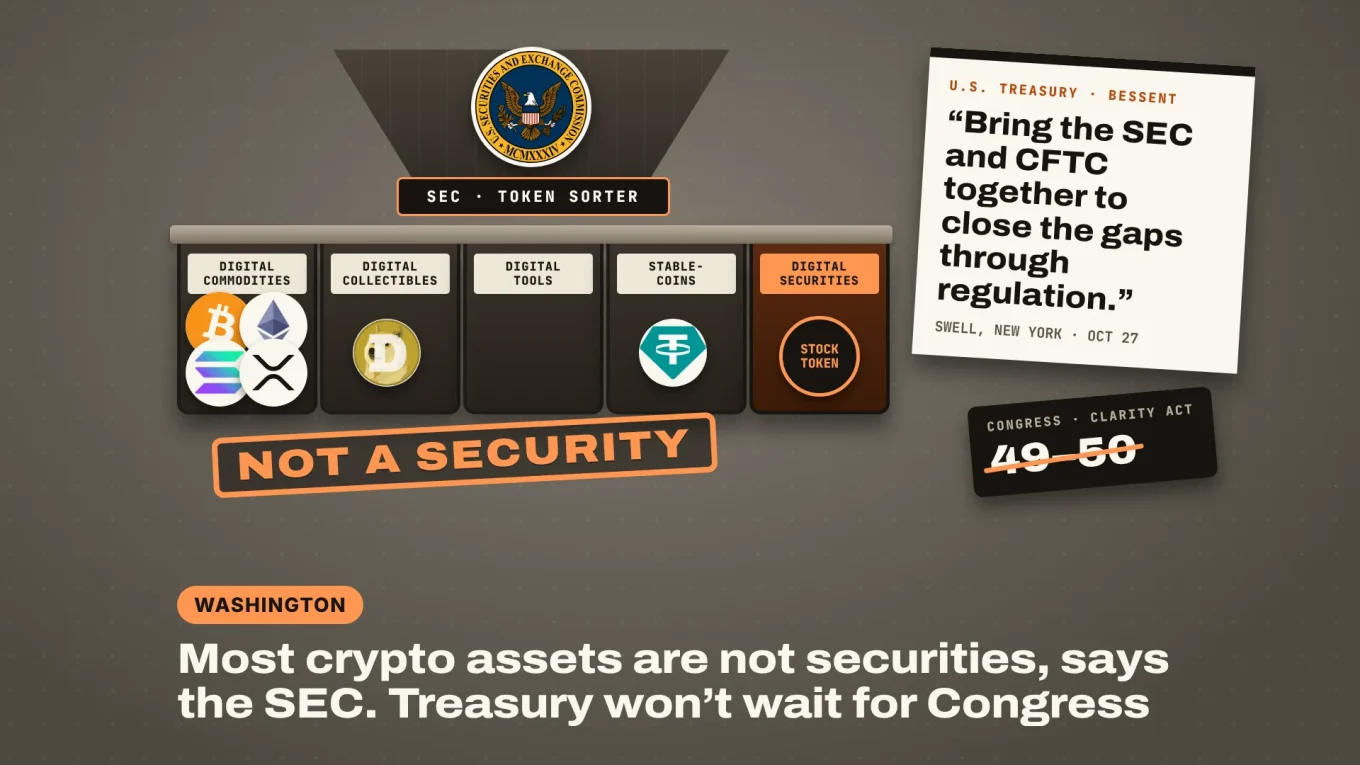
- Most crypto assets are not securities, SEC Chairman Paul Atkins said in Dallas on October 30, pointing to the SEC’s March interpretation that sorts tokens into five groups with only one, digital securities, treated as a security.
- Three days earlier, Treasury Secretary Scott Bessent said Treasury would bring the SEC and CFTC together to close the gaps through regulation, after the CLARITY Act failed a 49–50 Senate vote and now has a 3.2% chance of passing this year on Polymarket.
- Next: the midterms on November 3, the Senate’s return on November 6 and the December 14 comment deadline on the CFTC’s leveraged trading plan. Follow Base Camp on X to see each step first.
Most crypto assets are not securities, SEC Chairman Paul Atkins told the Economic Club of Dallas on Friday. Three days earlier in New York, Treasury Secretary Scott Bessent said his department would “bring the SEC and CFTC together to close the gaps through regulation.”
Put the two side by side and the message from Washington is plain. The crypto bill is stuck in the Senate, so the agencies are writing the rules themselves. Here is what each man said, and what it changes for anyone holding tokens.
Atkins has said that most crypto assets are not securities on his own X account before:

As I have stated previously, most crypto assets are not themselves securities. These assets include digital commodities, digital tools, and digital collectibles.
Most Crypto Assets Are Not Securities: What Atkins Said in Dallas
Nothing new on paper, but the clearest line yet from the man who runs the SEC. “We acknowledged what the SEC had long refused to recognize: that most crypto assets are not themselves securities,” Atkins said in his Dallas remarks, calling the old approach “rules that were written one enforcement action at a time.”
The line rests on the interpretation the SEC issued on March 17, which the CFTC joined. It sorts tokens into five groups: digital commodities, digital collectibles, digital tools, stablecoins and digital securities. Only the last group is a security by default. A token from the other four can still be sold as part of an investment contract when its team promises to build the value, and the interpretation also says how that contract can end.
Atkins listed what came next. In August, the SEC proposed “Regulation Crypto Assets,” its first set of fundraising paths written for crypto projects. And its “Innovation Exemption” opened the door to some onchain trading of tokenized securities.
Sponsored · Affiliate link
Save 20% on fees trading on WEEX
Base Camp may earn a commission if you sign up. It never affects what we write.
Why Is Treasury Going Around Congress?
Because Congress ran out of road. On September 15, the Senate vote to open debate on the CLARITY Act, the market structure bill that would put all of this into law, failed 49–50, eleven votes short of 60. Polymarket traders now give it a 3.2% chance of becoming law this year.
Bessent opened Ripple’s Swell conference on October 27 with a plan B. “At Treasury, we have a lot of convening powers,” he told the room, and said the SEC and CFTC would close the gaps between them through regulation.
SIDE TRAIL: CLARITY Act’s Last Chance: The Senate Returns After the Midterms With Odds Under 4%
There is a catch. An interpretation or an agency rule can be rewritten by the next SEC chair; only a law from Congress stays put when the White House changes hands. That is why the industry still wants the bill, even with the agencies on its side.
What It Means for Crypto Traders
In the short run, not much for prices. Bitcoin trades at $77,675 at the time of writing, and XRP, for years the face of the SEC’s old fight with crypto, sits at $1.25, down 17% in 30 days. Clearer rules haven’t stopped a red October.
The bigger effect is on what US platforms dare to list and launch. A token that isn’t a security falls outside the SEC, but no federal agency fully oversees its spot trading yet. That is the gap Bessent wants closed, and the CFTC’s plan for leveraged retail crypto trading is the first piece of it.
The crew is watching three dates. The midterms on Tuesday, November 3, decide who controls Congress next year. The Senate returns on November 6 for its last 2026 window on the CLARITY Act. And comments on the CFTC’s leveraged trading plan close on December 14.
TRAIL MAP: CFTC Crypto Rules Explained: The Plan to Bring Leveraged Retail Crypto Trading Onshore

TheCryptoMonk has been trading since 2017 and reads the market from the top down. The focus is macro and the high timeframes: where stocks, rates and liquidity are heading, and what the weekly and monthly charts say about Bitcoin. Short-term noise matters less than the bigger trend.
More from TheCryptoMonk