
The short version
- Midterm election results give Democrats the House, and they have flipped six Republican Senate seats on AP and prediction-market projections when they needed four; Kalshi prices Senate control at 99.5%.
- Bitcoin’s first reaction was down 2.8%, from $77,876 to $75,736, with Nasdaq 100 futures 2.1% lower, yet stocks rose in the months after each of the three midterms that gave a Republican president a Democratic Congress.
- Next: the US stock open at 14:30 UTC (9:30 a.m. in New York), the first full session to price the new Congress. Follow Base Camp on X for the market’s answer.
Midterm election results point to a Democratic Congress. The TV networks projected the House for Democrats just before 03:00 UTC on Wednesday (10 p.m. Tuesday in Washington). In the Senate, where Democrats needed a net gain of four seats, the AP has called two Republican seats for them, North Carolina and South Carolina, and prediction markets give them four more at 99%: Ohio, Texas, Kansas and Iowa. Kalshi prices Democratic control of the Senate at 99.5% at the time of writing, though no outlet had formally called the chamber yet.
The first market reaction was a sell. Bitcoin fell from $77,876 at 23:00 UTC, when the first polls closed, to $75,736 around 03:00 UTC, a 2.8% drop. Nasdaq 100 futures lost 2.1%, from 28,306 to 27,698, and S&P 500 futures 1.2%.
Crypto’s most expensive race of the cycle went the other way. Fairshake, the industry’s biggest super PAC, told CNBC it spent $55 million against Sherrod Brown:

BREAKING: Polymarket projects Democrat Sherrod Brown has defeated Republican Sen. Jon Husted, returning to the chamber two years after his 2024 loss — 99% chance.

Midterm Election Results Were Priced In. Why Did Markets Fall?
A Democratic House was a 94% favorite on Kalshi before the polls closed, and the Senate a 76% one. A sweep was the expected outcome, as VikingXBT put it on Tuesday afternoon:

Today should be pretty uneventful, the only shocker I see is if Dems don't sweep both House and Senate.
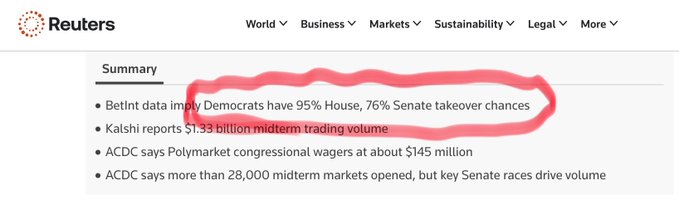
What wasn’t fully priced was the size of it. Democrats are winning Senate seats in Kansas, which hasn’t sent a Democrat to the Senate since 1932, and South Carolina, plus the Iowa toss-up, and the wave reached the governor races in Texas and Ohio. A bigger majority means more room to pass bills and more committee power from January.
Part of the selling hit the AI trade that leads the Nasdaq. Data-center limits became a campaign issue this year, to the point that Polymarket now lists a Texas data-center moratorium market. Bitcoin, trading through the night while stock exchanges were shut, took the first hit.
Sponsored · Affiliate link
Save 20% on fees trading on WEEX
Base Camp may earn a commission if you sign up. It never affects what we write.
Why a Democratic Congress Could End Up Bullish
The case for the bulls is gridlock. President Trump keeps the White House and his veto, but from January 3 every new law and every budget has to pass a Democratic House and Senate. That makes sudden policy moves from Washington less likely. Congress can’t easily undo what the White House already did, since overriding a veto takes two-thirds of both chambers, but it controls the money, can hold hearings, and can force votes on tariffs and war powers.
The midterms stock market record backs that up. Three times since World War II, a midterm turned Congress fully Democratic under a Republican president: Eisenhower in 1954, Reagan in 1986 and George W. Bush in 2006. The S&P 500 rose from the end of October to the end of June after all three, by 21.1% on average. In 2018, when Democrats took only the House under Trump, it gained 8.5% and Bitcoin rose 71% over the same months.
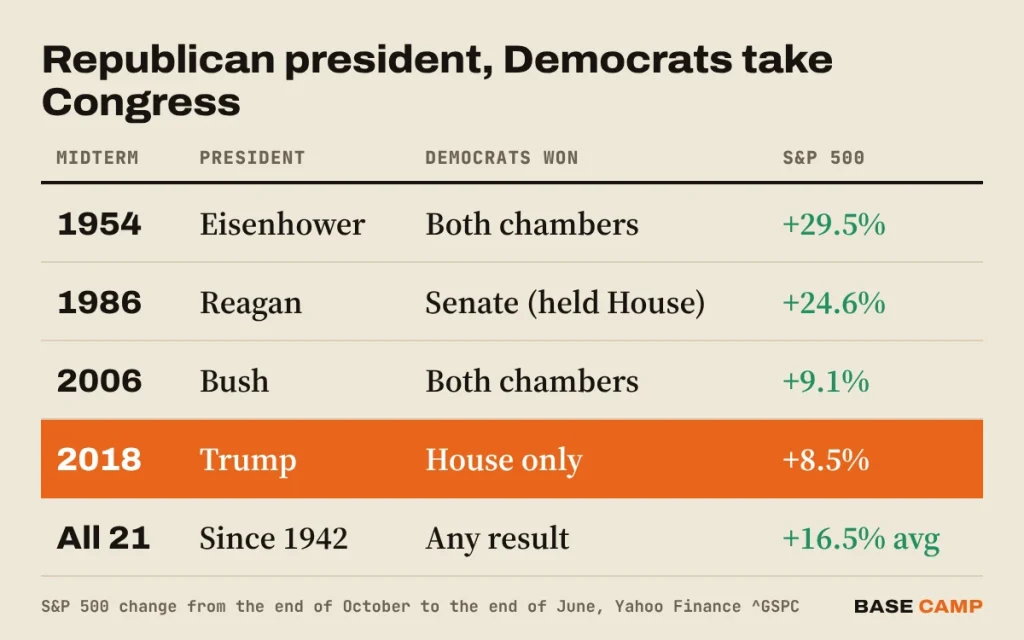
History is a short list here, and the record covers every midterm, not just divided ones: the S&P 500 rose in the same window after all 21 midterms since 1942. For crypto, the trade-off is the committees. Kalshi gives Maxine Waters 74% to chair House Financial Services, and Elizabeth Warren is in line for Senate Banking. Traders give a crypto market structure law only a 33% chance before 2028.
SIDE TRAIL: Election Night 2026: When Polls Close and the Races Crypto Is Watching
Bitcoin Price After the Vote
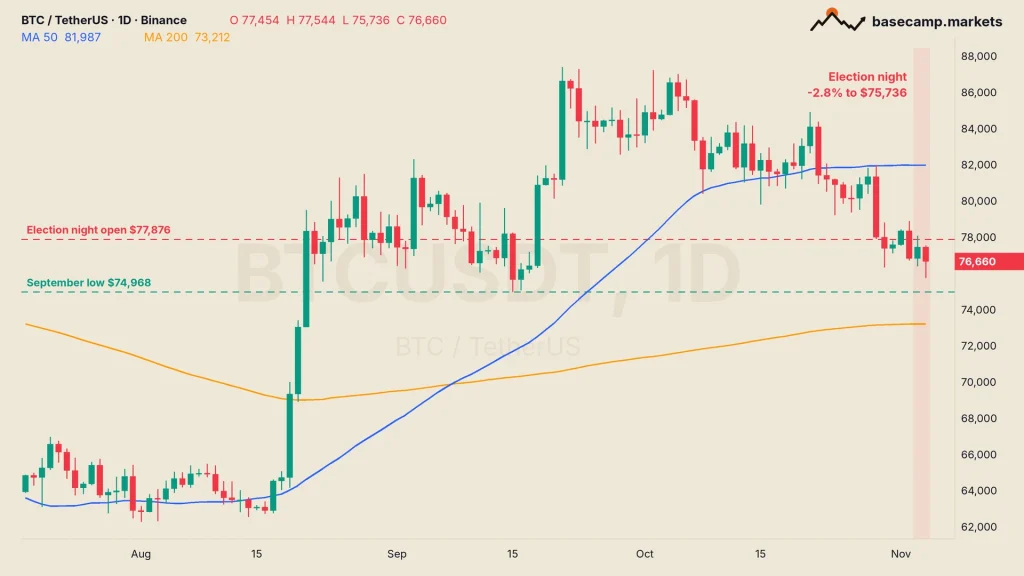
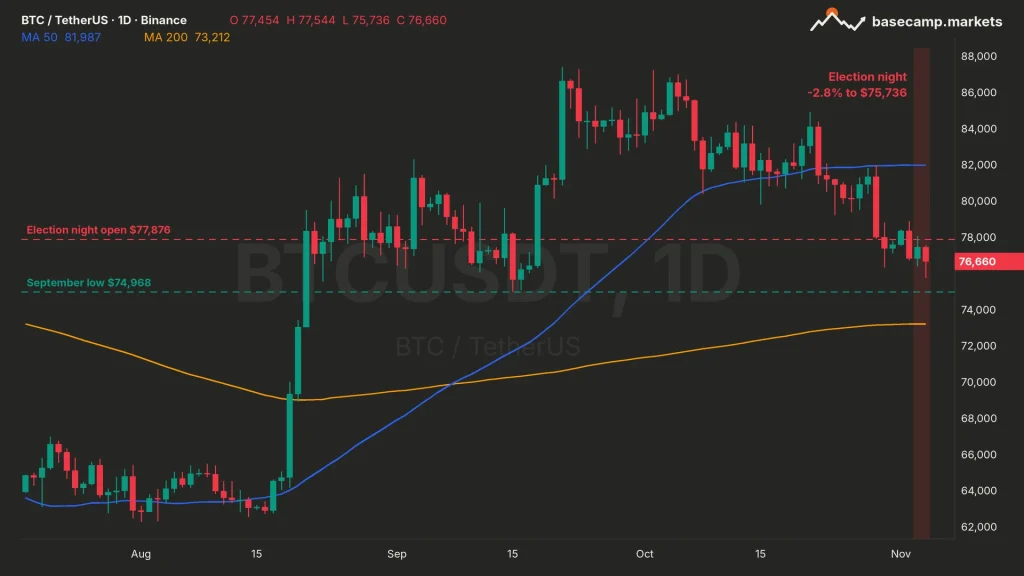
Bitcoin trades at $76,507 at the time of writing, down 0.4% on the day and back above the overnight low. It sits under the 50-day moving average at $81,987 and above the 200-day at $73,212.
Below, the level that matters is the September low at $74,968, the bottom of the range since the September breakout. Above, BTC needs to win back $77,876, where it stood when the first polls closed, to erase the election-night drop.
TRAIL MAP: Bitcoin After Midterms: What Happened in 2014, 2018 and 2022
The US stock open at 14:30 UTC (9:30 a.m. in New York) is the first full session to price the midterm election results, and it will show whether the overnight dip was fear or just a reset.

Teddy has been trading crypto since 2016. The focus is altcoins and EMA setups: finding coins sitting on key levels, waiting for support to hold or a range to be reclaimed, and trading the move from there. Bitcoin sets the tone, but the opportunities are usually in the alts.
More from Teddy