The short version
- Polygon hard fork proposal: Polymarket and Binance ask the network to move 70.49 million POL, about $6.9 million, from five blocked hacker addresses into their own recovery wallets.
- The coins can’t move today because Polygon’s four block producers blocked the addresses, but only a change to the chain’s rules can hand them back.
- Next: the plan goes before the Polygon Protocol Governance Call on Thursday, November 5, at 14:30 UTC (9:30 a.m. in New York).
“Leaving 70M POL locked indefinitely is neither a stable end-state nor a return of funds to their owners.” That line is the case for one of the boldest fixes a blockchain can make.
A Polygon hard fork proposal, posted on Wednesday, November 4, asks Polygon to wipe the balances of five hacker addresses and credit the same coins to recovery wallets run by the two victims. That is about 70.49 million POL, worth roughly $6.9 million at the time of writing.
Polymarket and Binance are the proposers. Both are named in the plan as the owners of the receiving wallets.
Where Is the Stolen POL Now?
Still sitting where the hackers left it. Polymarket’s attacker holds about 23.86 million POL across four addresses, from the Polymarket hack that drained traders on October 29. The Binance attacker’s single address holds about 46.63 million POL, sent straight out of a Binance hot wallet the same night.
We checked the five addresses on Polygon this morning. Every coin is still there, and the Binance address is even a little heavier, at 46,626,826 POL, because strangers keep sending it dust.
The address went on the radar within minutes of the theft. Onchain sleuth spreekaway flagged the drain before Binance said a word:

Unconfirmed, but possibly massive binance hack. Entire Binance wallet drained into new EOA. Contract call was funded by Tornado Cash
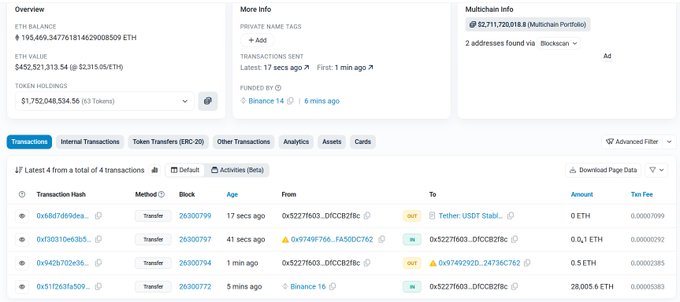
Normally that would be the end of it. POL has no issuer that can freeze it, which is exactly why a thief swaps into it. Tether froze the 6.19 million USDT that landed next to the Binance haul, part of the $2.85 billion Binance says was frozen or intercepted:

The POL needed another route. At the victims’ request, Polygon’s four block producers, the validators that build its blocks, put the five addresses on a block list. Anything they send is now dropped.
Sponsored · Affiliate link
Save 20% on fees trading on WEEX
Base Camp may earn a commission if you sign up. It never affects what we write.
Why Is a Block List Not Enough?
Because it can stop the coins, but it can’t return them, and it is fragile. Each producer reads the list only when its software starts, entries never expire, and it only checks who sends a transaction. The attacker is testing it. On October 30 a transaction offering a fee of about 219,450 POL was spotted waiting to get in, and the proposal says the attacker has offered validators cash to let a transfer through. Polymarket also opened an onchain channel to negotiate a return. No answer.
The Polygon hard fork would be a one-off rule. At a set block, before any transaction runs, each of the five balances goes to zero and the same amount lands in the Polymarket or Binance recovery wallet. Total supply stays the same. Each victim must first prove it controls that wallet.
SIDE TRAIL: Can Crypto Be Frozen? Who Froze $2.7B of the Binance Hack
Does a Polygon Hard Fork Break Decentralization?
That is the fight this vote opens. Moving a balance without its owner’s key is what blockchains are built to prevent, and the plan admits it. It calls the fork “an extreme action that should not be reproduced commonly” and rejects a general freeze-and-recover tool, which “would be a permanent power over user funds.”
Instead it lists the conditions: a theft the victims admit in public, the victim asking for the remedy, a block that every producer applied, funds traced onchain, and a sum big enough to justify a fork. Nodes that don’t upgrade will split off onto their own chain.
Ethereum rewrote the DAO hack in 2016 and the holdouts became Ethereum Classic. Sui’s validators froze $162 million from the Cetus hack in May 2025 and returned it after a vote.
The sums are small next to the hacks. Binance’s 46.63 million POL is worth about $4.5 million against a theft it put at $6.34 billion. The first reply on the forum backs the plan anyway: “Even in a decentralized system, exceptional circumstances call for collective action.”
POL Price: What Does the Fork Change?
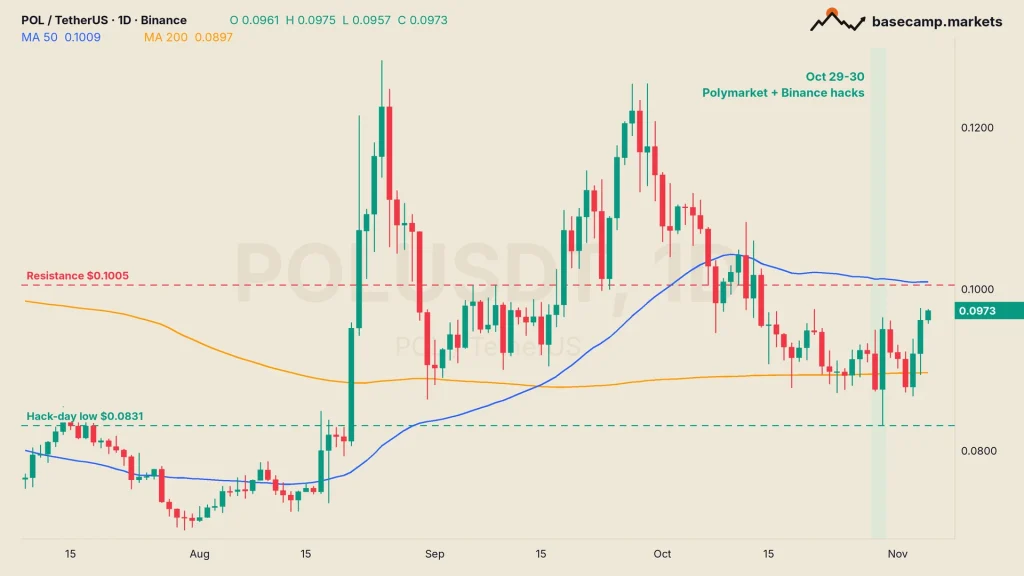
Very little on supply. The 70.49 million POL is about 0.66% of the 10.6 billion in circulation, and it can’t be sold either way. POL trades at $0.0974, up 7.5% in 24 hours, back from the $0.0831 low it hit the day after the Binance hack.
The 200-day moving average (MA) at $0.0897 held through the sell-off. The next wall is $0.1005, just under the 50-day MA at $0.1009, where POL has failed since mid-October.
Polymarket and Binance present the plan at the Polygon Protocol Governance Call on Thursday, November 5, at 14:30 UTC (9:30 a.m. in New York). If it passes, Polygon thinks about two weeks is workable to ship the code and rehearse it on its Amoy testnet.
TRAIL MAP: Your First Crypto Wallet, Set Up Safely: Hot vs Cold and the Seed Phrase

VikingXBT has been trading crypto since 2017. The focus is futures, onchain data and automation. Onchain flows get checked before a chart is trusted, and anything repetitive gets automated. VikingXBT built Base Camp's own onchain scanner, which flags bundlers, snipers, dev holdings and wallet clusters in one view, and backtests strategies before trading them.
More from VikingXBT