
The short version
- AI stocks crashing for a second week sent Taiwan’s Taiex down 12.2%, its worst week since 2001, and Nvidia down 8.8%.
- Taiwan is ready to deploy its $15 billion stabilization fund and caps intraday short sales at 3% of daily volume from November 9.
- Nvidia’s perp on Hyperliquid trades at $188.02, slightly above Friday’s close, despite a new FT report on Jensen Huang.
- Next: Nvidia reports earnings on November 17, and Congress has asked Huang for a closed-door briefing the day after.
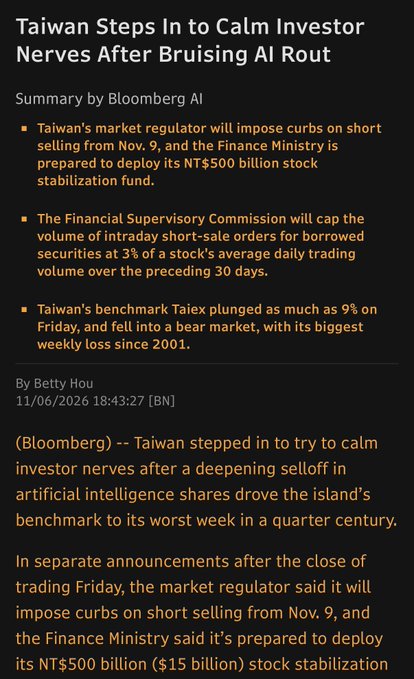
12.2%. That is how much Taiwan’s Taiex lost this week, its worst week since 2001, after falling as much as 9% on Friday alone. With AI stocks crashing for a second straight week, the government stepped in after the close: the Finance Ministry said it is ready to deploy its $15 billion stabilization fund, and the market regulator is cutting short selling from Monday, according to Bloomberg.
Then, late on Friday, the Financial Times added a new headline on Nvidia’s Jensen Huang.
Arthur Hayes read the Taiwan news the way a Bitcoin bull would:

AI Stocks Crashing: How Bad Was the Week?
Worse in Asia than in New York. The Taiwan stock market and South Korea’s are where the chips get made, and both indexes lost more than 11% in five sessions. The Nasdaq Composite lost 3.4% over the same days.
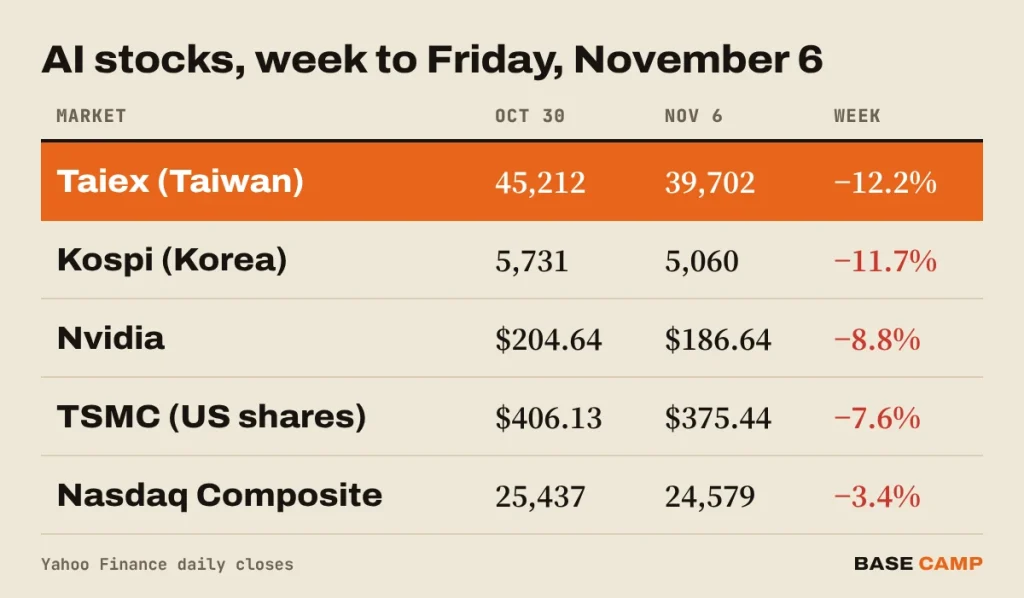
Thursday did most of the damage. Nvidia fell 9.3% that day after several Democrats said the new Congress should slow the AI build-out, and it won back only 2.8% on Friday.
Taiwan’s answer has two parts. From November 9, intraday short sales of borrowed shares are capped at 3% of a stock’s average daily volume over the past 30 days. And the stabilization fund, which last bought stocks in 2025 and stood down in January, is back on standby.
Does $15 billion move a market this size? On its own, probably not. Bloomberg data counted more than $45 billion of foreign net selling of Taiwan stocks this quarter, three times the fund.
Sponsored · Affiliate link
Save 20% on fees trading on WEEX
Base Camp may earn a commission if you sign up. It never affects what we write.
What Did the FT Report About Jensen Huang?
The FT says US officials believe Huang had a romantic relationship with Alice Huang, a Megaspeed executive they allege was recruited by China’s Ministry of State Security. The paper published the report on Friday. Megaspeed is a Singapore-based cloud company that buys Nvidia chips.
The story itself isn’t new. The New York Times first reported on October 29 that US intelligence had watched Alice Huang as a suspected Chinese asset, and that Jensen Huang was among her contacts. Neither report accuses him of wrongdoing, and the Times found no sign he knew of any covert activity.
Nvidia says the contacts were ordinary customer meetings. “Meetings with customers are part of a CEO’s job; Jensen talks with thousands of customer executives every year,” the company told CNBC.
Congress wants more. Three House Republican committee chairs, Brian Mast, John Moolenaar and Rick Crawford, asked Huang for a closed-door briefing on November 18, the day after Nvidia reports third-quarter earnings.
SIDE TRAIL: Crypto Crash Follows Nasdaq 100’s Worst Day Since 2020
Nvidia Trades Through the Weekend on Hyperliquid
Most stock traders get their first real chance to react to the FT story on Monday. Hyperliquid traders already have it. The NVDA perp on trade.xyz, the market for Hyperliquid stock perps, trades around the clock, and it has barely moved on the report.
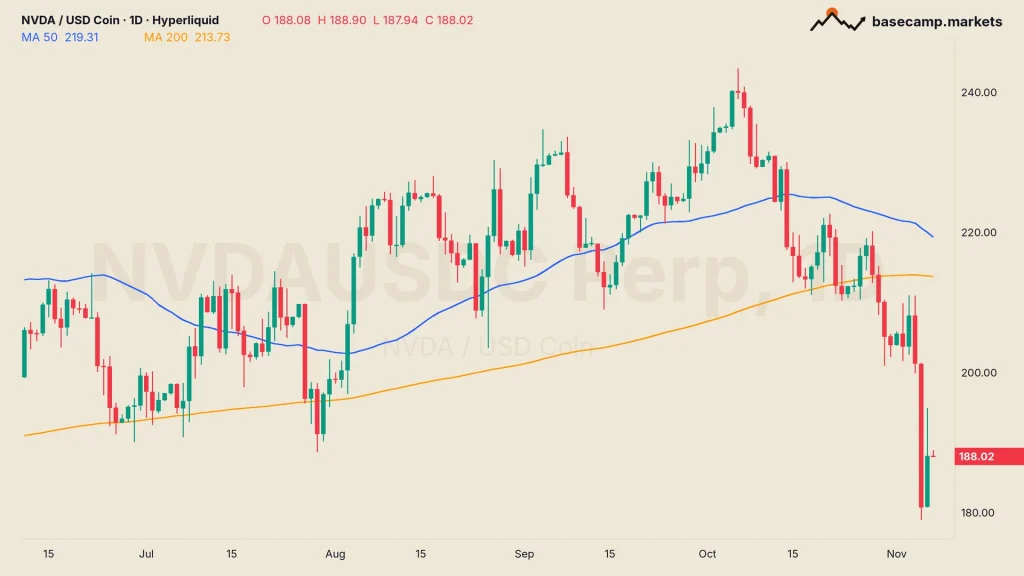
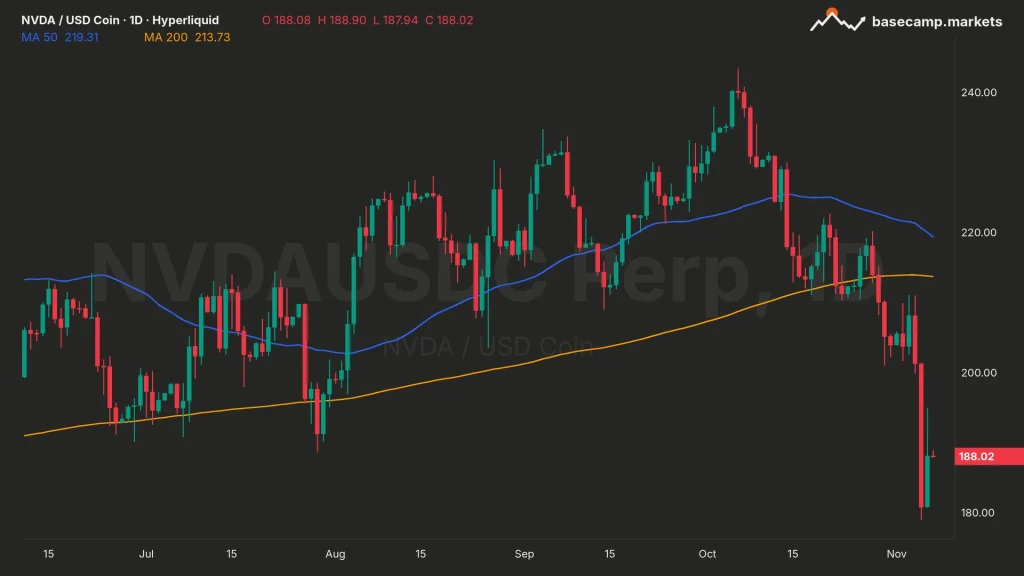
The perp sits at $188.02 at the time of writing, slightly above Friday’s $186.64 close on Nasdaq. It holds about $91 million of open bets and traded $128 million in the past 24 hours, with funding slightly negative, which means shorts are paying longs a little to stay in.
On the chart, Nvidia stock is still well under its 200-day average near $214. Thursday’s low of $181.46 on Nasdaq is the level that matters if Monday opens weak.
Why Crypto Traders Are Watching the AI Rescue
Because Hayes’s whole case for Bitcoin runs through rescues like this one. In his August essay he argued the debt-funded AI build-out could end in a credit crunch, and that the money printed to fix it would end up in Bitcoin. On Thursday he published another essay, “D is for Dilution,” arguing that the coming SpaceX, Anthropic and OpenAI listings could start the next leg down in AI.
For now, Bitcoin is following stocks, not rescue funds. BTC trades at $76,092 at the time of writing, flat on the day, after dipping to $74,888 on Friday.
TRAIL MAP: Shorting Chip Stocks Has Made This Hyperliquid Whale $25M
What decides the next move is whether the selling in Taipei stops when the short-selling cap kicks in, before New York even opens.

VikingXBT has been trading crypto since 2017. The focus is futures, onchain data and automation. Onchain flows get checked before a chart is trusted, and anything repetitive gets automated. VikingXBT built Base Camp's own onchain scanner, which flags bundlers, snipers, dev holdings and wallet clusters in one view, and backtests strategies before trading them.
More from VikingXBT