
The short version
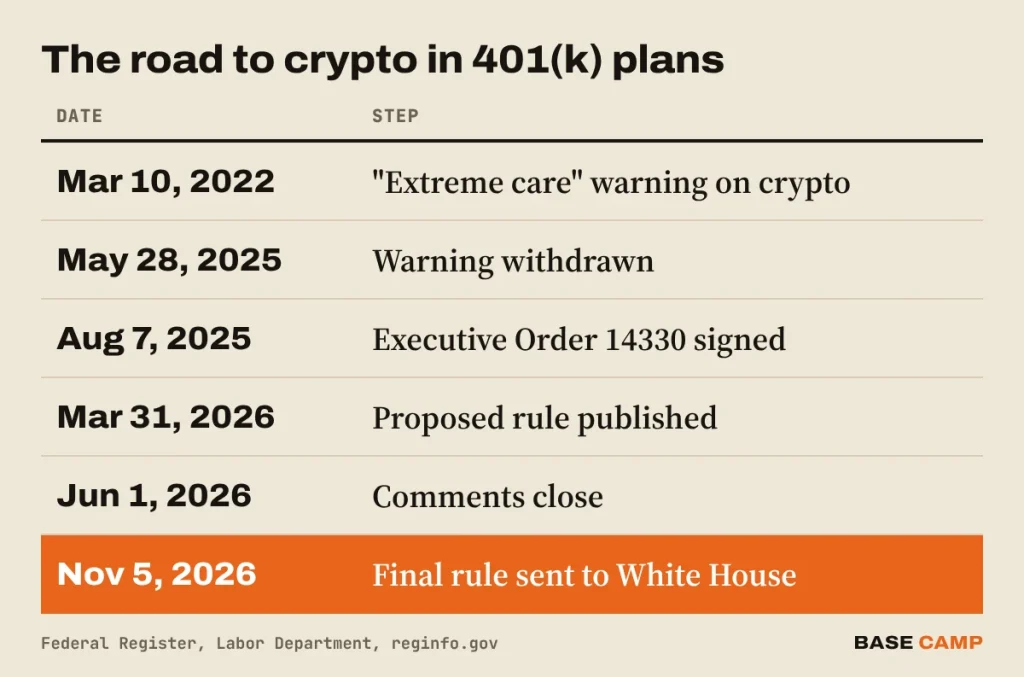
- Crypto 401(k) rule: the Labor Department’s final version reached the White House budget office on November 5 and is listed as pending review.
- It gives employers legal cover for adding funds with alternative assets, crypto included, to plans holding more than $8.8 trillion, but it makes nobody offer Bitcoin.
- Next: publication in the Federal Register once the White House clears it, with no deadline set. We’ll post it on Base Camp on X the day it lands.
The crypto 401(k) rule is one stop away from final. The Labor Department sent the final version to the White House budget office on Thursday, November 5, and the review page lists it as “Pending Review.”
It is not a Bitcoin buy order for your retirement account.
It is a legal shield for the people who pick the funds in it. That difference decides how much money actually moves, and when.
Solid Intel flagged the step on Friday, citing Bloomberg Law:

INTEL: Final rule letting 401(k) plans hold crypto sent to White House for review | Per Bloomberg Law
What Does the Crypto 401(k) Rule Change?
It gives employers a checklist that should hold up in court. The proposal, published on March 31 under the title “Fiduciary Duties in Selecting Designated Investment Alternatives,” names six factors: performance, fees, liquidity, valuation, benchmarking and complexity.
A plan fiduciary, the employer or committee that chooses a 401(k)’s funds, who works through those six in a documented process is presumed to have acted prudently. Nobody is told to offer crypto.
Lawsuits kept crypto out of most plans, not the law. ERISA, the 1974 law behind 401(k)s, never banned an asset. In March 2022 the department told employers to use “extreme care” before adding crypto, and plan lawyers read that as a stop sign. That warning was withdrawn in May 2025. President Trump’s Executive Order 14330 of August 7, 2025 then ordered the safe harbor that now sits at the White House.
The proposal lists “actively managed investment vehicles that are investing in digital assets” as one of six kinds of alternative assets, next to private equity, real estate, commodities, infrastructure and lifetime income products. In the department’s words, it “neither endorses, nor disapproves of” crypto on a plan menu.
Sponsored · Affiliate link
Save 20% on fees trading on WEEX
Base Camp may earn a commission if you sign up. It never affects what we write.
How Much Retirement Money Could Reach Crypto?
The pool is huge. The crypto 401(k) slice will likely be small. The proposal counts about 721,000 participant-directed plans with 118 million participants and more than $8.8 trillion in assets, based on 2023 filings.
The route in is target date funds, the “pick your retirement year” funds most savers never look at twice. Vanguard data cited in the proposal shows about 84% of participants in defined contribution plans used one in 2024, and most plans with automatic enrollment make it the default.
Plans will add a target date series with alternative assets about 51,307 times a year, by the department’s estimate. A crypto sleeve inside such a fund would be a few percent of it, bought from paychecks month after month.
Slow, steady money. Retirement plans change their menus at the speed of a benefits committee meeting.
Who Wants the Rule Stopped?
Democrats. Senators Bernie Sanders and Elizabeth Warren and Rep. Bobby Scott asked the department in June to scrap the proposal, pointing to crypto’s swings, fees and the Trump family’s crypto businesses. Rep. Maxine Waters filed her own comment asking for withdrawal.
That opposition gets louder in January, when Democrats take both chambers after Tuesday’s midterms. But a Labor Department rule needs no vote in Congress. Undoing it by law would need a bill Trump signs.
SIDE TRAIL: Crypto Market Structure Bill: What a Democratic Congress Changes
When Does It Take Effect?
Not yet, and nobody has a date. White House reviews under Executive Order 12866 can run up to 90 days, and this one has no legal deadline. Once it clears, the department publishes the final text in the Federal Register with an effective date.
Bitcoin hasn’t reacted. It trades at $76,029 at the time of writing, down 1.7% on the week, after a weekly close at $78,354. The 50-week average sits at $75,560, just under price, and the Fear & Greed index reads 25, “Extreme Fear.”
That is the line that matters on the big picture. A weekly close below it would be the first since mid-September.
TRAIL MAP: How to DCA Into Crypto
What decides how big this gets is one line in the final text: whether funds “investing in digital assets” survive the White House edit.

TheCryptoMonk has been trading since 2017 and reads the market from the top down. The focus is macro and the high timeframes: where stocks, rates and liquidity are heading, and what the weekly and monthly charts say about Bitcoin. Short-term noise matters less than the bigger trend.
More from TheCryptoMonk