The short version
- Zcash vote: polls for coinholders and community panels open November 16 and close November 30 at 23:59 UTC, with ZCG’s future on the ballot.
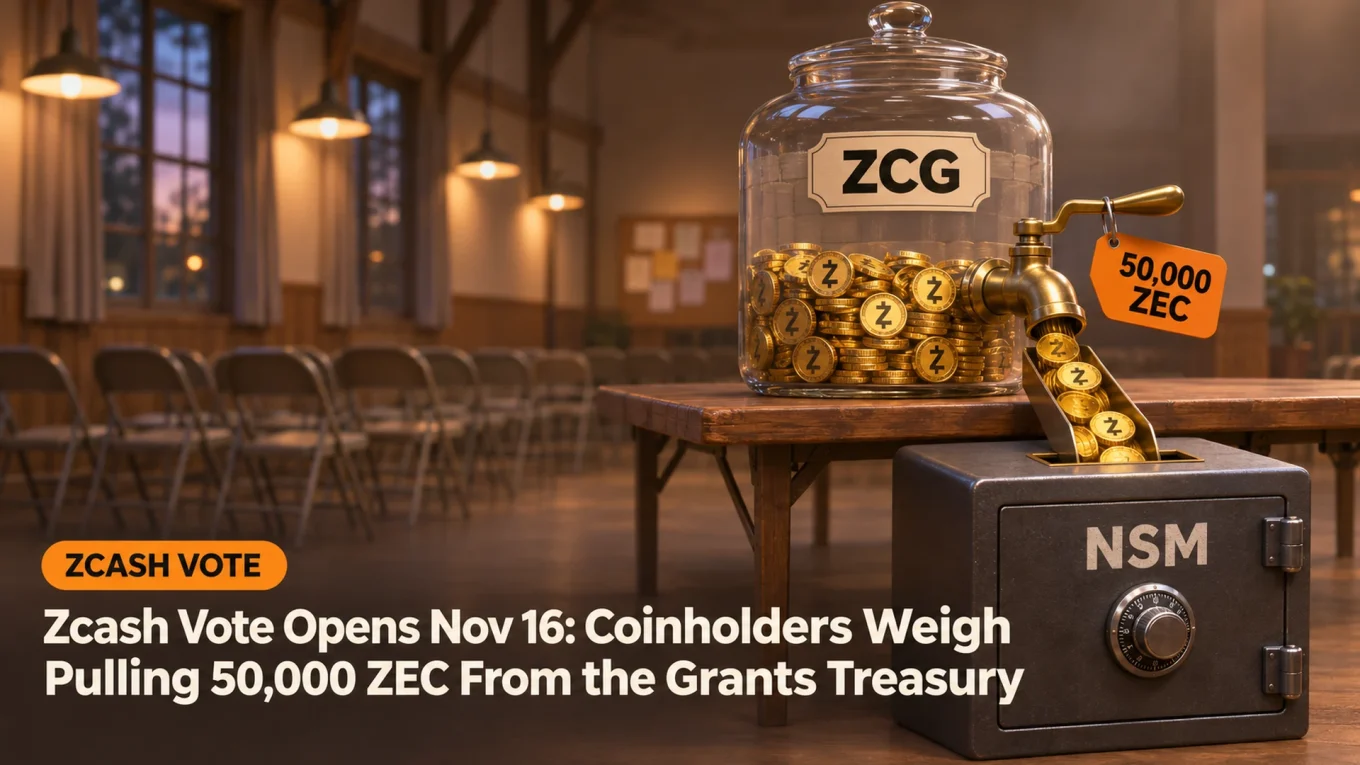
- The option drawing the most attention, merged as a draft ZIP on November 11, moves 50,000 ZEC (about $48.6 million, 55% of ZCG’s ZEC) to the NSM.
- It would also send ZCG’s 8% block share, 144 ZEC a day, into a lockbox nobody can spend from until a future ZIP, leaving ZCG about five years of runway.
- Next: the poll results after November 30, then a date for NU7.1. Follow Base Camp on X for more updates like this.
Zcash coinholders get their say on Monday. The Zcash vote on the future of Zcash Community Grants (ZCG) opens on November 16, and the option getting the most attention takes 50,000 ZEC out of the committee’s treasury and out of circulation.
That is about $48.6 million at today’s price. It is also 55% of all the ZEC ZCG holds.
The plan behind it, the Future Dev and Legal Defense Fund ZIP, was merged into the Zcash proposals repository on November 11. Don’t read too much into that. It is still a draft with no ZIP number, and nothing changes until the polls close and a network upgrade carries it.
ZEC trades at $971 on Binance at the time of writing, down 1.8% in 24 hours and back under $1,000.
So what exactly is on the ballot? And what would it do to ZEC supply?
Zooko Wilcox of Shielded Labs, one of the three authors, opened the pitch on X on October 30:

Tachyon Group (led by Sean Bowe) and Shielded Labs just posted a proposal to end future funding of the Zcash Community Grants program and reduce its treasury. ⤵️
What Is on the Zcash Vote Ballot?
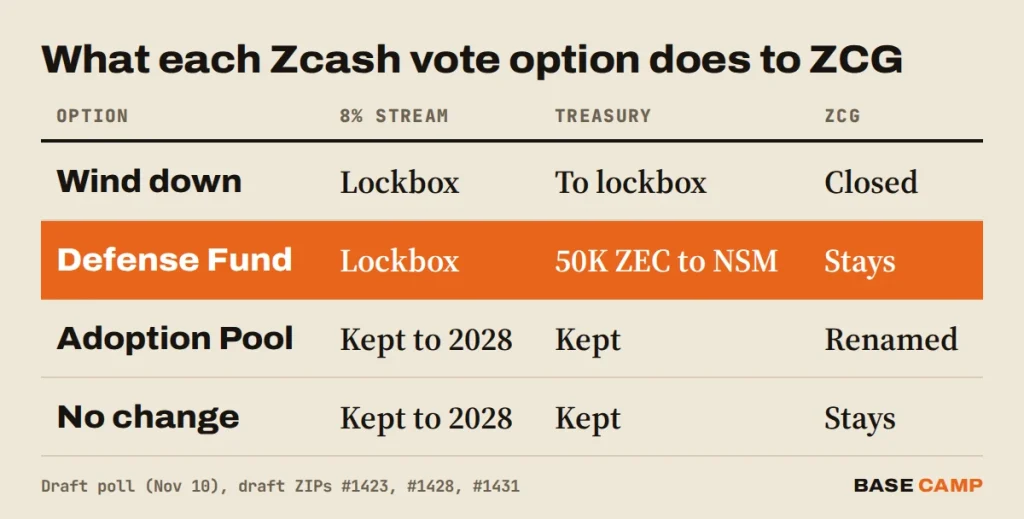
Five questions, each answered Support, Oppose or Abstain. Voters may back more than one, even proposals that clash.
Jason McGee of Shielded Labs posted the draft poll questions on November 10. He speaks for the five groups running the polls: Project Tachyon, Shielded Labs, Valar Group, the Zcash Foundation and ZODL. A revised draft is due after more feedback, so the wording can still move. The choices so far:
The fifth question has nothing to do with money. It asks whether the same upgrade should also cut Zcash’s block time from 25 to 20 seconds.
Question two is the one everyone is watching. Sean Bowe, Wilcox and McGee wrote it after the fight over Bowe’s earlier plan, which we covered in October. The draft ballot calls it “a compromise that led several authors to withdraw their competing proposals.”
Not everyone likes that line. Forum member fabacab, who has worked on the Adoption Pool proposal, called it “advocacy” that “has no place in polling language.”
Sponsored · Affiliate link
Save 20% on fees trading on WEEX
Base Camp may earn a commission if you sign up. It never affects what we write.
Where Would the 50,000 ZEC Go?
Into the Network Sustainability Mechanism (NSM), a protocol reserve that takes ZEC out of circulation and pays it back to miners over time as part of future block rewards. So it leaves circulation now and comes back slowly. It is not a burn.
The merged ZIP text has ZCG remove the coins with a ZIP 233 transaction, a new transaction type that carries a removal amount in the open. The first version named an unspendable address instead. That address is now a last resort, used only if ZIP 233 isn’t live in time.
Deadline: ZCG has 30 days after activation to do it, and must publish every transaction ID.
What does it do to supply? 50,000 ZEC is about 0.29% of ZEC circulating supply, which CoinGecko puts at 17.04 million coins. A one-off.
Bigger change: the stream. ZCG’s slice of the Zcash dev fund is 8% of every block: 144 ZEC a day, or about $51 million a year at today’s price. That stops landing in ZCG’s wallet. It keeps being created, but it piles up in a new lockbox until the November 2028 halving, and no one can spend it until a future ZIP sets the rules. The 12% coinholder fund is untouched. Total issuance stays the same. Who can spend it does not.
Here is what is left for ZCG:
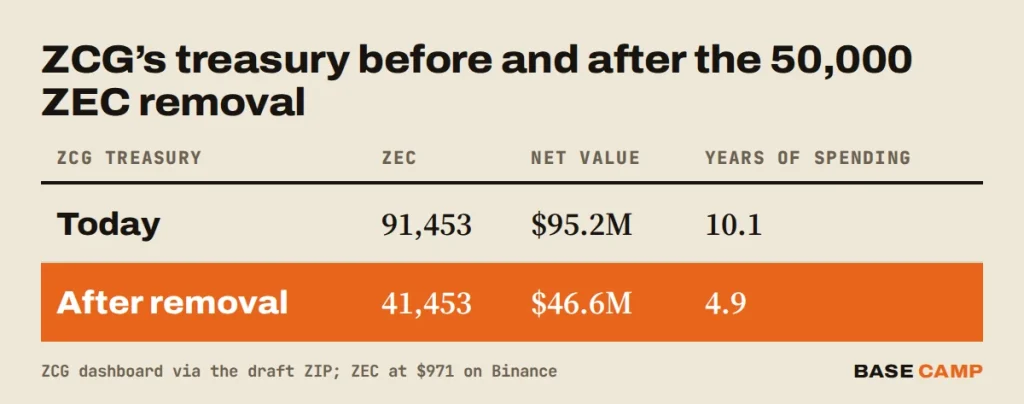
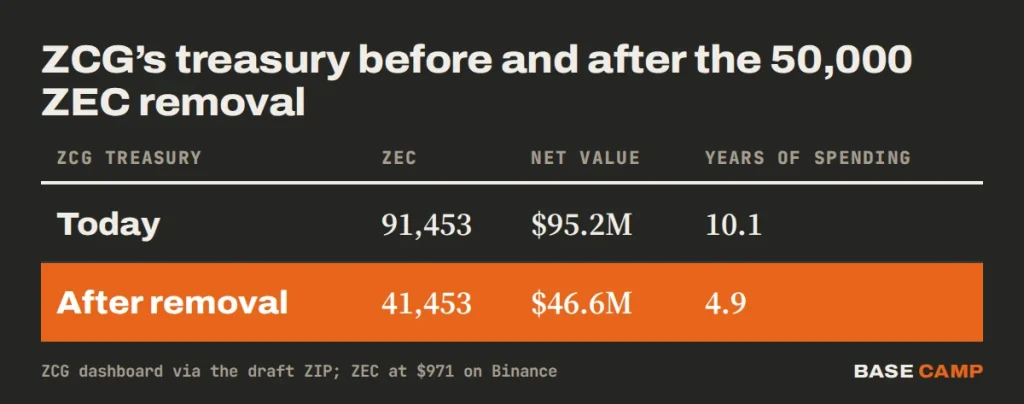
Net value counts the ZEC at $971, plus $8.8 million in cash, minus $2.4 million in grants already promised. Spending runs about $9.4 million a year, based on ZCG’s first half of 2026 as the ZIP reports it. The ZIP did the same sums at $1,300 per ZEC and got 13.3 years before and 6.4 after.
In other words, ZCG would keep roughly five years of runway at today’s price, with no new income behind it. The one catch: these are dashboard figures from October 26, and the dashboard itself is marked “Updates required.”
SIDE TRAIL: Zcash Dev Fund Fight: Plan to Cut a $125M Grant Pot Splits Builders
When Would the Zcash Vote Change Anything?
Not before a network upgrade called NU7.1, and that has no date yet. The timeline the five groups set on November 5:
- November 16: polls for coinholders and community panels open.
- November 30, 23:59 UTC (6:59 p.m. in New York): polls close.
- After the close: results go up, and if there is rough consensus, engineers and miners agree on a target date for NU7.1.
- Within 30 days of NU7.1: ZCG removes the 50,000 ZEC.
The polls are advisory. McGee describes rough consensus as “broad agreement that a proposed change should be adopted,” and says he’d weigh what miners and other stakeholders say too.
There is a catch nobody has settled yet. The timeline post says “major features and transaction format changes are outside the scope” of NU7.1. But the ZIP’s preferred route, ZIP 233, needs ZIP 248, a new transaction format. Zcash engineer Kris Nuttycombe has already asked for ZIP 248 to ship in whatever upgrade the polls approve. If it doesn’t, the last-resort address comes back into play.
McGee laid out the calendar on X the same day it went up on the forum:

ZEC Price: Is Anyone Trading the Vote?
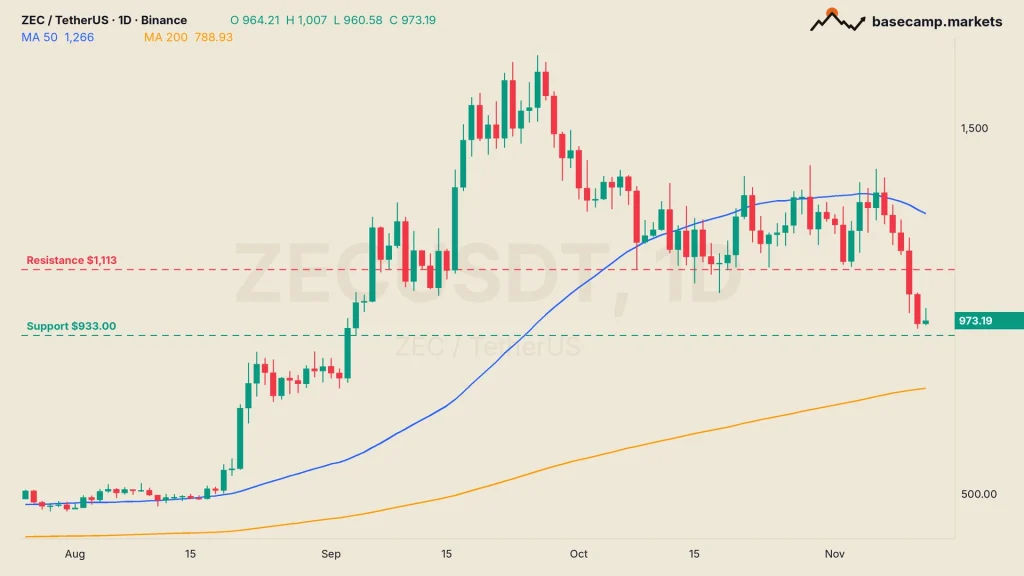
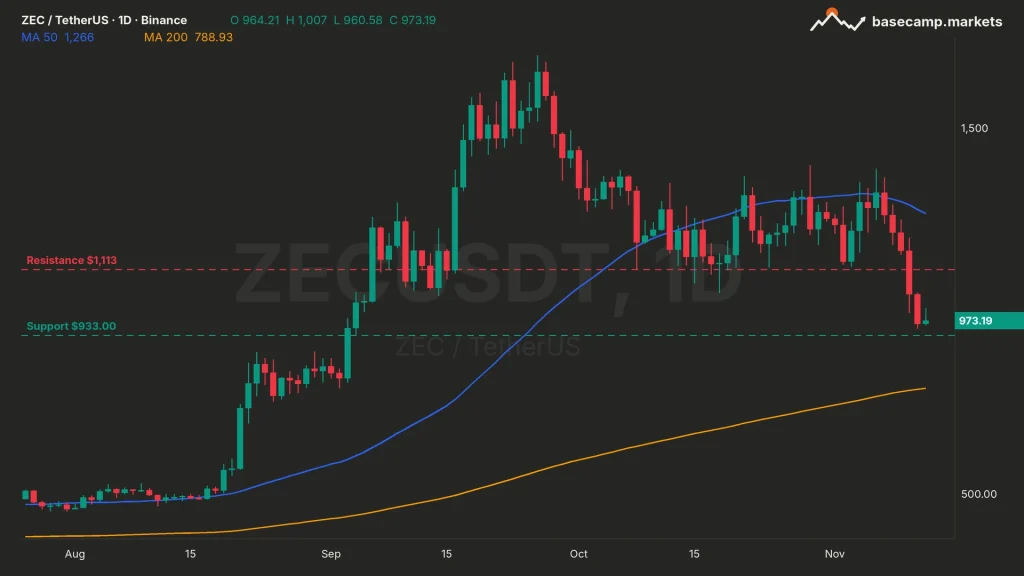
Not visibly. ZEC is down 26% in a week, and that came from leverage, not governance. A 0.29% supply cut doesn’t move a coin that lost 13% in one day this week.
At $971, the ZEC price sits in a 24-hour range of $951 to $1,025. Overhead, the 50-day moving average (MA), a trend line built from the last 50 daily closes, is up at $1,266. Far below, the 200-day MA is at $789.
- Resistance: $1,113. The October floor that broke on Tuesday.
- Support: $933. The September 4 low, where the September breakout started.
TRAIL MAP: Market Cap, Supply and Why “Cheap” Coins Aren’t Cheap
The coinholder polls close at 23:59 UTC on Monday, November 30.

Satoshi Flipper has more than 20 years of trading experience, starting in stocks before moving into crypto in 2017, and holds an MBA from the Kellogg School of Management. The edge is reading the economic data: rate decisions, inflation, jobs numbers, earnings and the US markets that move Bitcoin.
More from Satoshi Flipper