
The short version
- Bitcoin difficulty adjustment: mempool.space puts the next retarget at block 975,744 around 23:56 UTC on Friday, November 13, with a 7.82% cut, the biggest since June.
- Blocks have averaged 651 seconds (10m 51s) against a 600-second target, after two rises of 5.92% and 5.54% pushed difficulty to 148.36 trillion.
- A 7.8% cut lets the same machines find about 8.5% more Bitcoin, but BTC at $72,782 is down 12.6% in a month and fees are under 1% of miner rewards.
- Next: the retarget itself, which moves earlier or later with every block, and whether Bitcoin can close back above its 200-day MA at $73,143.
Ten minutes and 51 seconds. That is how long the average Bitcoin block has taken over the past two weeks, against a target of exactly 10 minutes.
The network will correct it on its own. The next Bitcoin difficulty adjustment is on track for a 7.82% cut late on Friday, according to mempool.space, which would be the biggest drop since June. It comes two weeks after a 5.54% rise that pushed difficulty to 148.36 trillion, close to the record.
Miners have had a rough month. Bitcoin is down 12.6% in 30 days, Core Scientific is leaving mining altogether, and MARA just sold more than 13,000 coins. So how much relief does a cut actually bring, and does it matter for the price?
Mining accounts on X saw it coming. On Wednesday evening the estimate was still about 7%, and it has only grown since:

Bitcoin mining is about to get easier.
Difficulty is on track to drop about 7% this Friday.
Why: Bitcoin wants one block every 10 minutes. Since the last adjustment, blocks have taken about 10 min 45 s.
So every 2,016 blocks the code resets the difficulty to pull the pace back
When Is the Next Bitcoin Difficulty Adjustment?
At block 975,744, which mempool.space puts at around 23:56 UTC on Friday, November 13 (6:56 p.m. in New York). That time is only an estimate. It moves with every block.
Here is the mechanism. Every 2,016 blocks, roughly two weeks, the network looks at how long those blocks took. Too slow, and difficulty drops so blocks come faster. Too fast, and it rises. The goal is one block every 10 minutes, whatever the number of machines. That keeps the supply schedule on track: new coins arrive at the same pace whether miners pile in or walk away.
The current epoch is 90.2% done, with 198 blocks to go. Blocks have averaged 651 seconds, which is 8.5% slower than the target. Hence the cut.
The final number can still move. If more machines switch back on before Friday, blocks speed up and the cut shrinks. If they stay off, it holds near 7.8%.
Sponsored · Affiliate link
Save 20% on fees trading on WEEX
Base Camp may earn a commission if you sign up. It never affects what we write.
Hash Rate Hasn’t Kept Up With 148.36 Trillion
The short answer is that difficulty ran ahead of the machines.
Difficulty rose 5.92% on October 16 and another 5.54% on October 29. Both jumps came from fast blocks in October, when more machines were online and Bitcoin still traded above $80,000.
Then the hash rate, the total computing power pointed at Bitcoin, stopped growing. At 148.36 trillion, the network needs about 1,062 exahashes per second (EH/s) to find a block every 10 minutes. A 651-second average means it has run closer to 978 EH/s. That is our own sum from mempool.space’s figures.
The daily estimates are noisier. Mempool.space shows two days near 825 EH/s on November 9 and 10, then a bounce back to about 983 EH/s.
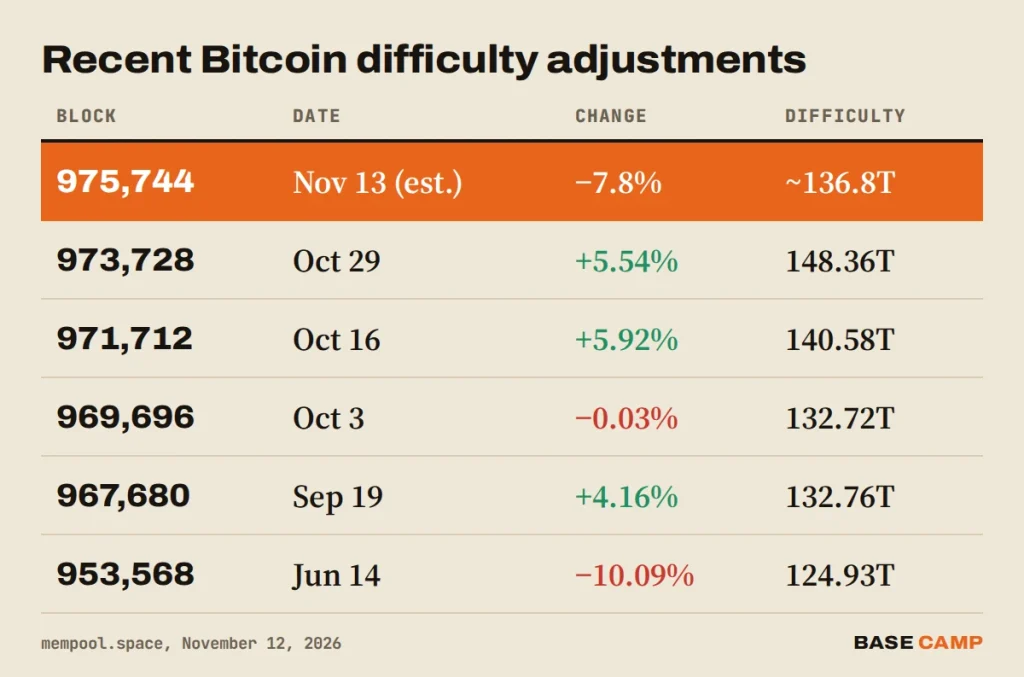
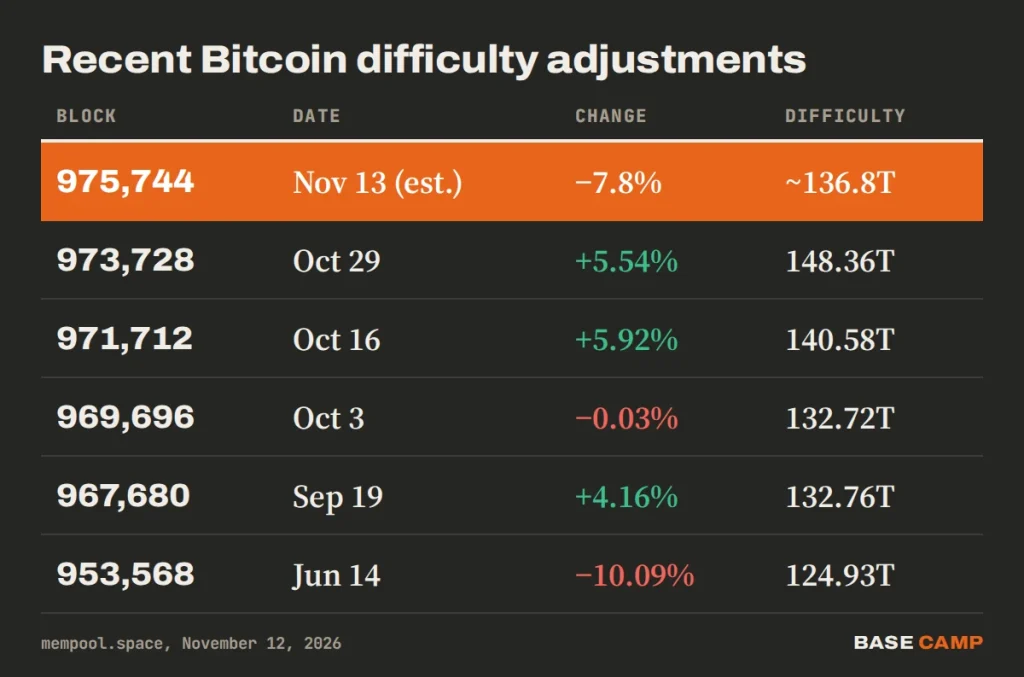
The June line is the one to compare. That −10.09% cut was the last mining difficulty drop bigger than 7.8% in a single adjustment. No drop since has been bigger than about 5%.
SIDE TRAIL: Bitcoin Miners Selling: Core Scientific Quits Mining, MARA Moves 1,650 BTC
How Much Does a 7.8% Cut Help Miners?
Some, not much. If difficulty falls 7.8% to about 136.8 trillion, the same machine finds about 8.5% more Bitcoin for the same power bill.
That matters because the margins are thin. The block reward is 3.125 BTC, and fees add almost nothing right now. The last 144 blocks paid 453.76 BTC in total, and only 3.76 BTC of that came from fees, under 1%. For context, those 144 blocks are meant to take a day. At the current pace they take about 26 hours, so miners also collect fewer rewards per day until the cut lands.
So miners live on the subsidy and the Bitcoin price. The price is the problem. A coin that is 12.6% cheaper than a month ago wipes out an 8.5% gain in output with room to spare.
The companies have already reacted. Core Scientific said on its third-quarter call that it will shut down its Bitcoin mining in the fourth quarter and run only AI data centers from 2027. Its quarterly report shows mining was down to 5% of revenue, and losing money. MARA went the other way on its balance sheet: it sold 13,597 BTC after September 30 and paid off $750 million in Bitcoin-backed loans.
Luxor’s Hashrate Index put a number on the squeeze this week. Hashprice, what one petahash of machines earns per day, fell 7.25% to $31.75 with no help from difficulty at all:

This week’s Hashprice Weather Report is out 🌧️
Bitcoin hashprice fell 7.25% to $31.75 per petahash. Last week’s drop came from a difficulty increase. This week difficulty hasn’t moved at all, and hashprice fell just as hard anyway.
In other words, the cut is the network doing what it was built to do. It makes mining cheaper for whoever is still plugged in. It does not bring back the miners who already left for AI.
Bitcoin Price Analysis: Does a Difficulty Cut Help BTC?
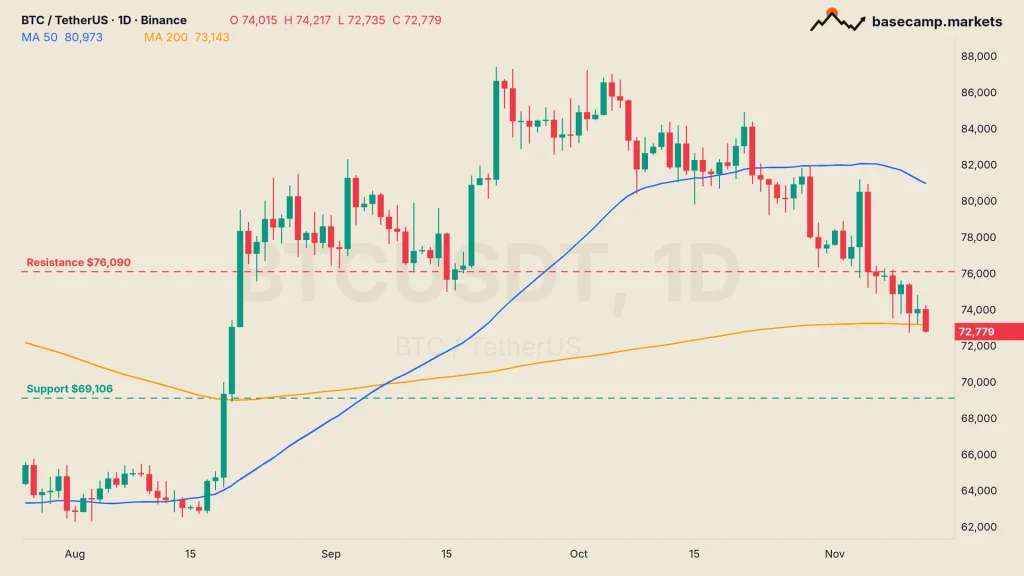
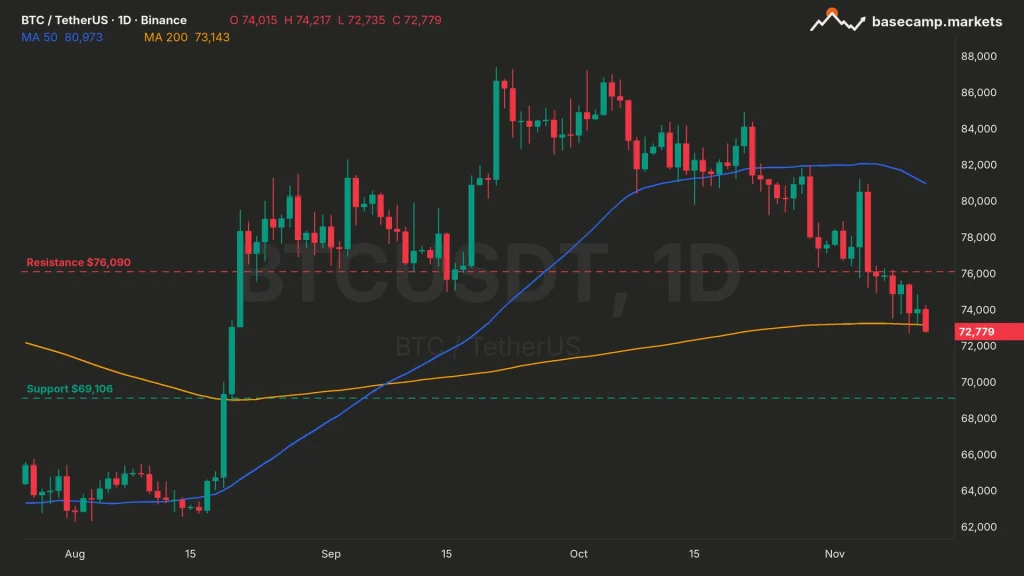
Not directly. A cut lowers the cost of mining, which can ease the pressure on miners to sell coins, but it changes nothing about demand.
Bitcoin trades at $72,782 at the time of writing, down 1.43% in 24 hours and 9.4% over the week. The Fear & Greed Index sits at 28, in fear.
Start with the weekly chart. Every weekly candle since early October has closed red, and last Sunday’s close at $74,851 landed under the 50-week moving average (MA), the average of the last 50 weekly closes, at $75,184.
The daily chart looks no better. Price sits just under the 200-day MA at $73,143, with the 50-day MA far above at $80,973.
- Resistance: $76,090. The 0.382 Fibonacci level, and the area Bitcoin lost in the first week of November.
- Support: $69,106. The 0.618 Fibonacci level of the move from the July low to the September high.
A daily close back above the 200-day MA would be the first sign of strength. Until then, the trend is down. It’s that simple.
TRAIL MAP: Bitcoin Cycles and the Halving
The cut lands at block 975,744. On the current pace, that is a little before midnight UTC on Friday.

TheCryptoMonk has been trading since 2017 and reads the market from the top down. The focus is macro and the high timeframes: where stocks, rates and liquidity are heading, and what the weekly and monthly charts say about Bitcoin. Short-term noise matters less than the bigger trend.
More from TheCryptoMonk