
The short version
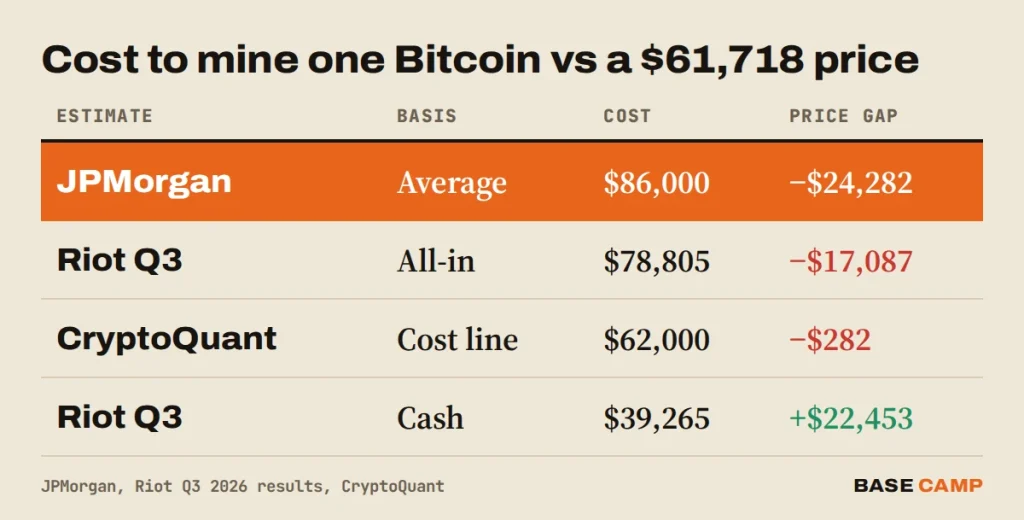
- Bitcoin production cost is about $86,000 a coin, JPMorgan estimates, while BTC trades at $61,718, $24,282 or 28.2% below it.
- Hashprice, what miners earn per petahash a day, hit a record low near $26.16 on Saturday, and fees pay only about 0.5% of rewards.
- Listed miners keep selling: MARA sold 13,597 BTC after September 30, and Riot’s all-in cost was $78,805 a coin last quarter.
- Next: a difficulty rise of about 8.4% around 03:09 UTC Friday, November 27. Follow Base Camp on X for the final number.
Bitcoin miners are selling their product for a lot less than it costs to make. JPMorgan puts the Bitcoin production cost at $86,000 a coin, and BTC trades at $61,718 at the time of writing.
That is a gap of $24,282, or 28.2% under the bank’s number. Bitcoin would need to rally 39.3% just to get back to it. Miners’ daily pay hit a record low on Saturday, and the network is about to make their job harder again. So who blinks first: the machines or the price?
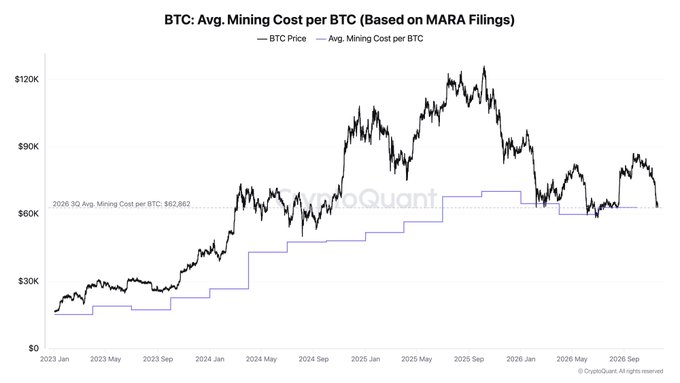
CryptoQuant’s Ki Young Ju flagged a much closer line on the same day the JPMorgan note came out. His chart put the miners’ cost level at $62,000, which is about where Bitcoin trades right now:

Bitcoin has reached the $62K mining cost level.
A break below could pressure public miners and their institutional backers.
Yet hashrate remains high despite BTC trading near mining costs, suggesting public miners are still betting on a long-term bull market.
What JPMorgan’s $86,000 Bitcoin Production Cost Means
It is an average, not a wall. JPMorgan analysts led by Nikolaos Panigirtzoglou estimated in a note dated November 18 that it costs about $86,000 to mine one Bitcoin across the network.
When the note came out, Bitcoin traded between $62,063 and $65,002 on Binance. Then BTC slid to $55,130 on Saturday, its lowest since September 2024, before bouncing 12%.
The bank calls production cost a soft floor. The logic goes like this:
- Price falls under what it costs to mine.
- The miners with expensive power or old machines lose money on every coin and switch off.
- Fewer machines means slower blocks, so the network cuts the difficulty, the setting that controls how hard it is to find a block.
- A lower difficulty means the miners still running earn more coins for the same power bill, so the average cost drops.
In other words, the gap can close without Bitcoin rallying a dollar. The cost line just comes down to meet the price. That is also why an average Bitcoin production cost is a poor guide to any single company. Miners with cheap power still cover their bills at $61,718.
Sponsored · Affiliate link
Save 20% on fees trading on WEEX
Base Camp may earn a commission if you sign up. It never affects what we write.
Hashprice Hits a Record Low
Hashprice is what one petahash per second of mining machines earns in a day, in dollars. It is the number every miner checks before deciding whether to keep the lights on.
Luxor’s Hashrate Index put it at about $26.16 per petahash per day on Saturday, when Bitcoin dipped to $55,130. That is the lowest reading on record. For context, the same index had it at $31.75 in its November 11 report.
The bounce helped a little. On today’s numbers from mempool.space, a difficulty of 134.82 trillion and a price of $61,718, one petahash earns about $28.92 a day. That is our own sum, and it is still thin.
Fees won’t rescue it. Of the 452.21 BTC paid to miners over the last 144 blocks, only 2.21 BTC came from transaction fees, about 0.5%. Miners live on the 3.125 BTC block reward and the Bitcoin price, and right now both are working against them.
SIDE TRAIL: Bitcoin Capitulation: Glassnode Says $62K-$66K Is the Line, With $58.5K and $53.7K Below It
Are Bitcoin Miners Selling? Glassnode Says Nearly Half Is Gone
Yes, and Bitcoin miners selling is not new. Glassnode says listed miners have sold nearly half their Bitcoin since January, with the money now going into AI data centers:

Bitcoin miners are rapidly selling their reserves.
For years, listed miners held what they mined, and some bought more. Since January, they have sold nearly half their bitcoin:native.
A major shift in their approach: the BTC now funds their move into AI data centers.
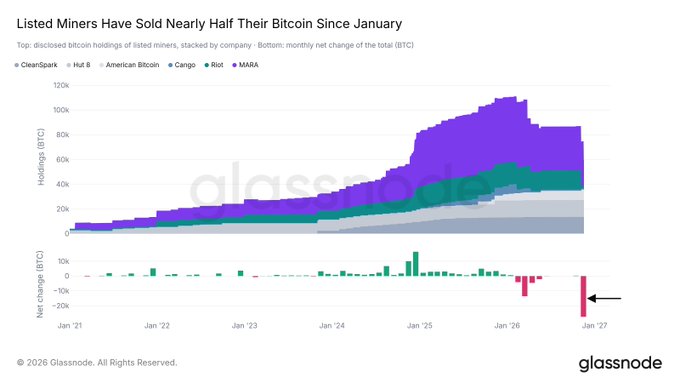
MARA is the biggest name on that list. It sold 13,597 BTC after its third quarter ended on September 30, for about $1.1 billion, and used $750 million of it to pay off its Bitcoin-backed loans. Base Camp’s count of MARA’s Bitcoin sales is now 40,581 BTC for 2026.
Riot Platforms shows the squeeze in its own books. Its third-quarter results put its Bitcoin mining cost at $78,805 a coin including machine depreciation, or $39,265 without it. Riot got an average price of $70,855 for the 1,637 BTC it mined in the quarter. So on paper, every coin lost money once the machines’ wear is counted, while the cash cost stayed well covered.
That split is the whole debate. A miner with a $39,265 cash cost can keep hashing at $61,718 and sell coins to cover the bills. A miner nearer the $86,000 average can’t, and selling is how it buys time.
The stocks have priced some of this in. In the week to Friday, November 20:
- MARA: down 27.2% to $5.09.
- Riot: down 7.4% to $16.23.
Thursday’s Bitcoin Difficulty Adjustment Makes It Harder
Here is the twist. Hash rate didn’t fall the way JPMorgan’s soft floor needs it to. It went up.
The network cut difficulty by 9.13% on November 14. Machines came back on, and blocks have averaged 9 minutes 14 seconds since then, well under the 10-minute target. Mempool.space shows the hash rate at about 1,028 exahashes per second.
So the next Bitcoin difficulty adjustment goes the other way. It is on track for a rise of about 8.4% at block 977,760, which mempool.space puts around 03:09 UTC on Friday, November 27 (10:09 p.m. Thursday in New York, Thanksgiving night). The estimate moves with every block.
What does that do to hashprice? At today’s price, an 8.4% rise would push it from about $28.92 to about $26.67 per petahash per day, right back near Saturday’s record low. That is our own arithmetic. For miners to earn the same as today after the change, Bitcoin would need to be around $66,900.
Bitcoin Price Analysis: Where Is the Floor If Not $86,000?
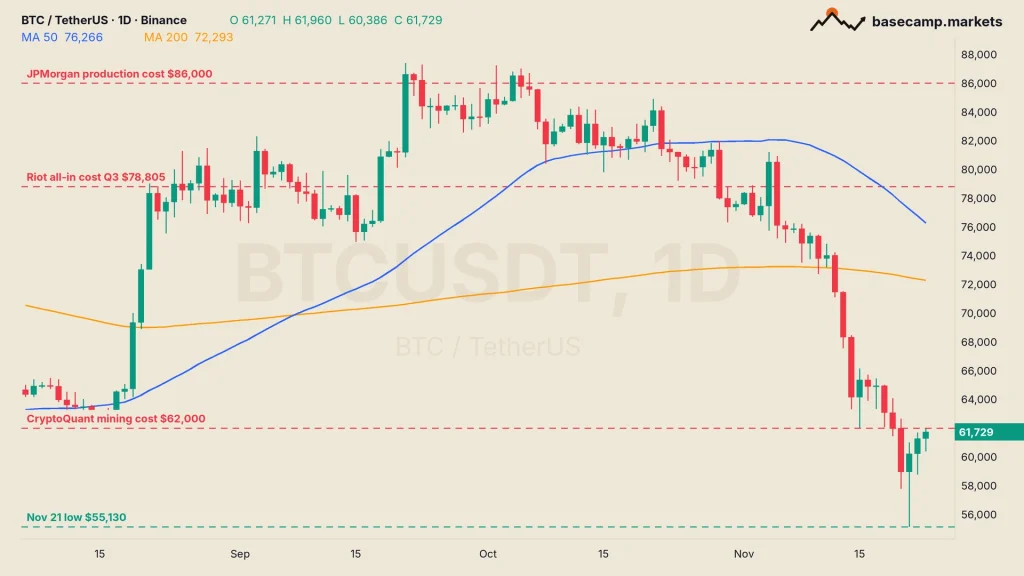
Much lower, and a lot closer to the cash costs. JPMorgan’s $86,000 sits above the high of every daily candle since early October.
Bitcoin trades at $61,718 at the time of writing, up 4.3% in 24 hours, and the Fear & Greed Index reads 11, extreme fear. Both moving averages, the average closes of the last 50 and 200 days, are far overhead at $76,266 and $72,293. This is still a bounce inside a downtrend.
The levels that matter:
- The line in the sand: $62,000. CryptoQuant’s miner cost level, a few hundred dollars above the price.
- Resistance: $64,700. The last swing high, then $65,474.
- First support: $59,131. The nearest swing low on the daily chart.
- The floor: $55,130. Saturday’s low, set when hashprice hit its record.
A daily close above $62,000 would put Bitcoin back over CryptoQuant’s cost line and take some heat off the miners. A slide back under $59,131 heading into Thursday’s difficulty rise is the setup that forces the weakest machines off.
TRAIL MAP: Bitcoin Difficulty Adjustment: Miners Set for a 7.8% Cut Friday as Blocks Slow to 10m 51s
$66,900. That is roughly where Bitcoin needs to be by Friday just to keep miners’ pay where it is today.

Satoshi Flipper has more than 20 years of trading experience, starting in stocks before moving into crypto in 2017, and holds an MBA from the Kellogg School of Management. The edge is reading the economic data: rate decisions, inflation, jobs numbers, earnings and the US markets that move Bitcoin.
More from Satoshi Flipper