The short version
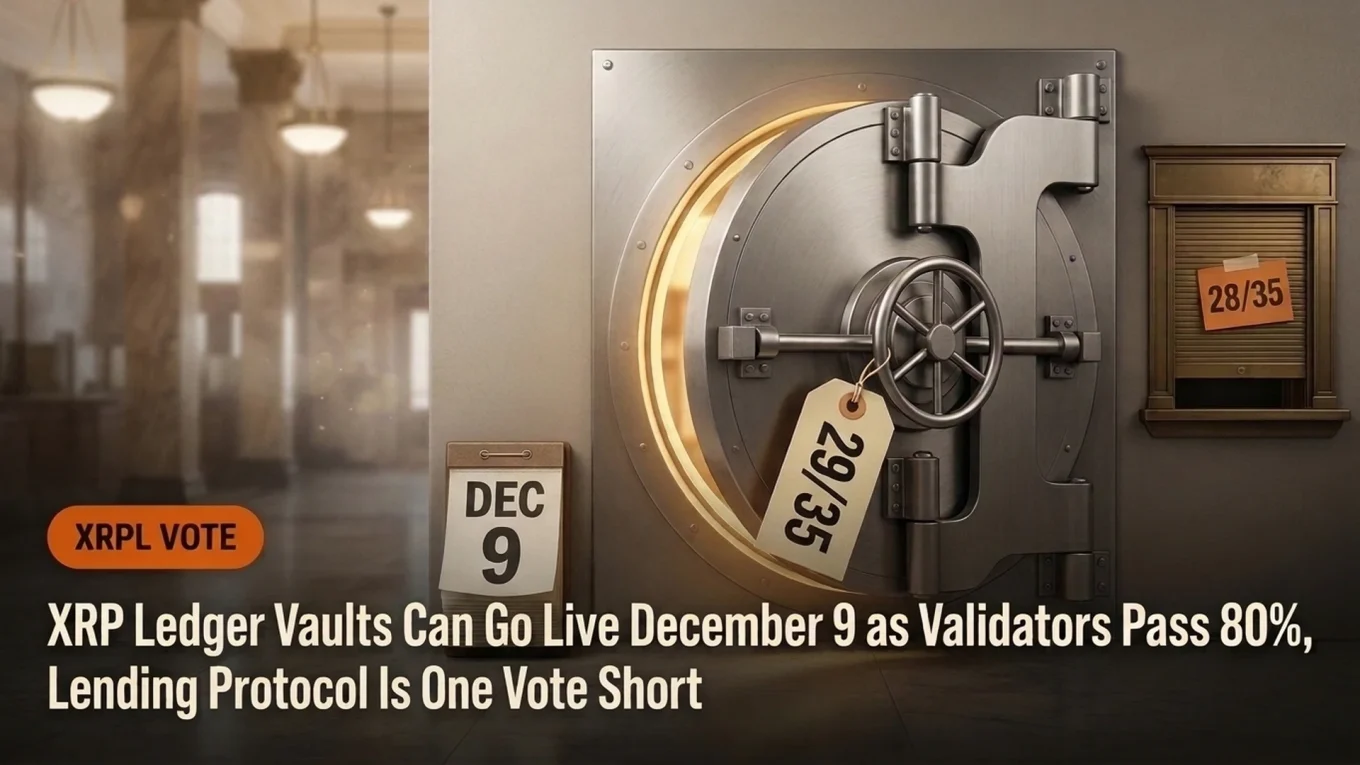
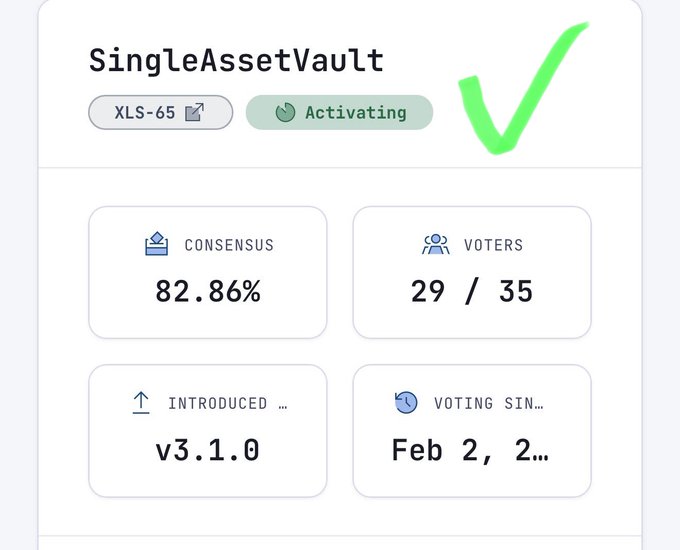
- XRP Ledger vaults (XLS-65) reached 29 of 35 validator votes on November 25, starting a 14-day clock that ends around 19:38 UTC on December 9.
- The vote has one yes to spare: if support drops to 28 of 35, exactly 80%, the timer resets to zero.
- The XRPL lending protocol (XLS-66), which adds uncollateralized fixed-term loans from vaults, sits at 28 of 35 and needs one more vote to start its own two weeks.
- Next: XRP trades at $0.98 with $0.86 as the floor, and December 9 is the first date anything changes onchain. We’ll post it on Base Camp on X if vaults go live.
29 of 35. That is how many trusted validators now vote for XRP Ledger vaults, and it was enough to start the clock.
SingleAssetVault, the amendment behind the XLS-65 standard, crossed the XRP Ledger’s 80% line on Wednesday, November 25, at about 19:38 UTC. If that support holds for 14 days straight, vaults switch on for everyone at the earliest around 19:38 UTC on Wednesday, December 9 (2:38 p.m. on the US East Coast).
Lending, the feature built on top of those vaults, is not there yet. It sits at 28 votes, exactly 80%, and on this ledger exactly 80% is not enough.
So what do vaults change, why is lending stuck one vote short, and does any of it matter for XRP at $0.98?
XPMarket, an XRP Ledger trading app, posted the count less than two hours after the vote crossed the line:

The 14-day countdown for vaults on the XRP Ledger has started.
SingleAssetVault just reached 29 out of 35 validator votes, passing the required 80% threshold.
If support holds, vaults could go live around December 9.
But what exactly is a Single Asset Vault?
Think of it as a
What Did XRP Ledger Validators Approve?
A new building block for pooled money. On the XRP Ledger’s amendment system, changes to the protocol go live only when more than 80% of trusted validators support them for two weeks in a row. A validator is a server that helps agree on which transactions make it into each ledger.
The ledger itself records the vote. Its Amendments object lists SingleAssetVault as the only upgrade holding a majority right now, with a start time that converts to November 25, 19:38 UTC. XRPScan’s amendments page shows the same thing from the other side: 29 of 35 validators for vaults, 28 of 35 for both versions of the lending protocol, and no majority for either lending upgrade.
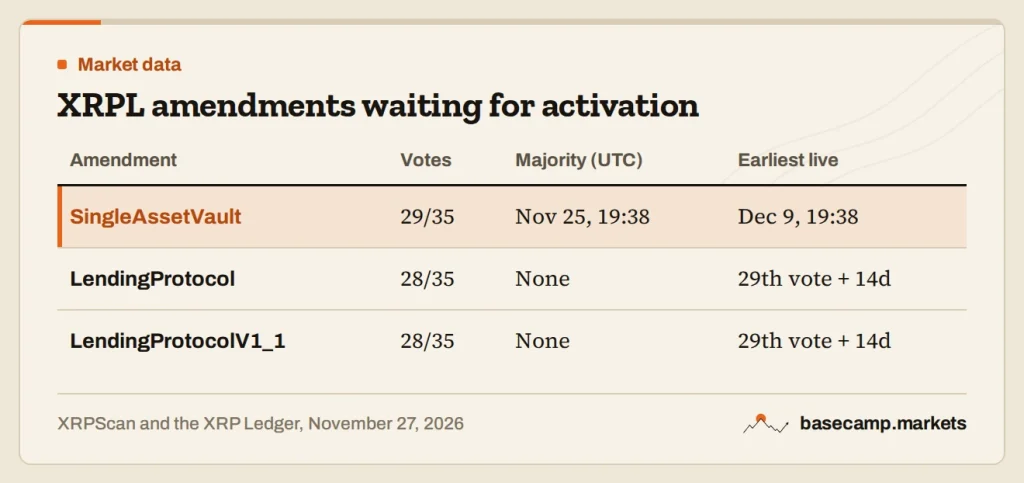
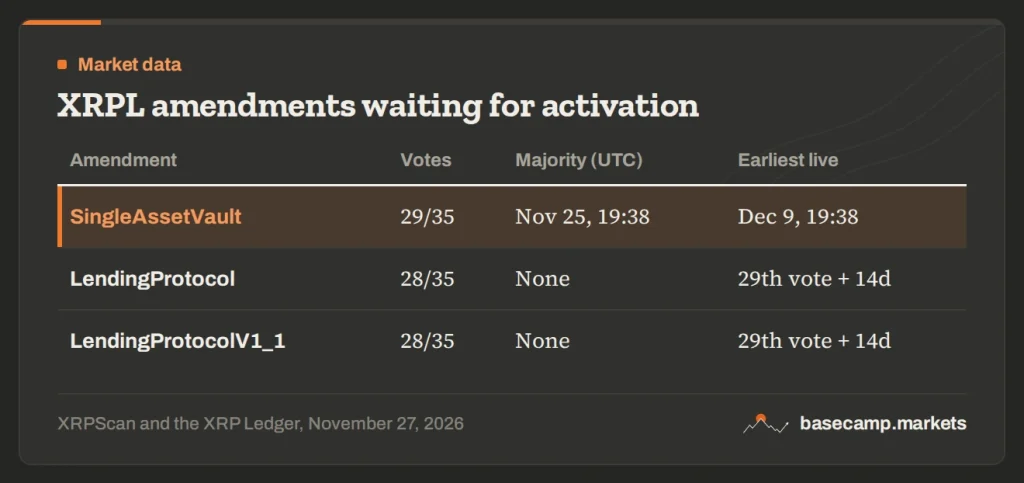
The math is tight. With 35 validators, 80% is 28, and the rule asks for more than that. Vaults have exactly one vote of room.
Sponsored · Affiliate link
Save 20% on fees trading on WEEX
Base Camp may earn a commission if you sign up. It never affects what we write.
What XRP Ledger Vaults Actually Do
They let many people pool one asset in one place, on the ledger itself, without a smart contract platform in the middle.
The XLS-65 specification describes a vault as “a new on-chain primitive for aggregating assets from one or more depositors.” Each vault holds a single asset, which can be XRP, a trust-line token such as a stablecoin, or a Multi-Purpose Token (MPT), the XRP Ledger’s newer token format. A separate account controlled by the protocol, not by the vault owner, holds the deposits.
Depositors get shares back, and those shares are MPTs too. Hand in your shares and you redeem your part of the pool.
Vet, an XRP Ledger validator operator affiliated with the XRP Ledger Foundation, put it simply on the night the clock started:

Single Asset Vaults (XLS-65) amendment is now in 2 weeks activation on the XRP Ledger!!! ✅
It's an important building block for Lending on XRP (XLS-66).
The vaults are native, without smart contracts, allow you to deposit XRP or any other issued asset into it.
Vault owners
Three details stand out for anyone thinking about putting money in one:
- Public or private: a vault can be open to anyone, or private, where only depositors holding the right credentials (through permissioned domains) can join. That second option is aimed at regulated funds and institutions.
- Withdrawals: the spec says any shareholder can withdraw, “to prevent Vault Owner from locking away depositor funds.”
- Losses: a vault can mark a “paper loss” that lowers its value while a loan looks shaky, with different exchange rates for deposits and redemptions so nobody can buy in cheap at the dip.
On their own, XRP Ledger vaults are a parking spot. The yield, if any, comes from whatever protocol plugs into them. That is where the second vote comes in.
SIDE TRAIL: DeFi Basics: How Decentralized Finance Works
Why Is the Lending Protocol Still One Vote Short?
Because 28 of 35 is exactly 80%, and XRP Ledger amendments need more than 80%. One more validator has to switch its vote on before the XRPL lending protocol even starts its own 14-day clock.
The XLS-66 specification calls it an “XRP Ledger-native protocol for issuing uncollateralized, fixed-term loans using pooled funds.” Read that word again: uncollateralized. Borrowers don’t lock up crypto worth more than the loan, the way they do on most DeFi lending apps. The design “relies on off-chain underwriting and risk management,” in other words, someone checks the borrower’s credit the old-fashioned way, outside the chain.
That someone is a Loan Broker. The broker runs the lending side of a vault, sets the fees (a management fee of up to 10% of the interest, plus origination, service and late fees) and can post optional first-loss capital, money that absorbs defaults before depositors take a hit. If that cover falls below the required level, the broker can’t issue new loans.
Loans run to a known end date with a fixed payment schedule. For a bank or a fund, that looks a lot more like a normal credit product than a crypto money market does.
Some validators are already on board. Filip Koprivec, chief product officer at Flare, said its XRP Ledger validator voted yes on Wednesday:

We voted in favour of XLS-66.
Native lending belongs on the XRPL, and credit origination at the base layer opens the door for serious institutional capital.
Steps add up. With Confidential Compute live and native lending coming, Flare Smart Accounts can route XRP into the
The two lending amendments, LendingProtocol from rippled 3.1.0 and LendingProtocolV1_1 from 3.4.0, both sit at 28. The spec lists XLS-65 as a requirement, so lending can’t switch on before vaults. If a 29th vote arrived today, the earliest start would be December 11. Every day without it pushes that date back.
Here is the one caveat that matters for both upgrades. Each timer resets if support drops to 80% or below at any point. With 35 validators, one of the 29 changing its vote would send XRP Ledger vaults back to zero.
XRP Price Analysis: Does December 9 Matter for XRP?
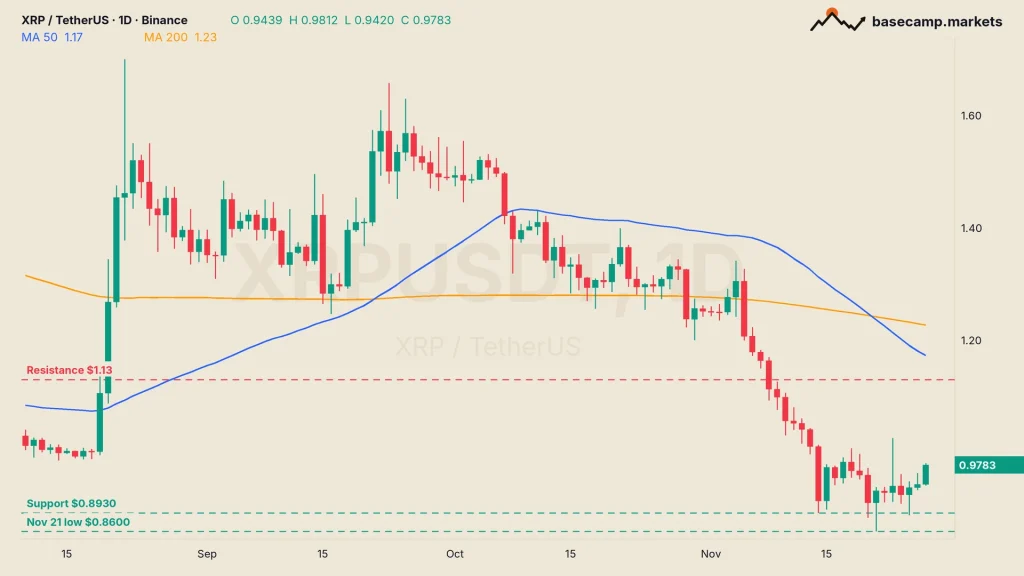
Not yet, judging by the chart. Ripple (XRP USD) trades at $0.98 at the time of writing, up about 2.5% in 24 hours but still down 26.5% over 30 days, and the vote news hasn’t changed that trend.
XRP sits far below both of its moving averages. The 50-day MA, the average closing price of the last 50 days, is at $1.17, and the 200-day MA is at $1.23. The 50-day crossed under the 200-day earlier this month, a sign the medium-term trend has turned down.
The levels that matter in this XRP price analysis:
- Resistance: $1.13, the swing high price would have to reclaim before the November slide looks like more than a pause.
- Support: $0.893, then $0.86, the November 21 low and the bottom of the last six months.
Nor is the wider market helping. The Fear and Greed Index reads 12, deep in extreme fear.
TRAIL MAP: Support and Resistance for Crypto Beginners
Upgrades like this rarely move price on the day they go live; what counts is whether anyone actually fills the vaults. For now, 29 votes hold the vault door open, and it takes just one to close it again.

VikingXBT has been trading crypto since 2017. The focus is futures, onchain data and automation. Onchain flows get checked before a chart is trusted, and anything repetitive gets automated. VikingXBT built Base Camp's own onchain scanner, which flags bundlers, snipers, dev holdings and wallet clusters in one view, and backtests strategies before trading them.
More from VikingXBT