The short version
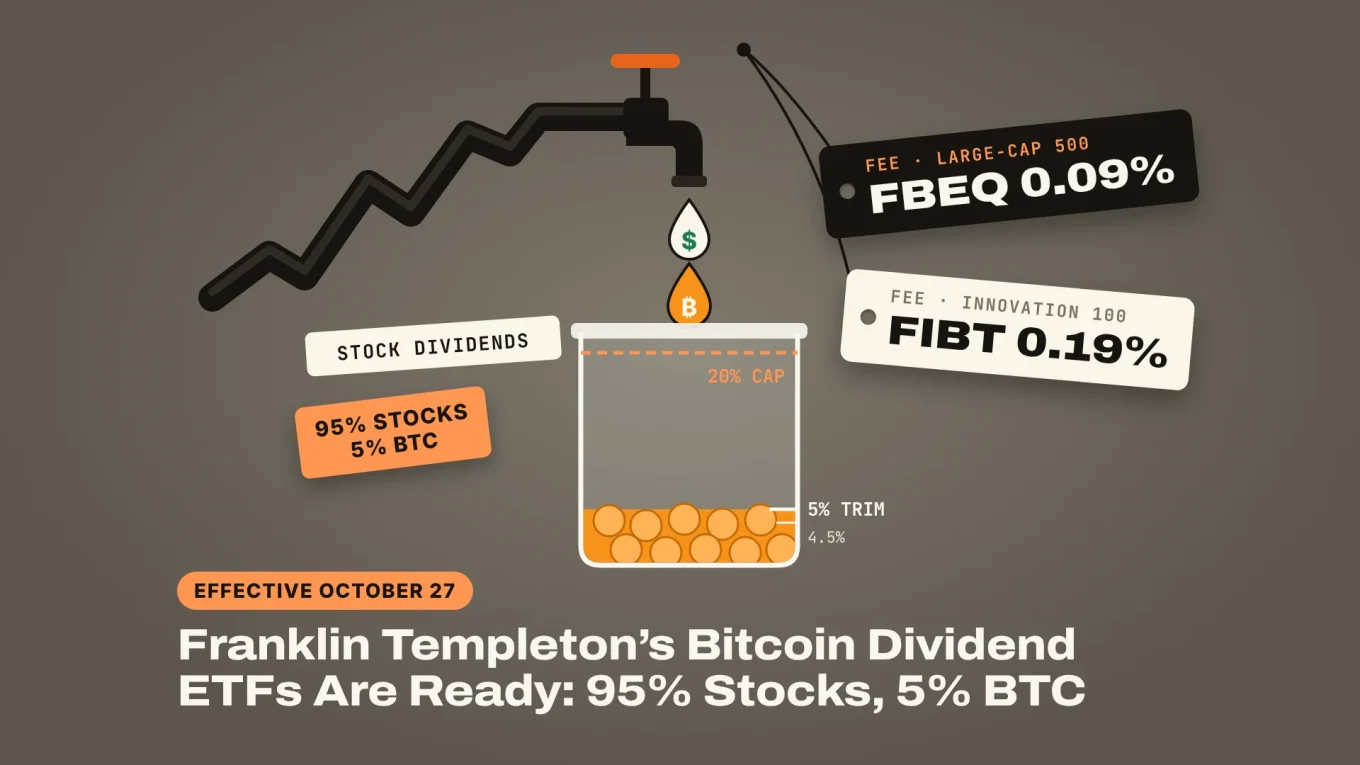
- The Bitcoin dividend ETF pair from Franklin Templeton, FBEQ (0.09% fee) and FIBT (0.19%), takes effect on October 27: 95% US stocks, 5% Bitcoin, and every stock dividend buys more BTC.
- The drip is small: run on the past year, the dividends on a $10,000 S&P 500 mix bought just $107 of Bitcoin, and the mix trailed plain SPY by about $200 as BTC fell 26%.
- The crew is watching the first trading day, which Franklin hasn’t announced, and whether BTC holds Saturday’s $79,221 low.
A Bitcoin dividend ETF sounds like Wall Street finally stacking sats for you. Franklin Templeton’s two new funds do something quieter. They hold US stocks, take the dividends those companies pay, and buy Bitcoin with them instead of more shares.
The funds are the Franklin US Equity Bitcoin DRIP Index ETF (FBEQ) and the Franklin US Innovation Bitcoin DRIP Index ETF (FIBT). Their final prospectus, filed on October 22, takes effect on Tuesday, October 27, and the shares are registered for Nasdaq. Franklin hasn’t named a first trading day yet. The mix starts at 95% stocks and 5% Bitcoin, and FBEQ costs 0.09% a year. So how much Bitcoin does a dividend actually buy?
The Bitcoin Conference account summed up the hype on Friday:

🚨 FRANKLIN TEMPLETON IS PREPPING 2 NEW #BITCOIN ETFS 🇺🇸
EVERY STOCK DIVIDEND AUTOMATICALLY BUYS BTC 🤯
WALL STREET IS STACKING SATS ‼️

How Does the Bitcoin Dividend ETF Work?
It owns stocks, and every payout becomes Bitcoin. FBEQ tracks the VettaFi US Large-Cap 500 Bitcoin DRIP Index, 499 large US companies weighted by size. FIBT tracks the VettaFi US Innovation 100 Bitcoin DRIP Index, the 100 biggest non-financial Nasdaq stocks, and charges 0.19%.
DRIP stands for dividend reinvestment plan. In a normal fund the payouts go back into the same stocks. Here, the prospectus says all regular and special dividends are “reinvested into bitcoin at the market open on the day following the dividend ex-date”.
Three rules keep the Bitcoin slice small:
- The quarterly trim: if Bitcoin is above 5% at a quarterly rebalance, it is cut back to 4.5%.
- The hard cap: if Bitcoin passes 20% between rebalances, it goes back to 4.5% two business days later.
- No coins: the fund gets its Bitcoin through ETPs such as Franklin’s own spot fund, EZBC, plus futures, options or a Cayman Islands subsidiary. Franklin says it will waive its fee on the money parked in its own Bitcoin fund, so you don’t pay twice.
Sponsored · Affiliate link
Save 20% on fees trading on WEEX
Base Camp may earn a commission if you sign up. It never affects what we write.
How Much Bitcoin Do Dividends Really Buy?
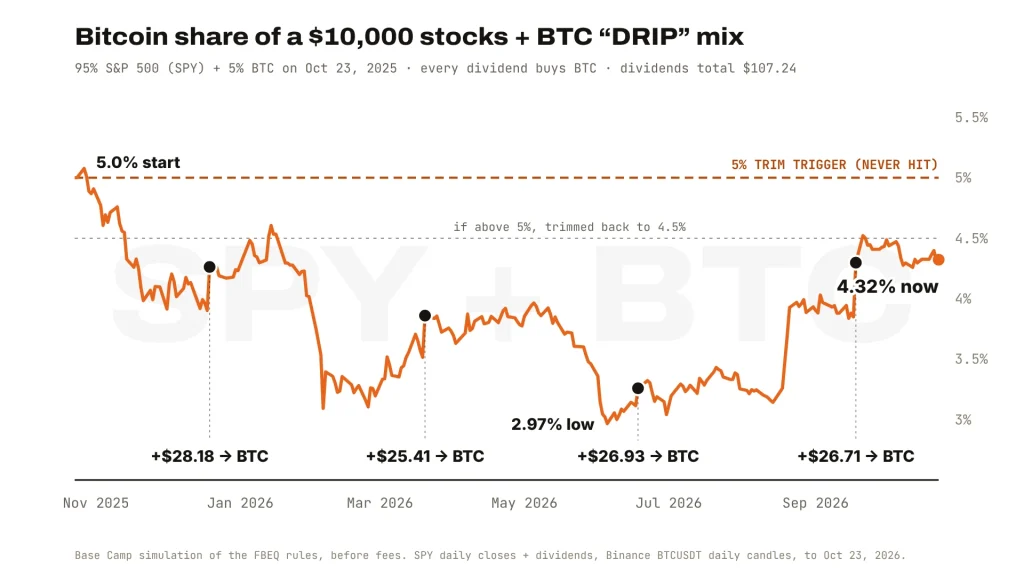
Not much. We ran the rules on the past year with SPY, the S&P 500 ETF, standing in for the index: $9,500 in stocks and $500 in Bitcoin on October 23, 2025. The four quarterly dividends came to $107.24, and every cent went into BTC.
That is about 1.1% of the fund per year. The S&P 500 pays out roughly 0.25% to 0.3% a quarter, so the drip nudges the Bitcoin share up by a few tenths of a percent each time. Price does the real work. Bitcoin fell 26.2% over the year, from $110,078 to $81,189, and its share sank from 5% to 2.97% at the June low before ending at 4.32%. The 5% trim never kicked in.
In other words, the past year cost money. Our $10,000 mix ended at $11,233, while SPY with its dividends reinvested in stocks reached $11,435. The FIBT version, with SPY swapped for QQQ, did $11,380 against $11,590, and its dividends bought only $48.09 of Bitcoin, because big tech pays little.
Who Is FBEQ For, and What’s the Catch?
Someone who wants a plain index fund with a pinch of Bitcoin and no buttons to press. At 0.09%, this Bitcoin dividend ETF is cheap for a crypto product, though still three times a plain S&P 500 fund like VOO at 0.03%.
Two catches sit in the filing. The index tracks the stocks’ price only, so you give up the stock dividends that normally compound, and you get a slow BTC drip in their place. Tax rules also force the fund to pay out “substantially all its net income”, so Franklin may have to limit the reinvestment or sell other holdings to cover it. The filing says the fund intends to pay income dividends at least once a year, and those are taxable outside a retirement account.
If you want 5% Bitcoin, you can build it yourself with an S&P 500 fund and a spot ETF, or with a DCA plan. What FBEQ sells is the autopilot.
DISCOVER: Grayscale In-Kind Swaps Open for 10 Crypto ETFs, From $80,300
Bitcoin Price Analysis: Where Is BTC as the DRIP ETFs Arrive?
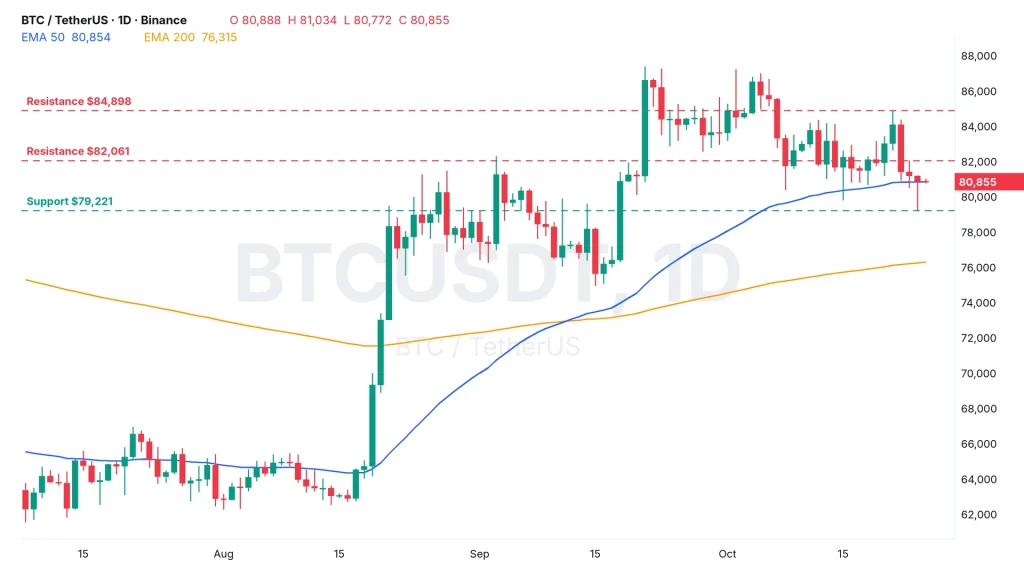
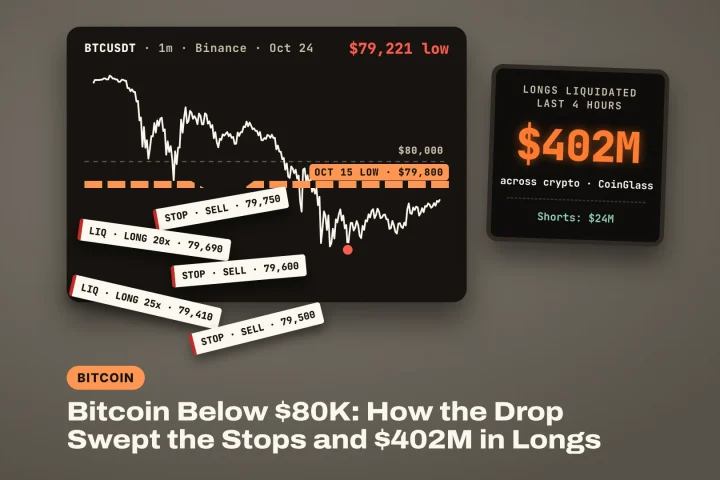
Right on its 50-day average, after a scare. The BTC price trades at $80,855 at the time of writing, flat over 24 hours and sitting exactly on the 50-day EMA at $80,854. On Saturday it dipped to $79,221 before buyers pulled it back over $80,000.
- The first ceiling: $82,061. Friday’s high, where the last bounce ran out.
- The bigger ceiling: $84,898. Wednesday’s high, the top of last week’s range.
- The floor to defend: $79,221. Saturday’s low, the lowest price this month.
- The deeper support: $76,315. The 200-day EMA, about 5.6% below the price.
In the bull case, BTC closes above $82,061 and retests $84,898. In the base case, it chops between $79,221 and $82,061 into the Fed meeting on October 28. In the bear case, a daily close under $79,221 opens the way to the 200-day near $76,300.
EXPLORE: BlackRock Buffer Bitcoin ETF PBIT Caps Losses Near 10%, and Caps the Gains Too
A Bitcoin DRIP ETF won’t move the price. A dividend drip on a new fund is pocket change next to IBIT’s daily flows. The thing to watch is whether advisers treat a 95/5 fund as the easy way into Bitcoin, because that money arrives slowly and stays.

On the climb since 2017. Trades futures and reads onchain data. Automates the boring parts.
More from VikingXBT →