The short version
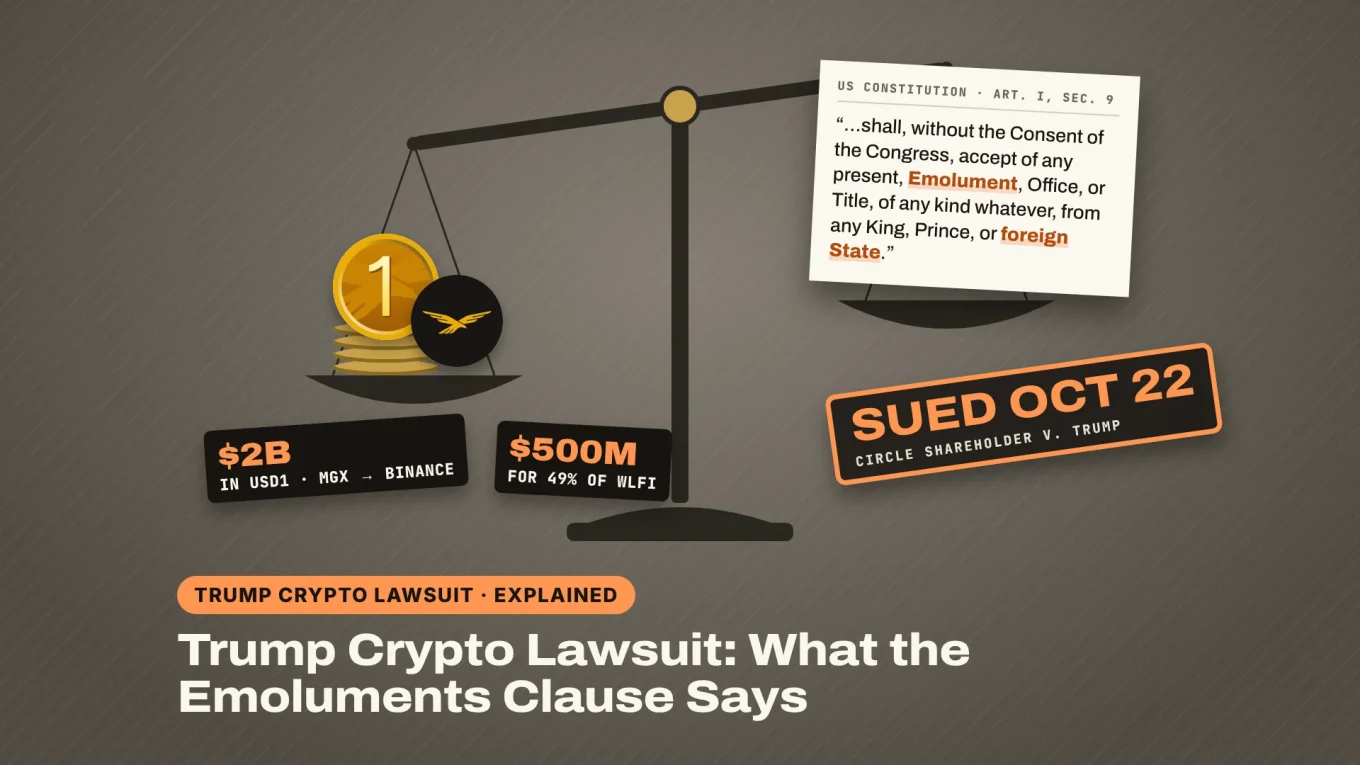
- Trump crypto lawsuit: on October 22 a Circle shareholder sued Trump and World Liberty Financial in federal court in Washington, claiming more than $2 billion in UAE-linked crypto money broke the Constitution’s ban on foreign payments.
- It is the first emoluments case built on crypto: the complaint names a $500 million deal for 49% of World Liberty and MGX’s $2 billion Binance investment paid in USD1, and the White House calls it frivolous.
- The crew is watching whether the case survives a motion to dismiss on standing, where every earlier emoluments suit against Trump stalled, and whether the CLARITY Act’s ethics rules come back after the November 3 midterms.
The Trump crypto lawsuit puts a 238-year-old line of the Constitution up against a stablecoin. On October 22, a Circle shareholder sued President Donald Trump and World Liberty Financial in federal court in Washington, claiming Trump has illegally profited from crypto deals tied to the United Arab Emirates.
The complaint puts the foreign money at more than $2 billion. Trump, World Liberty and the White House all reject the claims, and no judge has ruled. So what does the law actually say, which deals are named, and does the case have a real chance?
Bloomberg Law had the story first:

Donald Trump and World Liberty Financial, the cryptocurrency venture he co-founded with his sons, were sued by a shareholder in a rival crypto firm over claims the president illegally profited from his office in violation of the US Constitution. news.bloomberglaw.com/crypto/trump-a…
What Is the Trump Crypto Lawsuit About?
It claims Trump broke the Constitution’s ban on officials taking payments from foreign governments. The plaintiff is J. Benjamin Greenberg, a former Circle software engineer who still owns Circle stock. He sued on Circle’s behalf, a so-called derivative suit, in the US District Court for the District of Columbia.
The defendants are Trump, World Liberty Financial (WLFI), US envoy Steve Witkoff, whose family co-founded World Liberty, and three related companies: WLF Holdco, Stablecoin Holdco and DT Marks DEFI LLC. Circle itself is named only as a nominal defendant, the usual role for the company in a suit like this.
Why a Circle shareholder? Circle issues USDC, the second-largest dollar stablecoin at about $71.7 billion. World Liberty’s USD1 competes with it. The complaint argues that foreign-linked business flowed to USD1 at Circle’s expense, which gives a Circle investor a reason to sue.
The suit asks the court to:
- declare that Trump’s profits from these deals break the Foreign Emoluments Clause;
- order an accounting of foreign government payments to Trump and his businesses, and the disclosure of other crypto deals with foreign money;
- stop Trump from taking such payments without the consent of Congress;
- make him hand back the profits the court finds unlawful, plus damages, with no amount named.
Sponsored · Affiliate link
Save 20% on fees trading on WEEX
Base Camp may earn a commission if you sign up. It never affects what we write.
What Does the Emoluments Clause Say?
It bars federal officials from taking gifts or payments from foreign states unless Congress agrees. The words, in Article I, Section 9 of the Constitution: no person holding any office of profit or trust “shall, without the Consent of the Congress, accept of any present, Emolument, Office, or Title, of any kind whatever, from any King, Prince, or foreign State.”
An emolument is, roughly, any profit or benefit. The clause was written to stop foreign powers from buying influence over American officials. Whether it covers a president’s business deals with companies tied to a foreign government has never been settled by the Supreme Court.
Which Foreign Crypto Deals Does the Suit Name?
Two main deals, plus a list of government decisions it ties to them. Everything below is what the complaint alleges; a court has not tested any of it.
- A $500 million stake in World Liberty. The complaint says an entity backed by Sheikh Tahnoon bin Zayed Al Nahyan, the UAE’s national security adviser, agreed to buy 49% of World Liberty days before Trump’s January 2025 inauguration. It says Trump received more than $75.5 million from that deal after taking office. World Liberty says Trump played no role in the transaction.
- $2 billion in USD1 for Binance. MGX, an Abu Dhabi investment firm chaired by Tahnoon, put $2 billion into Binance in 2025, and World Liberty co-founder Zach Witkoff said in May 2025 that the deal would close in USD1. The complaint calls this a “scheme” to lift the value of the president’s crypto holdings. Binance CEO Richard Teng has said the choice of stablecoin was MGX’s own.
The suit also points to the Commerce Department’s 2025 approval of advanced Nvidia chip sales to an Abu Dhabi AI company chaired by Tahnoon. And it names the Office of the Comptroller of the Currency, part of the Treasury, which gave conditional approval on August 14 to World Liberty Trust Company, a national trust bank that would issue USD1 itself. The complaint says that bank is co-owned by the Trump family and the UAE government.
USD1 has about $3.96 billion in circulation today, according to DefiLlama, so the $2 billion MGX deal alone was a large share of the coin’s early supply.
What Do Trump, World Liberty and Circle Say?
All three distance themselves from the suit, for different reasons.
- The White House: spokesperson Anna Kelly called it “yet another frivolous lawsuit” and said there are “no conflicts of interest.” Another spokesperson pointed out that Trump’s assets are held in a trust.
- World Liberty: its lawyer Bill Burck of Quinn Emanuel said the filing reads “more like a partisan press release than a lawsuit.” A spokesperson called the claims without merit and said the company looks forward to answering them in court.
- Circle: a spokesperson said Circle “did not initiate, direct, authorize, or participate in the filing.”
Greenberg’s lawyer, Matt Pelikan of Evergreen Legal, put the goal this way: “We’re suing to stop the corruption and to force President Trump to return the profits to American taxpayers.”
Are There Laws on Trump’s Foreign Crypto Deals?
Only the Constitution, for now. No federal statute deals with a president’s crypto business, and the ethics rules Congress has written for crypto are stuck in the CLARITY Act, the market structure bill that failed a 49–50 Senate vote on September 15.
Those ethics rules were the main reason it stalled. In July, Trump agreed to a version that would ban federal officials and their spouses from issuing or sponsoring crypto tokens, which would have ruled out a new meme coin like the one he launched in January 2025. Democrats said it fell short. Senators Thom Tillis and Ruben Gallego then sent the White House a tougher version that would let state attorneys general enforce the ban too, and push officials to sell or move big crypto stakes into a blind trust.
The bill is now waiting for the lame-duck session after the November 3 midterms. We went through its odds in the CLARITY Act’s last chance. Even if it passes, a new law would cover what officials do next. The deals in this suit would still be a question for the court.
DISCOVER: TRUMP Coin Is Down 97%, and the Prize Is Another Dinner
Can the Trump Crypto Lawsuit Actually Win?
The Trump crypto lawsuit first has to show Greenberg has the right to sue at all. That is where earlier emoluments cases against Trump stalled.
During his first term, more than 200 members of Congress sued over his hotel and business income. In 2020 a federal appeals court in Washington threw the case out, ruling that lawmakers had no standing to bring it. Two other suits, from an ethics group and from Maryland and the District of Columbia, reached the Supreme Court, which ended them as moot in January 2021 after Trump left office. None of them got a final ruling on what counts as an emolument.
This case tries a different route. It argues a real company, Circle, lost business to a competitor because of the foreign money, which is a more concrete harm than the earlier suits had. Whether a judge accepts that link between USD1’s growth and Circle’s losses is the first question, and it will likely take months to answer.
WLFI Price: Did the Lawsuit Move World Liberty’s Token?
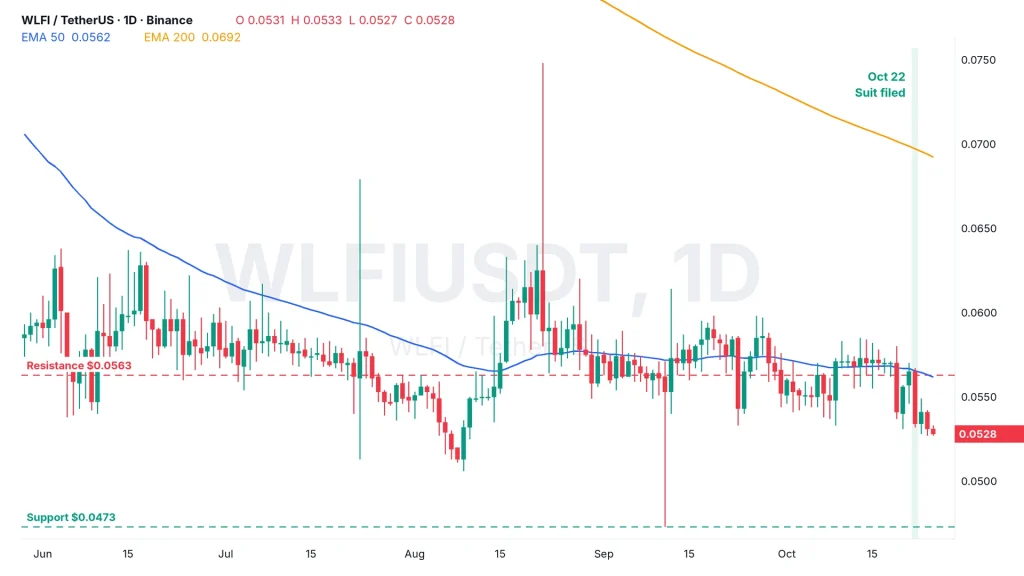
Hard to say, because it was already weak. WLFI slid 5.5% on October 22, the day the suit was filed, from $0.0565 to $0.0534, most of it during US trading hours. It won back 1.3% the next day, then kept drifting lower. At the time of writing it trades at $0.0528, down 7.3% on the week and 84% below its $0.3313 high from September 2025.
The token sits under both moving averages: the 50-day EMA at $0.0562 and the 200-day at $0.0692.
- Bull case: a daily close back above $0.0563, the 50-day line, puts the token back in its October range.
- Base case: chop between $0.0520 and $0.0563 while the court sets a schedule.
- Bear case: a close below $0.0520 opens the way to $0.0473, the September 11 low.
EXPLORE: Bitcoin vs Altcoins vs Stablecoins vs Memecoins: What You’re Actually Buying
The next step is World Liberty’s answer to the complaint, which will most likely be a motion to dismiss. Until a judge rules on that, the case is a set of claims, and the question it raises still has no answer from the courts: when does a president’s crypto business become a payment from a foreign state?