The short version
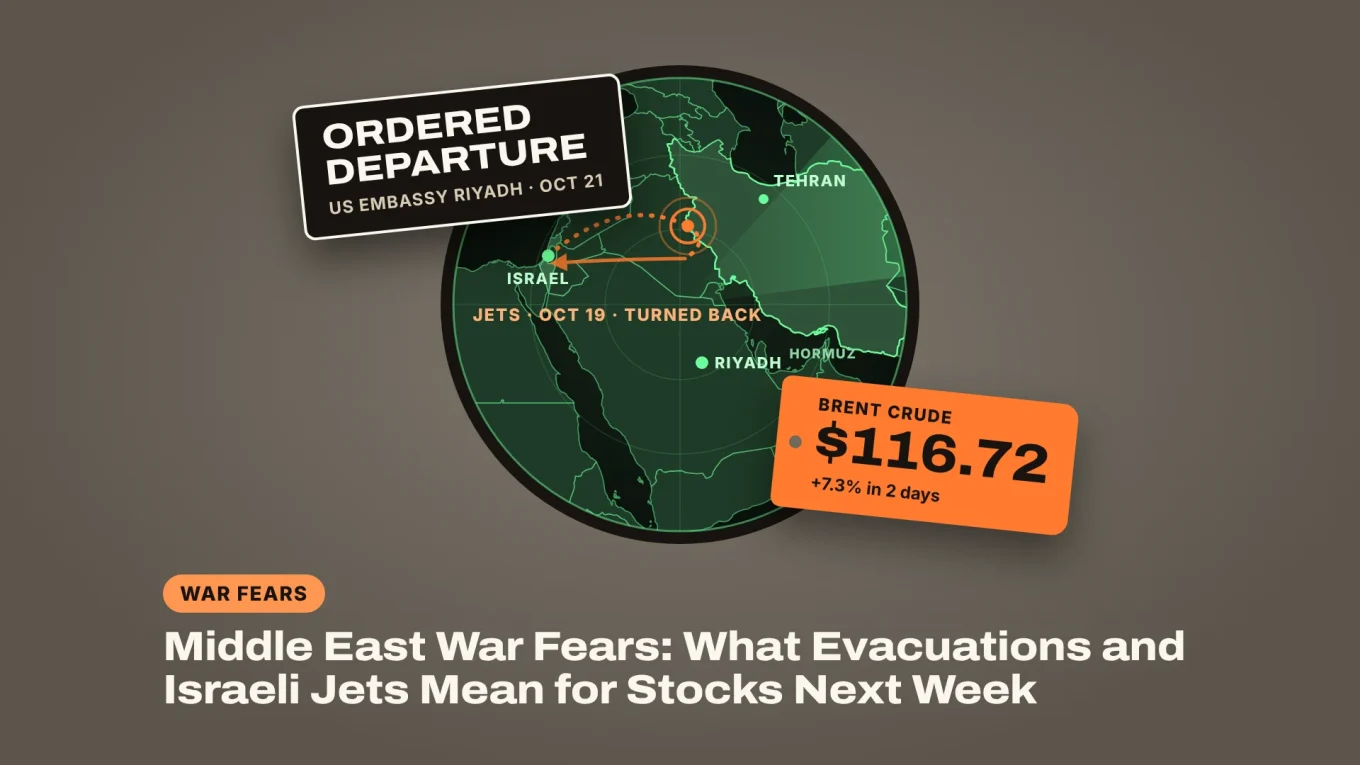
- Middle East war fears are back: the US ordered non-emergency staff out of Saudi Arabia on October 21, Israeli jets flew to Iran’s border on October 19, and Brent crude closed at $116.72 on Friday.
- The Nasdaq fell 2.6% on Thursday and Bitcoin broke below $80,000 on Saturday, while the hacked Iranian cameras shared on Telegram are still unconfirmed.
- The crew is watching for a weekend strike, Brent’s Sunday night open, the Fed on October 28 and Bitcoin support at $76,264.
Middle East war fears are back, and this time the warning signs are logistics, not headlines. The US ordered non-emergency diplomats out of Saudi Arabia on Wednesday, Israel flew dozens of fighter jets to Iran’s border on Monday, and a US carrier in the Arabian Sea is loading bunker-buster bombs.
Markets noticed. Brent crude settled at $116.72 on Friday, up 7.3% in two days and its highest close since April 29. The Nasdaq fell 2.6% on Thursday’s session, and Bitcoin dropped below $80,000 on Saturday for the first time since September 18.
So are new Iran strikes coming, and what would they do to the stock market next week? Here’s what is confirmed, what is only reported, and what happened the last time.
The State Department pushed back on the biggest version of the evacuation story on Wednesday:

This is inaccurate. The U.S. Department of State issued an ordered departure for non-emergency U.S. government employees and their family members in Saudi Arabia only.
Iranian-supported Houthis have increasingly engaged in hostilities against Saudi Arabia, including attacks on
What Is Behind the Middle East War Fears?
Four things in one week, and they aren’t equally solid. Some come from officials on the record, some from unnamed sources, and one has no confirmation at all.
| What happened | Who says so | How solid |
|---|---|---|
| Ordered departure of non-emergency US staff and families from Saudi Arabia (October 21) | State Department spokesperson Tommy Pigott, on the record | Confirmed |
| Wider pullout of diplomats from other Gulf embassies | Reuters, citing US officials | Denied by the State Department as “inaccurate” |
| US military quietly shrinking its footprint at Middle East bases | Unnamed US officials to CBS and The Wall Street Journal | Reported, not confirmed by the Pentagon |
| Dozens of Israeli jets flew 800+ miles to Iran’s border and turned back (October 19) | Israeli and US officials to Axios | Reported; Israel called it a drill |
| US carrier rearming with bunker busters for possible strikes | The Wall Street Journal, on board | Reported, no decision made |
The Saudi order is the solid part. Pigott tied it to the Iran-backed Houthis, who have hit Saudi airports and oil sites. The rest points the same way, though. US officials told CBS the military had reduced its presence at Middle East posts because of Houthi threats and direct threats from Iran, and CENTCOM said only that it moves troops “to optimize mission readiness.”
The jets are the strangest part. Israel told Washington in advance and called it a “power projection” drill to deter Iran before its October 27 election. Some US officials told Axios they had the impression Israel hoped Iran would fire at the planes, which would have handed it a reason to strike.
Then Trump said it himself. “We may do another little Epic Fury,” he told a Florida rally on Friday, without saying more. On Saturday The Wall Street Journal reported, citing US officials, that he is leaning toward another major operation, with strikes on nuclear sites and bridges among the options, but no final decision. US envoy Tom Barrack went further in an interview: “Could there be a strike this weekend? Absolutely,” per Gulf News. Iran’s armed forces chief answered that US warships won’t be allowed into the Gulf “under any circumstances.”
Sponsored · Affiliate link
Save 20% on fees trading on WEEX
Base Camp may earn a commission if you sign up. It never affects what we write.
What About the Hacked Iranian Cameras?
There is no confirmation yet. A video forwarded on Telegram on Saturday claims to show hacked Iranian security cameras, but we couldn’t verify it, and no news outlet had reported it by the time of writing. Treat it as a rumour until someone traces where the footage came from.
What is on the record is why camera stories make traders nervous. Israel had hacked almost all of Tehran’s traffic cameras for years, AP reported in March, and the feeds were one of the inputs behind the February 28 strike that killed Supreme Leader Ali Khamenei.
It runs the other way too. Iran-linked groups breached more than 250 Israeli cameras this year that Israel counts as sensitive to national security, The Wall Street Journal reported on October 11. On Wednesday the pro-Iran hacking group Handala posted videos it said came from inside Israeli army bases. Nobody has confirmed that one either.
How Did Markets React to Middle East War Fears This Week?
Oil prices moved first and hardest. Brent went from $108.82 on Wednesday to $116.72 on Friday, after Iran’s Revolutionary Guard claimed hits on tankers near the Strait of Hormuz. Before the war started, on February 27, Brent was at $72.48. That’s 61% higher in eight months.
Stocks took it badly, but calmly:
- Nasdaq: down 2.6% on Thursday and 2.8% over the two days to 25,955. Not all of that is war, though: Meta fell 7.0% the same day after its earnings.
- S&P 500: down 1.7% over two days to 7,623.68.
- VIX, Wall Street’s fear gauge: up from 16.68 to 19.45. Higher, but far from panic levels.
- US 10-year yield: down from 5.15% to 4.95% on Thursday as money ran into Treasuries.
- Gold: down 3.4% over two days to $4,007.90, so the classic safe haven didn’t catch the bid.
Bitcoin had the worst of it because it trades on the weekend. BTC fell from $84,093 on Wednesday to a low of $79,221 on Saturday, and $402 million in longs were liquidated as it broke $80,000. Oil above $110 has also nearly halved the Bitcoin mining stocks this month.
DISCOVER: Volatility in the Base Camp glossary
What Happened to Stocks the Last Time Strikes Started?
They slid for a month, and Bitcoin bounced first. The war began with strikes on Saturday, February 28, so crypto was the only big market open to react.
Bitcoin dipped to $63,030 that day, then closed at $72,667 on March 4, up 10.3% from its February 27 close. Stocks went the other way slowly. The S&P 500 lost 2.0% in the first week and kept falling as Brent climbed toward $118, ending down 7.8% at 6,343.72 on March 30. The Nasdaq lost 8.3% over the same stretch. Bitcoin gave its bounce back too, closing at $66,011 on March 29.
The turn came with the ceasefire talk. The S&P 500 rose 2.5% on April 8, the day the truce started, and was back above its pre-war level by April 13.
One episode isn’t a rule. But it shows the pattern traders will look for: the first move on the weekend isn’t the whole move, and the slower damage follows oil.
What Could Move the Stock Market Next Week?
The war, the Fed and big earnings, in that order of surprise. All times are UTC.
| Day | What happens |
|---|---|
| Weekend | Any strike lands while only crypto is trading |
| Tuesday, October 27 | Israel’s election; Robinhood earnings after the US close |
| Wednesday, October 28 | Fed decision at 18:00; Microsoft earnings after the close |
| Thursday, October 29 | US GDP and PCE inflation at 12:30; Coinbase and Strategy earnings after the close |
| Tuesday, November 3 | US midterm elections |
The midterms matter here. Trump had signalled no new strikes before November 3, and Saturday’s reporting is the first sign that might change. If he waits, the Israeli election and the Fed run the week. We went through every date in our crypto week ahead.
Three ways the stock market next week can go:
- Strikes this weekend: oil spikes again, futures gap down on Sunday night and Bitcoin is the first price to show it. In March, though, that first drop was the shallow one.
- No strike, tension holds: oil keeps a war premium above $110, the Fed sounds hawkish on inflation and stocks drift lower into the earnings.
- Talks or a pause: the oil premium comes out fast and stocks bounce, like April 8.
EXPLORE: Fed Meeting Next Week: Traders Bet on a Hold. What It Means for Bitcoin
Bitcoin Price Analysis: Where Is Support if War Fears Grow?
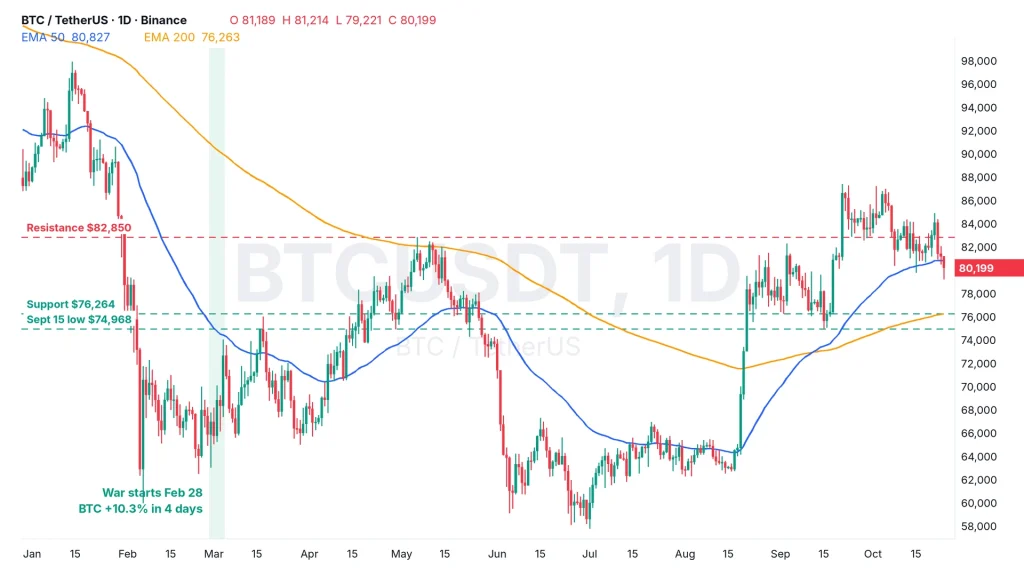
First at $76,264, then $74,968. The Bitcoin price is $80,199 at the time of writing, back above $80,000 but under its 50-day exponential moving average (EMA), a trend line that weights recent prices more, at $80,827. The 200-day EMA sits at $76,263, right on top of the $76,264 swing low.
- In the bull case, no weekend strike and a quick reclaim of $80,827 put $81,479 and $82,850 back in play.
- In the base case, BTC chops between $76,264 and $80,827 until the Fed speaks on Wednesday.
- In the bear case, a strike or a hawkish Fed breaks the 200-day EMA, and $74,968, the September 15 low, comes next.
Watch Brent on Sunday night. If oil opens above $120, Middle East war fears are running the market again, and stocks will feel it before the Fed says a word.

On the climb since 2017. Trades futures and reads onchain data. Automates the boring parts.
More from VikingXBT →